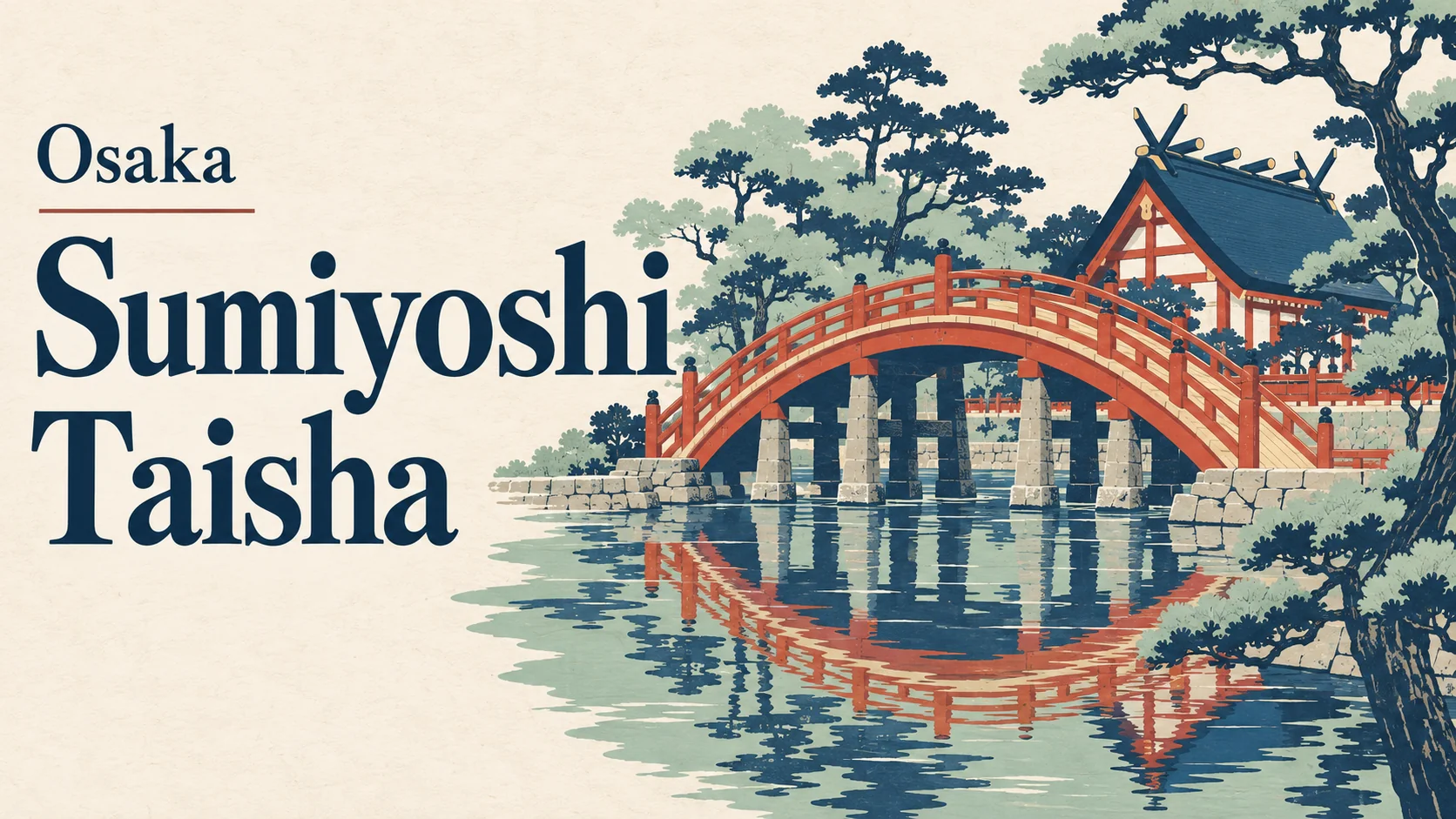
Sumiyoshi Taisha is a Shinto shrine in southern Osaka for three sea gods and Empress Jingu, and the head of more than 2,000 Sumiyoshi shrines across Japan. Its official access page puts it a three-minute walk east of Sumiyoshitaisha Station on the Nankai Main Line, nine minutes from Namba by local train. The grounds are free. Gates open at 6:00 from April to September and 6:30 from October to March, and the outer gates close at 16:00.
What you’ll learn
- Who the four main halls are for, and why the founding year of 211 rests on tradition
- How to read the Sumiyoshi style, one of the oldest forms of shrine building, on the halls themselves
- The steep Sorihashi Bridge, the five-stone charm and the monthly four-shrine circuit
- Gate times, prayer fees from April 2026, goshuin, trains from Namba and Kansai Airport, and the 2026 festival dates
- How the Osaka shrine differs from the Sumiyoshi shrines in Fukuoka and Shimonoseki, and why it scores Water 130
Sumiyoshi Taisha: What It Is and Who Is Enshrined
Sumiyoshi Taisha, also called Sumiyoshi Shrine in Osaka, is a Shinto shrine whose four main halls honour three sea gods and Empress Jingu.
A shrine is where kami, the deities of Shinto, are worshipped; a temple is a Buddhist site that houses images of the Buddha. Sumiyoshi Taisha is a shrine. Taisha means “grand shrine”. Locals call it Sumiyossan, and the shrine calls itself the guardian of all Naniwa, the old name for Osaka.
How many shrines follow it depends on which page you read. The shrine’s home page and history page say about 2,300 Sumiyoshi shrines; its FAQ says “about 2,000 or more”. The Nihon Kokugo Daijiten dictionary on Kotobank gives “over 2,000”. This guide uses more than 2,000.
The grounds cover about 30,000 tsubo, roughly 10 hectares, with four main halls and 27 smaller shrines. About 600 stone lanterns stand along the paths, most of them, the shrine says, given by shipping and transport merchants.
| Hall | Kami | Who the kami is | Source |
|---|---|---|---|
| First Main Hall | Sokotsutsu-no-o-no-mikoto | Sea god born from the deepest water | Sumiyoshi Taisha |
| Second Main Hall | Nakatsutsu-no-o-no-mikoto | Sea god born from the middle water | Sumiyoshi Taisha |
| Third Main Hall | Uwatsutsu-no-o-no-mikoto | Sea god born from the surface | Sumiyoshi Taisha |
| Fourth Main Hall | Empress Jingu (Okinagatarashihime-no-mikoto) | Legendary empress who, by the shrine’s account, founded it | Sumiyoshi Taisha |
The Three Sumiyoshi Gods and Empress Jingu
The three gods, together called Sumiyoshi Okami, are kami of purification and the sea, and the shrine says Empress Jingu enshrined them here.
In the myth, the three were born when the god Izanagi washed himself in the sea after a visit to the land of the dead, one at the bottom, one in the middle and one at the surface. The shrine’s page on its kami lists their blessings as purification, safe voyages, poetry, farming and industry, archery and sumo. The Nipponica encyclopedia on Kotobank adds that the envoys Japan sent to Tang China “always prayed at this shrine” before they sailed.
A Founding Date Kept by Tradition
The shrine dates its founding to 211, the eleventh year of Empress Jingu’s regency, but that year comes from a medieval chronicle, not from records.
The shrine’s timeline itself notes that its early dates are estimated from the medieval Teio Hennenki chronicle and are “subject to scholarly debate”. A cultural-property paper from the City of Osaka says the exact time of founding “is unknown”. The shrine’s English page puts it the same way: “according to traditional histories”. In 2011 the shrine marked its 1,800th year by that count.
Firmer dates come later. The shrine’s history lists it among the highest-ranked shrines of the tenth-century Engishiki register, with the top court rank, and as the first shrine (ichinomiya) of Settsu Province. Until 1946 it was a state shrine of the first grade. The sea was once at its door: Japan’s tourism agency, in its official multilingual text, writes that land reclamation “moved the shoreline almost 7 kilometers to the west”.
Sumiyoshi-zukuri: Why the Four Main Halls Are National Treasures
The four main halls, rebuilt in 1810, are National Treasures because they keep Sumiyoshi-zukuri, one of the oldest styles of shrine building in Japan.
The shrine’s page on its architecture dates the present halls to 1810. Japan’s cultural heritage database, Bunka Isan Online, lists all four as National Treasures from November 14, 1953, and says the present halls are the ones rebuilt that year. All four face west, toward Osaka Bay. The First, Second and Third halls stand one behind another in a single line, and the Fourth stands beside the Third, to its south.
The halls are not kept unchanged forever. The shrine’s history says rebuilding every 20 years is first recorded in 749, and it counts the 2011 renewal as the 49th. Its English page, by contrast, says the cycle was abandoned in the early nineteenth century; this guide follows the Japanese page and the national record, which both tie today’s halls to 1810. Several offering halls and corridors in front of the main halls were added to the Important Cultural Property list in 2010, the shrine’s timeline says.
How to Recognize the Sumiyoshi Style
Look for a straight gabled roof, an entrance on the gable end, red pillars, white walls, and two rooms one behind the other.
| Feature | What you see | Source |
|---|---|---|
| Roof | Gabled, covered in cypress bark, with no upward curve at the eaves | Kotobank |
| Entrance | On the gable end (tsumairi), not the long side | Sumiyoshi Taisha |
| Plan | Two rooms, an outer room in front and an inner room behind | Bunka Isan Online |
| Colour | Pillars painted red; walls coated white with shell powder | Sumiyoshi Taisha |
| Gate | Sumiyoshi torii: square pillars, and the tie beam does not stick out past them | Sumiyoshi Taisha |
For contrast, the unpainted halls of Ise Jingu are entered from the long side. The shrine compares its own two-room plan to the halls built for an emperor’s enthronement rite.
What to See at Sumiyoshi Taisha
The main sights are the Sorihashi Bridge, the four main halls, the five-stone plot of Gosho Gozen and the Hattatsu circuit of smaller shrines.
| Sight | What it is | Where |
|---|---|---|
| Sorihashi Bridge | Steep arched bridge over the pond; the shrine says crossing it purifies | By the entrance facing the tram stop |
| Four main halls | National Treasures, 1810 | Centre of the grounds |
| Gosho Gozen | Fenced plot where the kami were first worshipped; pick lucky stones | South of the First Hall |
| Ishibutai stone stage | Stage for court dance, built in 1607 for Toyotomi Hideyori, per the shrine’s English page | Inside the grounds |
| Rabbit statue | The kami’s messenger; rub it for luck | In front of the Fourth Hall |
| Omokaru stones | Lift a stone twice; lighter the second time means a wish comes true | Otoshi Shrine, 2 minutes southeast |
| Oumi Shrine | Highest-ranked subsidiary shrine; its hall of 1708 is older than the main halls | Inside the grounds |
The rabbit comes from the founding legend: the shrine says the kami settled here on a day of the rabbit, in a month and year of the rabbit. On the subsidiary shrines page, Oumi Shrine’s hall dates from 1708 and is an Important Cultural Property. The English page says the stone stage is one too; the national database search did not return it, so this guide quotes the shrine.
Sorihashi Bridge
The Sorihashi Bridge is a red arched bridge so steep that crossing it feels like a climb, and the shrine says the crossing itself purifies.
The Japanese sights page gives about 20 m long, about 3.6 m high, about 5.5 m wide, with a slope of up to about 48 degrees. The English page gives about 21 m, 5 m, 6 m and more than 40 degrees. The shrine says its stone piers were a gift from Yodo-dono, mother of Toyotomi Hideyori, around 1600, and its English page says the steps were added in 1955. The novelist Yasunari Kawabata named a 1948 story after the bridge. Two great lanterns over 10 m tall stand on either side.
Gosho Gozen and the Godairiki Stones
Gosho Gozen is where the kami were first worshipped, and visitors search its gravel for stones marked with three characters for five blessings.
Look for stones bearing go (five), dai (great) and riki (strength). Together they stand for strength of body, mind, wealth, fortune and long life. The shrine sells a pouch for them at the charm office for ¥500 (approx. US$3), in ten colours since January 2026. The rule is in the shrine’s own words: when the wish comes true, return the stones doubled, with stones you collect yourself. The plot opens at the gate time and closes at 16:00, and the stone picking stops from December 31 to January 4.
Hattatsu Mairi: The Monthly Four-Shrine Circuit
Hattatsu Mairi is a visit to four subsidiary shrines on the first Dragon day of each month, repeated for 48 months to complete a wish.
In Japanese counting, each day carries one of twelve zodiac animals. The shrine’s Hattatsu page sets the order and the goal: 48 visits, four years, for shiju hattatsu, “growth from start to finish”, a pun on 48. At Nanku Shrine you receive a beckoning-cat figure, left paw raised in odd months and right paw in even months.
| Order | Shrine | Kami | Asked for | Prayer fee |
|---|---|---|---|---|
| 1 | Tanekashi Shrine | Uka-no-mitama | Starting capital, children | ¥1,500 from Sept 2026 |
| 2 | Nanku Shrine | Uka-no-mitama | Business growth (beckoning cat) | ¥2,000 from Sept 2026 |
| 3 | Asazawa Shrine | Ichikishima-hime | Beauty and the arts | None listed |
| 4 | Otoshi Shrine | Otoshi-no-kami | Harvest and gathering money | ¥1,000 |
On those days the gates open at 6:00. Nanku Shrine’s kami is the rice and harvest kami known from Inari shrines. The shrine pages we read give no list of future Dragon days, so this guide does not list them either.
Visiting Sumiyoshi Taisha: Hours, Prayers, Goshuin and Access
Entry is free, the outer gates close at 16:00, the inner fence at 17:00, and the nearest station is Sumiyoshitaisha on the Nankai Main Line.
| Item | Time or fee | Source |
|---|---|---|
| Gates open | 6:00 (Apr to Sept); 6:30 (Oct to Mar); 6:00 on the 1st of each month and on Hattatsu days | Access |
| Gates close | Outer gates 16:00; inside the main fence 17:00, all year | Access |
| Charm office (goshuin) | 9:00 to 17:00 | Access |
| Prayer reception | 9:00 to 15:50, no booking taken | Prayers |
| Individual prayer | ¥10,000 (approx. US$65) from April 1, 2026; ¥5,000 if left to the priests | Prayers |
| Entry | Free; cash only, no credit cards | English FAQ |
| Parking | About 200 cars; ¥200 per 30 min; closed Dec 31 to Jan 3 | FAQ |
The two closing times matter. The FAQ gives 17:00 alone, but the access page closes the outer gates an hour earlier. Plan to enter before 16:00. The shrine has no closing days. Eating, smoking, drones and pets are not allowed in the grounds, and since August 1, 2024, most bicycles too.
For a goshuin, the handwritten red seal of a shrine, go to the charm office between 9:00 and 17:00. The shrine’s charms page shows its goshuin books and embroidered seals as images, without a written fee for the regular seal. For New Year 2026, its New Year page listed a Hattatsu seal from January 1 to 18 and an embroidered seal from January 1 to February 1, each ¥1,000; in that period it did not write into books visitors brought. Our goshuin guide covers how to ask. The shrine’s model routes take 20 to 40 minutes; allow an hour to add the bridge and the circuit.
| From | Route | Time and fare | Source |
|---|---|---|---|
| Namba | Nankai Main Line local to Sumiyoshitaisha, then 3 min east on foot | 9 min, ¥240 | Nankai |
| Kansai Airport | Nankai, change at Sakai | About 45 min, ¥920 | Nankai route search |
| Tennoji or Ebisucho | Hankai tram to Sumiyoshi Toriimae, at the gate | ¥240 flat fare | Hankai Tramway |
| Nankai Koya Line | Sumiyoshi-Higashi Station, then 5 min west on foot | — | Access |
Nankai lists only local trains as stopping at Sumiyoshitaisha, so do not board the express from Namba. The Hankai tram runs down the street and stops at the front gate.
Festivals and the Sumiyoshi Taisha Calendar
The biggest days are New Year, the June 14 rice-planting rite and the Sumiyoshi Matsuri, whose procession left August 1 in 2025.
| When | Event | Note |
|---|---|---|
| Jan 1 to 3 | Hatsumode, the first shrine visit of the year | The shrine says about two million visitors come over the first three days |
| Dec 31 to Jan 1 | Gates open 22:00 on Dec 31, close 20:00 on Jan 1 | Jan 2 and 3: 6:00 to 19:00 |
| June 14 | Otaue rice-planting rite, 13:00 | National Important Intangible Folk Cultural Property since 1979 |
| July 26, 2026 | Mikoshi procession, from 15:40 | South along the old Kishu road to Sakai; no carrying through the Yamato River |
| July 31, 2026 | Nagoshi-no-harae, the main festival | Summer purification rite |
| Aug 1, 2026 | Rite at the Shukuin Ton-gu in Sakai | Evening rite at the shrine’s resting place |
The two-million figure is the shrine’s own, from its about page; no yearly count is published. The special festivals page describes the Otaue rite, held on the shrine’s own rice field, and the great portable shrine, about 2 tonnes with 11 m poles, revived in 2016 after about 70 years.
The summer festival is where older guides go wrong. For 2026, the shrine’s festival notice set the procession for Sunday, July 26, and said there would be no carrying of the mikoshi through the Yamato River. The City of Sakai wrote that the procession was held every August 1 until it moved to July 27 in 2025. Some of the shrine’s own pages still say August 1; the newer notice is used here.
Three Sumiyoshi Shrines: Osaka, Fukuoka and Shimonoseki
Osaka’s Sumiyoshi Taisha calls itself the head shrine, Fukuoka’s Sumiyoshi Shrine calls itself the first by tradition, and Shimonoseki’s has a 1370 hall.
The Hakata shrine’s own history page names the three as Japan’s three great Sumiyoshi shrines. All worship the same three sea gods. The table quotes each shrine’s or each record’s own words; this guide does not judge which came first.
| Shrine | How it describes itself | Main hall | Nearest station | Source |
|---|---|---|---|---|
| Sumiyoshi Taisha, Osaka | Head shrine of more than 2,000 Sumiyoshi shrines; first shrine of Settsu | Four halls, 1810, National Treasures | Sumiyoshitaisha (Nankai), 3 min | Sumiyoshi Taisha |
| Sumiyoshi Shrine, Fukuoka (Hakata) | “Said to be the first” of 2,129 Sumiyoshi shrines; first shrine of Chikuzen | Important Cultural Property | Hakata, about 10 min on foot | Sumiyoshi Shrine (Hakata) |
| Sumiyoshi Shrine, Shimonoseki | First shrine of Nagato | 1370, National Treasure | — | Bunka Isan Online |
If you searched for Sumiyoshi Shrine in Fukuoka, you need the Hakata shrine, a separate place in Kyushu. Its main hall is an Important Cultural Property, not a National Treasure; Fukuoka Prefecture’s tourism page gives the walk from Hakata Station. Shimonoseki’s hall, a nine-bay building of 1370, is the National Treasure of the two; Yamaguchi tourism covers the visit. You may read that Shimonoseki worships the gods’ rough spirit and Osaka their gentle spirit; we found no first-hand source for that and leave it out.
Five Elements Classification: Why Sumiyoshi Taisha Is a Water Shrine
Sumiyoshi Taisha scores Water 130 in our classification, because all three sea gods, the old shoreline and the Sumiyoshi name point to water.
Kannavi sorts every shrine into one of five elements. This is our classification, not a teaching of the shrine and not a fortune. It reads three checkable layers: the principal deity, 60, with 15 for each further deity; the geography, up to 25; and the lineage in the name, 15.
| Layer | What was matched | Category | Element | Points |
|---|---|---|---|---|
| 1. Deity | Sokotsutsu-no-o, First Hall | Sea and voyage kami | Water | 60 |
| 1. Deity | Nakatsutsu-no-o, Second Hall | Sea and voyage kami | Water | 15 |
| 1. Deity | Uwatsutsu-no-o, Third Hall | Sea and voyage kami | Water | 15 |
| 1. Deity | Empress Jingu, Fourth Hall | Not in our deity list | — | 0 |
| 2. Geography | Coast, entered by hand from the ancient Sumiyoshi harbour | Coast, island or cape | Water | 25 |
| 3. Lineage | Sumiyoshi in the name | Sumiyoshi and Konpira shrines | Water | 15 |
| Total | Water 130; Earth, Fire, Wind, Void 0 | Water (high) | ||
Two points are open to question, so we show them. Empress Jingu scores nothing because our deity list has no category for her; she is not ignored as unimportant. The coast entry is a judgment: today the sea lies several kilometres west. We ran the shrine again without it.
Without the coast it is still Water 105, and Fukuoka’s Sumiyoshi Shrine, run with a city setting, comes out the same Water 105 with Earth 15. On the ring of five, each element shifts the flow of the next, and Water shifts the flow toward Wind. Another Water shrine in this guide is Itsukushima Shrine, also built for sea kami.
Frequently Asked Questions
These six answers cover entry, the train from Namba, the Fukuoka shrine, timing, how long to stay and the shrine-or-temple question.
Q. Is Sumiyoshi Taisha free to enter?
A. Yes, entry to the grounds is free during opening hours, and the shrine says so on its English FAQ. You pay only for what you choose: an individual prayer at ¥10,000 from April 2026, the five-stone pouch at ¥500, charms and goshuin. Bring cash, because the shrine does not take credit cards. Enter before 16:00, when the outer gates close. The exception is New Year’s Eve, when the gates open at 22:00 on December 31 and stay open until 20:00 on January 1.
Q. How do I get to Sumiyoshi Taisha from Namba?
A. Take a local train on the Nankai Main Line from Namba to Sumiyoshitaisha Station, nine minutes for ¥240, and walk three minutes east. Expresses do not stop there, so check the train type before boarding. From Tennoji or Ebisucho, the Hankai tram stops at Sumiyoshi Toriimae, right at the gate, for a flat ¥240.
Q. Is Sumiyoshi Taisha the same as Sumiyoshi Shrine in Fukuoka?
A. No, they are separate shrines in different cities, Osaka and Fukuoka, though both worship the same three sea gods. Sumiyoshi Taisha in Osaka calls itself the head of more than 2,000 Sumiyoshi shrines. Sumiyoshi Shrine in Hakata, Fukuoka, calls itself the first of them by tradition. Its main hall is an Important Cultural Property; Osaka’s four halls are National Treasures. The gate times, fees and trains on this page are for Osaka only and do not apply in Fukuoka.
Q. When is the best time to visit?
A. Come at opening time, 6:00 or 6:30 depending on the month, to see the grounds before the charm office opens at 9:00. For ceremony, come on June 14 for the rice-planting rite or in late July for the summer festival; in 2026 the procession was July 26. New Year is the busiest time: the shrine says about two million people come over January 1 to 3.
Q. How long do you need at Sumiyoshi Taisha?
A. Allow about an hour to see the four halls, the bridge, the stones and the smaller shrines without hurrying. The shrine’s own model routes run from about 20 minutes for a formal visit to the four halls to about 40 minutes for routes that add the smaller shrines. Add time for crossing the Sorihashi Bridge, picking five-stone pebbles at Gosho Gozen and lifting the omokaru stone two minutes away.
Q. Is Sumiyoshi Taisha a temple?
A. No, Sumiyoshi Taisha is a Shinto shrine, where kami such as the three sea gods are worshipped, not a Buddhist temple. You can tell from the torii gates at the entrances and from the halls themselves, built in the Sumiyoshi style, one of the oldest forms of Japanese shrine building.
Summary
Sumiyoshi Taisha is Osaka’s shrine of the sea gods, with four National Treasure halls in one of the oldest shrine styles in Japan.
- Three sea gods and Empress Jingu in four halls rebuilt in 1810, all facing west toward the bay.
- Founded in 211 by tradition; the shrine itself calls the date an estimate.
- Free entry; outer gates close at 16:00; prayers ¥10,000 from April 2026, cash only.
- Nankai local train from Namba, nine minutes, ¥240; or the Hankai tram to the gate.
- Summer procession on July 26 in 2026, no longer on August 1.
- In the Kannavi classification, Sumiyoshi Taisha is Water 130, and still Water 105 without the coast.
Next: Osaka Tenmangu, Osaka’s other great shrine; Fushimi Inari Taisha, a day trip to Kyoto; Yasaka Shrine and the rest of the shrines in Kyoto; what to ask for in the goshuin guide; or the English guide to Japanese shrines.
Climb the bridge, stand before halls that still face a sea now kilometres away, and look for three small stones to carry home.