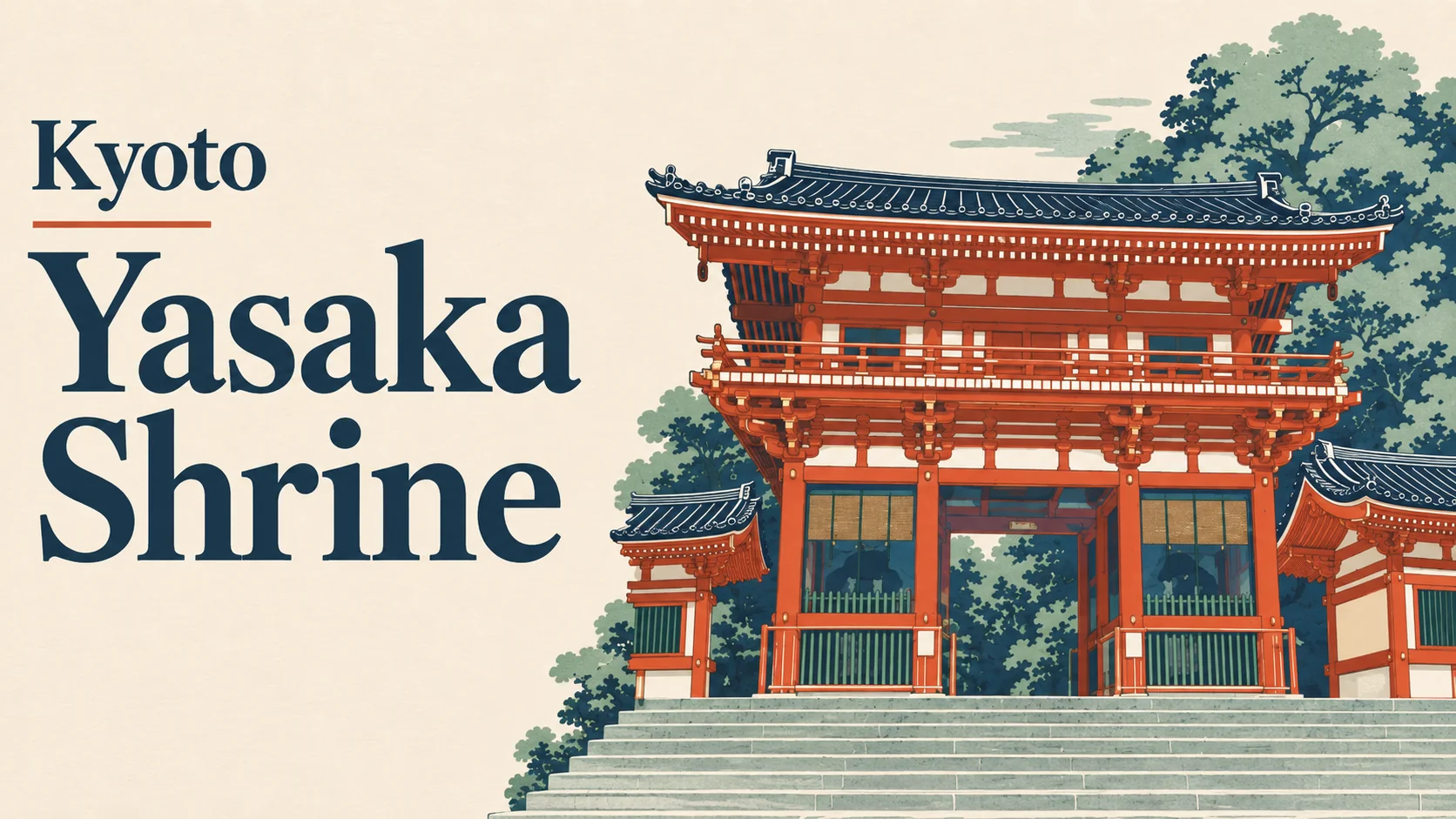
Kyoto’s Yasaka Shrine stands at the top of Shijo Street, where the Gion district runs into the Higashiyama hills, and it never closes: the grounds are open 24 hours, so you can climb the steps at midnight as easily as at noon. What does close is the shrine office, at 5 p.m., and with it the amulets and the goshuin. Plan around that one hour, and the rest — the trains, the festival dates, the National Treasure main hall — falls into place.
What you’ll learn
- What Yasaka Shrine is, why Kyoto calls it Gion-san, and how it differs from the Yasaka Pagoda and from Namba Yasaka in Osaka
- How to get there from Gion-Shijo, Kyoto-Kawaramachi and Kyoto Station, with the address as the shrine writes it
- What is open at which hour, and what a goshuin costs
- The Gion Matsuri dates, and why our classifier scores the shrine 75 as Wind
What Is Kyoto’s Yasaka Shrine?
Kyoto’s Yasaka Shrine is the Shinto shrine at the eastern end of Shijo Street in Gion, and the home of the Gion Matsuri. Its grounds are open 24 hours, and its main hall, built in 1654 under a single roof, has been a National Treasure since December 2020.
The shrine gives two founding traditions and does not choose between them. In one, an envoy from the Korean Peninsula enshrined the deity Susanoo here in 656; in the other, a monk from Nara named Enjo built a hall on the site in 876. Both are shrine tradition rather than record. A standard Japanese encyclopedia, the Sekai Dai-Hyakka Jiten, dates the first written mention of the shrine to 920.
For most of its history it was not called Yasaka at all. Until 1868 it was Gion-sha, also known as Gion Kanshin-in, a shrine and a Buddhist institution run as one, and its deity was worshipped as Gozu Tenno — in Buddhist tradition the guardian of Gion Shoja, the monastery of the Buddha’s time, and identified with Susanoo. When the new Meiji government separated Shinto from Buddhism in 1868, the name became Yasaka Shrine. The district kept the old name, and people in Kyoto still call the shrine Gion-san.
Why “Yasaka Jinja Shrine,” and Why Some Call It Gion Shrine
Because jinja is simply the Japanese word for shrine, “Yasaka Jinja Shrine” says shrine twice; Yasaka Jinja and Yasaka Shrine are one place.
Kyoto’s official tourism site writes it “Yasaka-jinja Shrine,” which keeps both halves, and English guides use every combination. The older name turns up too. “Gion Shrine” in an older English source, or Gion-san in conversation, means the same shrine; the name Yasaka only dates from 1868.
Not the Yasaka Pagoda, and Not Namba Yasaka in Osaka
Search “Kyoto Yasaka” and three different places come up: this shrine, the Yasaka Pagoda, and a hotel restaurant with the same name.
The Yasaka Pagoda is the five-storied pagoda of Hokanji, a Buddhist temple on the slope between here and Kiyomizu-dera. It shares a neighborhood name with the shrine and nothing else. Namba Yasaka Shrine is a separate shrine in Naniwa Ward, Osaka, famous for a stage built in the shape of a giant lion’s head; its name is written with a different second character. Neither is covered on this page.
Getting to Yasaka Shrine: Stations, Buses and the Address
The shrine’s access page names Gion-Shijo on the Keihan Line as the nearest station, about five minutes’ walk east along Shijo Street.
Shijo Street ends at the shrine’s two-storied vermilion West Gate, so from either Gion-Shijo or Kyoto-Kawaramachi you walk east and cannot miss it. The official address is 625 Gionmachi Kitagawa, Higashiyama-ku, Kyoto 605-0073. The shrine’s own English page spells it “Giommachi Kitagawa” — the same address, romanized with an m before the m that follows.
| From | Route | Time |
|---|---|---|
| Gion-Shijo Station (Keihan Line) | Walk east along Shijo Street | about 5 min on foot |
| Kyoto-Kawaramachi Station (Hankyu Line) | Walk east along Shijo Street | about 8 min on foot |
| Kyoto Station | Kyoto City Bus 100 or 206 to the “Gion” stop, right by the shrine | not published by the shrine |
| Kyoto Station | Taxi or car | about 15 min |
| By car | No car park at the shrine; use a nearby paid lot | — |
The walking times, bus routes and the note about parking all come from the shrine’s access page, and the 15-minute drive from Kyoto Station from its English access page. Note that the English version lists only the 206 bus; the Japanese version lists both 100 and 206. The shrine gives no journey time for the bus, so allow for Kyoto’s traffic rather than trusting a figure.
Open 24 Hours: What Is Open When
The grounds never close, but the shrine office that handles amulets, prayers and goshuin keeps hours of 9 a.m. to 5 p.m.
That split is the thing to plan around. Walking the grounds and praying at the main hall costs nothing and is possible at any hour; Keihan’s guide to the shrine lists the grounds as free to enter. Anything you take away with you depends on the office.
| What | Hours | Note |
|---|---|---|
| Grounds and worship at the main hall | 24 hours, every day | No admission charge |
| Shrine office (amulets, goshuin) | 9:00 a.m. – 5:00 p.m. | Closed outside these hours |
| Goshuin written by hand in your book | 9:00 a.m. – 4:00 p.m. | After 4:00 p.m., given on a sheet of paper only |
| Formal prayer (gokito) | 9:00 a.m. – 4:00 p.m. | From ¥8,000 (approx. US$53) |
Goshuin at Yasaka Shrine
The main shrine’s goshuin costs ¥500 when written by hand into your own book, which the office does from 9 a.m. until 4 p.m.
A goshuin is a seal and calligraphy given at a shrine office as a record of your visit, written into a goshuincho, a book kept for the purpose. After 4 p.m. the shrine stops writing in books and hands the seal over on a sheet of paper, and at 5 p.m. the office closes. The shrine publishes its prices on its amulets and goshuin page:
| Seal | Offering |
|---|---|
| Main shrine seal, handwritten in your book | ¥500 (approx. US$3.30) |
| Main shrine seal | ¥300 (approx. US$2) |
| Seiryu (blue dragon) seal | ¥500 |
| Goshin-en seal | ¥500 |
| Each smaller shrine, including Eki-jinja, Utsukushi-gozen-sha and Okuninushi-sha | ¥300 each |
| Goshuincho (seal book) | ¥1,500 – ¥3,800 |
The Seiryu seal is based on a tradition, repeated on the shrine’s own pages, that a blue dragon lives in a pond beneath the main hall. Our guide to goshuin covers how to ask for one.
The Main Hall: One Roof, and a National Treasure Since 2020
The main hall was built in 1654 in a style called Gion-zukuri, with the sanctuary and the worship hall under one great roof.
Most shrines keep those two buildings apart: a closed sanctuary (honden) where the deity is enshrined, and a worship hall (haiden) in front of it. Here a single hinoki-bark roof covers both, a plan the shrine says preserves a form from the Heian period. The Tokugawa shogunate built the present hall. Japan’s Agency for Cultural Affairs listed it as an Important Cultural Property in 1911 and designated it a National Treasure on December 23, 2020. On the same occasion 26 more buildings in the grounds were made Important Cultural Properties, so the shrine now counts one National Treasure and 29 Important Cultural Properties.
By the shrine’s account, the oldest of them is the West Gate you walk through from Shijo Street, rebuilt in 1497. The South Gate, rebuilt in 1879, is the formal entrance: the portable shrines leave through it during the Gion Matsuri, and so do wedding processions.
Susanoo and the Deities of Yasaka, and How to Worship
Susanoo is enshrined at the center of the main hall, and worship follows the ordinary Shinto form: two bows, two claps, one bow.
With Susanoo-no-mikoto are his wife Kushiinadahime-no-mikoto to the east and his eight children, the Yahashira-no-mikogami, to the west. Those three are the names on the shrine’s English page. Its Japanese page is fuller. Beside Kushiinadahime it lists two further wives of Susanoo, Kamuoichihime-no-mikoto and Samirahime-no-mikoto. It names the “eight children” one by one, among them Itakeru-no-kami, Otoshi-no-kami and Ukanomitama-no-kami. And to one side, for Kushiinadahime’s parents, it enshrines Inada-no-miyanushi-Suga-no-yatsumimi-no-kami. Counted that way, thirteen deities share the hall.
In the shrine’s telling, taken from the Kojiki, Susanoo is born from the nose of the creator god Izanagi. He is sent out of the Plain of High Heaven for his outrages and comes down to Izumo, where he meets Kushiinadahime and her grieving parents. That makes him an awkward sort of guardian: a storm god who misbehaves in heaven and then, on earth, takes a wife.
To worship, stand at the offering box in front of the hall, bow twice, clap twice and bow once. There is no fixed amount for the offering (saisen).
The Smaller Shrines: Utsukushi-gozen-sha, Eki-jinja and Okuninushi-sha
Three of the smaller shrines in the grounds draw visitors of their own: one for beauty, one for the July purification, one for good relationships.
Utsukushi-gozen-sha enshrines the three goddesses of Munakata. Spring water rises in front of it, and the shrine says that a few drops on the skin make body and mind beautiful. Its hall dates from 1591. Eki-jinja, whose name means “epidemic shrine,” enshrines Somin Shorai. On July 31 at 10 a.m. it holds the Nagoshi-sai: a large ring of reeds (chinowa) is set up in its torii for visitors to pass through, and they receive an amulet reading “descendant of Somin Shorai” and a millet cake. Okuninushi-sha enshrines Okuninushi, Sukunahikona and Kotoshironushi, and is visited for good relationships, including marriage.
Shrine or Temple? What Changes at the Front
Yasaka is a Shinto shrine, and the difference at the front is the clap: two claps at a shrine, none at a Buddhist temple.
At a temple you press your hands together and bow without clapping. The quick test on the way in is the gateway: a torii marks a shrine. The confusion has history here. Until 1868 Gion-sha was run as a joint Buddhist and Shinto institution, and the Yasaka Pagoda up the hill is a temple to this day. At the main hall, clap.
Gion Matsuri and the Rest of the Shrine’s Year
The Gion Matsuri is Yasaka Shrine’s festival, and it runs the whole of July, from an opening rite on the 1st to the 31st.
The shrine dates the festival to 869. The two float processions are the famous part. In 2026 the first, on July 17, set out from Shijo-Karasuma at 9 a.m. with 23 floats, and the second, on July 24, from Karasuma-Oike at 9:30 a.m. with 11, according to Kyoto’s official tourism site. The shrine’s own ritual core happens on the same two days. On the evening of July 17 the portable shrines (mikoshi) leave at 4 p.m. for the Otabisho, a temporary shrine on Shijo Street. On the night of July 24 they return, arriving back late at night. The float procession was first inscribed by UNESCO as Intangible Cultural Heritage in 2009, and it is now listed as part of “Yama, Hoko, Yatai, float festivals in Japan.”
Outside July, these are the dates worth knowing:
| Date | Event |
|---|---|
| February 2–3 | Setsubun: bean-throwing on the dance stage, with dances offered by Kyoto’s four geisha districts |
| July 1–31 | Gion Matsuri |
| September 25, 2026 | Gion-sha Kangetsu-sai, a moon-viewing rite, as announced on the shrine’s news page |
| December 28 | Kiribi-shiki: the sacred fire for Okera Mairi is kindled |
| December 31, around 7:30 p.m. – January 1, around 5:00 a.m. | Okera Mairi: the okera fire is offered to visitors through the night |
| January 1, 5:00 a.m. | Okera-sai, a rite on New Year’s morning |
The shrine lists all of these on its events page, and the July detail on its Gion Matsuri pages.
Five Elements Classification: Why Yasaka Scores 75 as Wind
Yasaka scores as Wind with 75 points, because its principal deity, Susanoo, falls in our category of storm and thunder deities.
Kannavi classifies every shrine into one of five elements — Earth, Water, Fire, Wind and Void. This is our classification, not a teaching of the shrine and not a fortune. It reads three checkable layers — the deities enshrined and their category of divinity, the geography of the site, and the shrine’s lineage — each worth fixed points, and we print the score sheet so you can disagree with it line by line.
| Layer | What was matched | Category | Element | Points |
|---|---|---|---|---|
| 1. Enshrined deity | Susanoo-no-mikoto (principal) | Deities of storm and thunder | Wind | 60 |
| 1. Enshrined deity | Ukanomitama-no-kami (joined) | Deities of rice, food and harvest | Earth | 15 |
| 2. Geography | Center of a plain, guardian of a town | Urban siting | Earth | 15 |
| 3. Lineage | Hikawa / Yasaka / Gion line | Lineage match | Wind | 15 |
| Total | Wind 75 / Earth 30 | Wind | ||
Water, Fire and Void score zero. Earth’s 30 is less than half of Wind’s 75, so there is no secondary element. The table also shows what did not score. We ran all thirteen deities on the shrine’s Japanese list, and eleven of them — Kushiinadahime, the two other wives, seven of the eight children and the deity enshrined for Kushiinadahime’s parents — belong to no category in the rule set, so they add nothing rather than being guessed into one. The festival does not count either, since “Gion Matsuri” is not one of the rites the rules look for.
Compare the other shrines we have scored: Fushimi Inari Taisha scores 100 as Earth, Meiji Jingu 100 as Void and Itsukushima 130 as Water. In the Kannavi scheme the five elements sit in a cycle — Earth, Fire, Void, Water, Wind — in which each shifts the flow of the next rather than opposing it. Wind sits close to Earth and Water; Fire and Void shift its flow instead. The category follows the myth, not the weather in Gion.
Frequently Asked Questions
These answer the questions the sections above leave open, from the shrine’s own pages unless another source is named.
Q. Can I visit Yasaka Shrine at night?
A. Yes. The grounds are open 24 hours and you can worship at the main hall at any time. What you cannot do after 5 p.m. is buy an amulet or get a goshuin, because the shrine office closes then.
Q. Can I order amulets or a goshuin by mail from abroad?
A. No. The shrine does send amulets and seals by post, but only to addresses in Japan. Payment is by a postal transfer slip, shipping costs ¥500, and it takes about ten days. Seals sent this way come on paper, dated the day you apply.
Q. Can I still get a goshuin after 4 p.m.?
A. Until 5 p.m., yes, but not written in your book. From 4 p.m. the shrine gives the seal on a sheet of paper, which you can paste into your goshuincho later. After 5 p.m. the office is closed.
Q. Is July a good time to visit?
A. It is the festival month, with something on the shrine’s calendar almost every week, but it is also hot. The Kyoto Shimbun reported 38.8°C (101.8°F) at 1:18 p.m. during the July 24, 2026 procession, and called it the hottest procession on record. Carry water and plan around midday.
Q. What is Okera Mairi?
A. The shrine’s New Year’s Eve rite. From around 7:30 p.m. on December 31 until around 5 a.m. on January 1, it offers visitors the okera fire, kindled at a rite on December 28. The dates do not change from year to year.
Q. Is there parking at Yasaka Shrine?
A. No. The shrine has no car park and asks visitors to use nearby paid lots. In practice the train is easier: Gion-Shijo on the Keihan Line is about five minutes away on foot.
Summary
Yasaka Shrine is the open-all-night shrine at the end of Shijo Street, and the only fixed hours are the office’s.
- The grounds are open 24 hours and free to enter; the shrine office keeps 9 a.m. to 5 p.m., and goshuin are written in your book only until 4 p.m.
- Walk five minutes east from Gion-Shijo (Keihan) or eight from Kyoto-Kawaramachi (Hankyu). There is no parking.
- The main hall, built in 1654 under a single roof, is a National Treasure; it has been Yasaka Shrine only since 1868 and was Gion-sha before that.
- The Gion Matsuri fills July, with float processions on the 17th and 24th; Okera Mairi runs through New Year’s Eve.
- Susanoo is enshrined at the center, and in the Kannavi classification the shrine scores 75 as Wind, with eleven of its thirteen deities left unscored.
Next: read our guide to goshuin, compare it with Fushimi Inari Taisha across the city, or return to the English guide to Japanese shrines.
For most of its history this was Gion, a shrine and a temple under one name, and the neighborhood never let the name go. It keeps its gates open all night, the way a local shrine does, and puts a storm god who misbehaved at the center of its main hall. For all its National Treasure status, it works less like a monument kept to office hours than like the shrine at the top of the street.