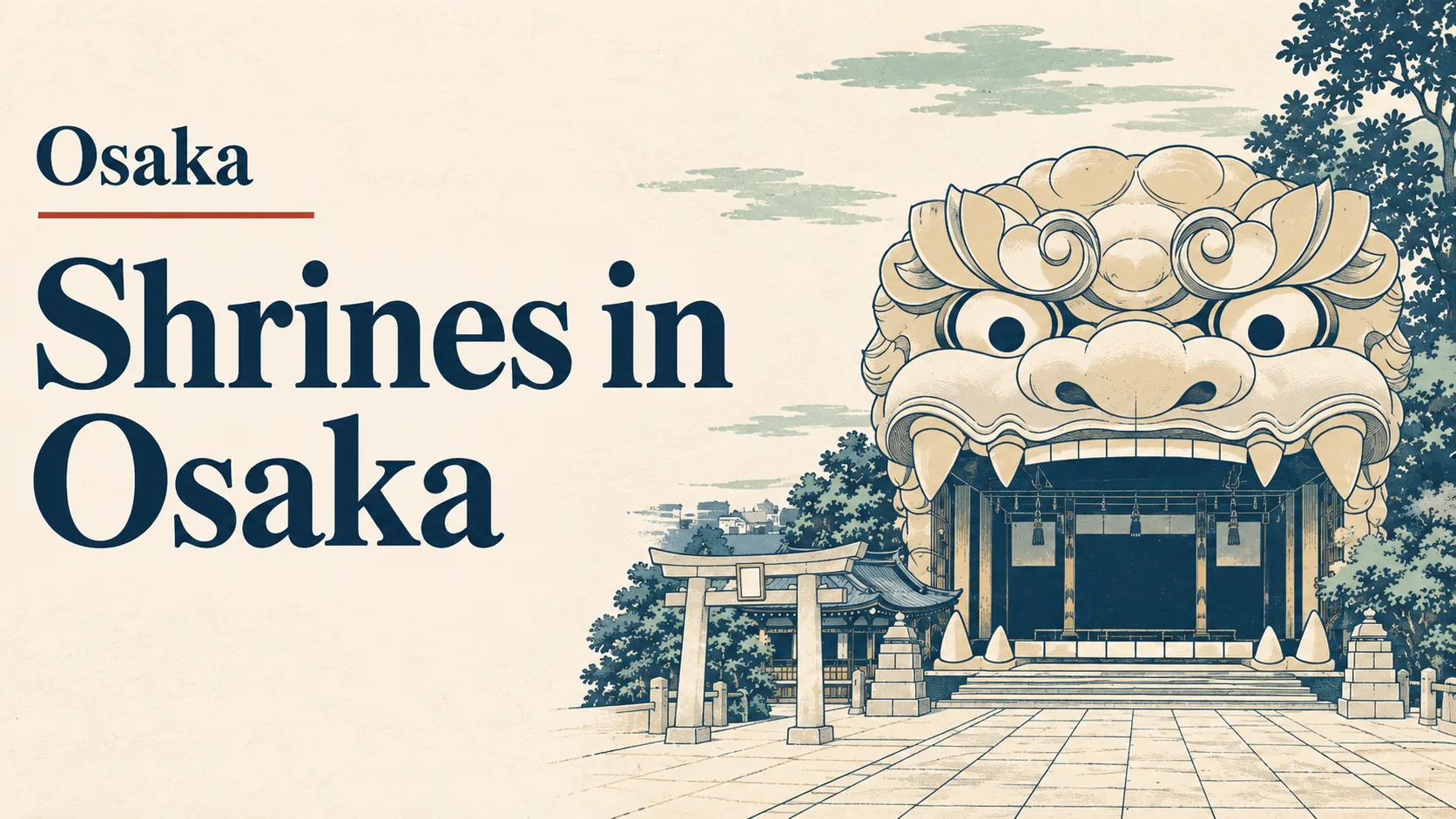
In US search results, “Namba shrine, Osaka” mostly means Namba Yasaka Shrine, the one with a stage shaped like a giant lion’s head. Of the nine US results we read on October 19, 2026, seven were about it, but the first was Osaka’s tourism bureau page for Namba Jinja, a different shrine in the Semba district. And the lists of famous shrines in Osaka all mixed in temples. This guide sorts out both names, then covers eight more shrines across the city, their festivals, the order to visit them, and how our classifier scored all ten.
What you’ll learn
- Which “Namba shrine” you are looking for, and how to tell the two apart
- The lion head stage at Namba Yasaka: its size, what the lion swallows, and the January tug of war
- Eight more famous shrines in Osaka, area by area, from Umeda to Sumiyoshi
- Osaka’s shrine festivals by month, and three routes by subway, Nankai and tram
- The score sheet for all ten, where all five elements turn up
Namba Shrine, Osaka: Two Shrines with One Name
Namba shrine in Osaka can mean two Shinto shrines: Namba Yasaka in Naniwa Ward, with the lion head, and Namba Jinja in Chuo Ward.
Both names begin with Namba, the old name of the Osaka area, and both sit in the city center, but they are separate shrines with different deities. Most searches in English mean the lion head; the tourism bureau page that ranks first describes the other one. A shrine, or jinja, is a place of Shinto worship for deities called kami; a temple, or tera, enshrines a Buddhist image, as our English guide to Japanese shrines explains. This guide covers shrines only.
| Namba Yasaka Shrine | Namba Jinja | |
|---|---|---|
| Ward | Naniwa Ward (Motomachi) | Chuo Ward (Bakuromachi) |
| Known for | The lion head stage, 12 m tall | An old shrine in the Semba business district |
| Main deity | Susanoo, with ten more | Emperor Nintoku, with Susanoo |
| Nearest station | Namba, about 6 min on foot | Shinsaibashi exit 3 or Hommachi exit 13, 5 min |
| Summer festival | July 13 and 14 | July 20 and 21 |
| Official site | nambayasaka.jp | nanba-jinja.or.jp |
Namba Jinja says it was founded under Emperor Hanzei for his father Nintoku, by tradition, and moved to its present site in 1583 after Toyotomi Hideyoshi built Osaka Castle; its hall was rebuilt in July 1974. Osaka Prefecture has 728 Shinto shrines registered as religious corporations, by the Agency for Cultural Affairs’ religious statistics as of December 31, 2024.
Namba Yasaka Shrine: The Lion Head Shrine in Osaka
Namba Yasaka is the lion head shrine of Osaka, a local guardian shrine about six minutes on foot from Namba Station.
The shrine says no detailed records of its founding survive. By the shrine’s own tradition, it was long called the “Lower Shrine of Naniwa” and was already known in the Enkyu era, 1069 to 1073, as a shrine to Gozu Tenno of the Gion faith, the same faith as Kyoto’s Yasaka Shrine. The present main hall was completed in May 1974.
The Lion Head Stage
The lion head, or shishiden, is a stage built in 1974 whose open mouth, the shrine says, swallows evil.
The shrine’s lion hall page words it more fully: the great mouth calls in victory, swallows evil spirits and invites luck in winning and in business. The shrine adds that people come from across Japan to pray for school results, job hunting, entrance exams and company growth. The shrine itself calls it Japan’s largest lion stage; we found no outside count to confirm that.
| What | Detail | Source |
|---|---|---|
| Height | 12 m | Shrine and tourism bureau agree |
| Width and depth | 7 m by 7 m by the shrine; 11 m wide and 10 m deep by the tourism bureau | The two disagree |
| Built | May 1974, with the main hall; inside and front renovated at the end of 2008 | Shrine |
| Structure | Steel and reinforced concrete, partly wood inside | Shrine |
| Details | 24 brass teeth; the eyes are lights and the nose is a speaker | Shrine |
| Inside | The rough spirit of Susanoo and a pair of Kaga lions | Shrine |
| Ceiling | Phoenix carvings, all hand-cut, no two alike | Shrine |
The stage is used: the shrine lists kagura dance and iaido sword forms at New Year, and lion dances and folk dance at the summer festival.
Deities, the Tug of War and the Summer Festival
Namba Yasaka enshrines Susanoo first among eleven deities, and its January tug of war retells his fight with an eight-headed serpent.
The deities page lists eleven names led by Susanoo and his wife Kushinadahime, including the Yahashira-no-Miko, the “eight child deities”. The Tsunahiki Shinji, the tug-of-war rite, is held on the morning of the third Sunday of January: a great rope with eight heads and eight tails is twisted into the shape of the serpent Yamata-no-Orochi and pulled toward the year’s lucky direction, by the rite’s page. In 2001 it became Osaka City’s first designated intangible folk cultural property. The summer festival falls on July 13 and 14, with a boat procession on the Dotonbori canal on the 13th, revived in 2001 after 230 years, by the festival page.
Visiting: Access, Hours and Goshuin
Walk about six minutes from Namba on the Midosuji or Yotsubashi line or from Nankai Namba, or seven from Daikokucho.
Those times are from the shrine’s access page, which gives no exit numbers. The shrine does not publish gate hours, an entry fee or the price of its goshuin, the handwritten seal; the tourism bureau lists the gate as open 6:00 to 17:00 and reception as 9:00 to 16:50. Our guide to goshuin explains how to ask for one. Prayers are by reservation at the office west of the main hall.
Ten Shrines in Osaka at a Glance
The ten shrines sit in five parts of Osaka City, each a short walk from a subway, Nankai or tram stop.
Founding dates are each shrine’s own, and several rest on tradition. Access is from each shrine’s site, or the tourism bureau’s where the shrine gives none. Elements are explained further down.
| Shrine | Area | Began | Getting there | Element, score |
|---|---|---|---|---|
| Namba Yasaka | Minami | Known by 1069–73 | Namba, about 6 min | Wind, 60 |
| Imamiya Ebisu | Minami | 600, by tradition | Nankai Imamiyaebisu, next to the station | Fire, 60 |
| Namba Jinja | Semba | By tradition, under Emperor Hanzei | Shinsaibashi exit 3, 5 min | Void, 60 |
| Sukunahikona | Semba | 1780 | Kitahama exit 6, 5 min | Earth, 75 |
| Hokoku | Osaka Castle | 1880 | Tanimachi 4-chome exit 1-B, 13 min | Fire, 90 |
| Osaka Tenmangu | Kita | 949, by tradition | Minamimorimachi exit 4 | Wind, 75 |
| Tsuyu no Tenjinsha | Kita (Umeda) | Uncertain | Higashi-Umeda or Umeda | Earth, 90 |
| Ikukunitama | Uemachi | Moved here 1583 | Tanimachi 9-chome, 3 min | Earth, 90 |
| Kozu-gu | Uemachi | 866 | Tanimachi 9-chome exit 2, 5 min | Void, 75 |
| Sumiyoshi Taisha | Sumiyoshi | 211, by its own account | Nankai Sumiyoshitaisha, 3 min | Water, 130 |
Left out are two shrines that do appear in some lists: Ishikiri Tsurugiya Shrine in Higashiosaka, outside the city, and Samuhara Shrine in Nishi Ward, whose own history traces it to an old shrine in Tsuyama, Okayama, brought to Osaka in 1950.
Famous Shrines in Osaka, Area by Area
The famous shrines in Osaka cluster in four areas beyond Minami: Kita, Semba with Osaka Castle, the Uemachi heights, and Sumiyoshi.
Kita: Osaka Tenmangu and Tsuyu no Tenjinsha
Osaka Tenmangu honors the scholar Sugawara no Michizane and hosts the Tenjin Matsuri; Tsuyu no Tenjinsha stands among Umeda’s office towers.
Osaka Tenmangu’s history says that in 949 seven pines grew overnight in front of an older shrine here and glowed at night, and the shrine was founded for Michizane; the present main hall dates from 1843 after fires the shrine counts at seven in the Edo period alone. It is reached from exit 4 of Minamimorimachi Station or exit 7 of JR Osakatemmangu. Our Osaka Tenmangu guide covers it in full. Wind 75.
Tsuyu no Tenjinsha, known as Ohatsu Tenjin, lists five deities led by Sukunahikona and Michizane among them. Its own page says its founding date is uncertain and its halls were rebuilt in September 1957 after the war. The grounds open 6:00 to 24:00, the office 9:00 to 18:00, by its access page. It holds a memorial on April 7 for the puppet play Sonezaki Shinju. Earth 90.
Semba and Osaka Castle: Sukunahikona and Hokoku
Sukunahikona Shrine is the medicine trade’s shrine in Doshomachi, and Hokoku Shrine stands inside the Osaka Castle grounds for Toyotomi Hideyoshi.
Sukunahikona Shrine began in 1780, when the district’s medicine dealers invited Sukunahikona from Kyoto’s Gojo Tenjin to join Shennong, the Chinese god of medicine they already honored, by its own history. Its paper tiger charms go back to the cholera of 1822. The gates open 8:00 to 17:00 and goshuin are given 9:30 to 16:00; Kitahama exit 6 is five minutes away. Earth 75.
Hokoku Shrine enshrines Hideyoshi, his son Hideyori and his brother Hidenaga. It was founded in Nakanoshima in 1880 and moved into the castle grounds in January 1961, by its own history; a 5.2 m statue of Hideyoshi, base included, stands in the precinct. Worship is possible at any hour, and the office opens 9:00 to 16:50. Fire 90.
Uemachi: Ikukunitama and Kozu-gu
Ikukunitama Shrine and Kozu-gu both stand on the Uemachi heights, each about five minutes or less from Tanimachi 9-chome Station.
Ikukunitama Shrine’s site publishes no history, so we rely on the tourism bureau: it began with the deities Ikushima and Tarushima near today’s Osaka Castle and moved here in 1583, when Hideyoshi built the castle. Its roof style, Ikukunitama-zukuri, is named after the shrine; the hall was rebuilt in concrete after the war. Its 2026 summer festival ran on July 11 and 12. Earth 90.
Kozu-gu enshrines Emperor Nintoku with five more members of the imperial line. Its history dates its founding to 866 by imperial order, a move to the present site in 1583, and rebuilding in October 1961 after the war. Exit 2 of Tanimachi 9-chome is five minutes away. Void 75.
South: Imamiya Ebisu and Sumiyoshi Taisha
Imamiya Ebisu is Osaka’s shrine for business luck, and Sumiyoshi Taisha is the head shrine of the Sumiyoshi shrines across Japan.
Imamiya Ebisu says it was founded around 600, by tradition, when Prince Shotoku built Shitennoji temple, as its western guardian. The shrine’s FAQ gives gates 6:00 to 17:00, a south side gate until 22:00, and seals 9:00 to 17:00; the goshuin is ¥500. Because the main hall roof is being replaced, the shrine cannot hold prayers in the hall during 2026. Fire 60.
Sumiyoshi Taisha enshrines the three Sumiyoshi sea deities and Empress Jingu, and dates its founding to 211 in its own chronology. Its four main halls, built in 1810, are National Treasures, designated in 1953. The access page gives gates at 6:00 from April to September and 6:30 from October to March, and three minutes from Nankai Sumiyoshitaisha Station. Our Sumiyoshi Taisha guide has the full visit. Water 130.
Osaka’s Shrine Festivals by Month
Osaka’s shrine year peaks twice: Toka Ebisu and the tug of war in January, and a run of summer festivals through July.
| When | Festival | Shrine | Published figure |
|---|---|---|---|
| January 9–11 | Toka Ebisu | Imamiya Ebisu | 46 fukumusume, shrine maidens of luck, in 2026 |
| Third Sunday of January | Tsunahiki Shinji | Namba Yasaka | City intangible folk property since 2001 |
| July 11–12 (2026) | Ikutama Summer Festival | Ikukunitama | Procession to Osaka Castle on the 12th |
| July 13–14 | Summer festival | Namba Yasaka | Boat procession on Dotonbori on the 13th |
| July 17–18 | Summer festival | Kozu-gu | — |
| July 24–25 | Tenjin Matsuri | Osaka Tenmangu | About 100 boats and 3,000 fireworks in 2026 |
| Marine Day in July to August 1 | Sumiyoshi Matsuri | Sumiyoshi Taisha | Main festival July 31 |
| August 18 | Taiko-sai | Hokoku | Hideyoshi’s death day |
| November 22–23 | Shinno Matsuri | Sukunahikona | An estimated 50,000 in 2025 |
The Tenjin Matsuri’s own page calls it one of Japan’s three great festivals, naming Kyoto’s Gion Matsuri and Tokyo’s Kanda Matsuri as the others; the encyclopedia Nipponica instead pairs it with Gion and Tokyo’s Sanno Matsuri as the three great summer festivals, so the list depends on who is counting. The 2026 boat and firework figures come from a Kyodo News report; no attendance total was given.
Dress for the season. The Japan Meteorological Agency’s 1991–2020 normals for Osaka give a January average of 6.2°C and a July average of 27.7°C, with daily highs near 31.8°C.
In What Order: A Minami Walk, a Kita Morning, a Sumiyoshi Trip
Start at Namba for the lion head, then take the subway north to Kita or the Nankai line south to Sumiyoshi.
None of the ten shrines publishes a visitor count on its site, so these routes rest on access and hours. Subway times are from Osaka Metro’s timetable, not an official journey time.
| Plan | Order | Getting around | Published fares |
|---|---|---|---|
| Minami walk | Namba Yasaka, then Imamiya Ebisu | On foot from Namba; Imamiya Ebisu is by Nankai Imamiyaebisu and 8 min from Daikokucho exit 3 | — |
| Kita morning | Tsuyu no Tenjinsha, then Osaka Tenmangu | Midosuji line, Namba to Umeda about 8 min; Tanimachi line to Minamimorimachi | Subway ¥190 to ¥390 by distance |
| Semba and the castle | Sukunahikona, Namba Jinja, Hokoku | Kitahama, Shinsaibashi or Hommachi, then Tanimachi 4-chome | Subway fares as above |
| Uemachi | Kozu-gu, then Ikukunitama | Both from Tanimachi 9-chome | Subway fares as above |
| Sumiyoshi trip | Sumiyoshi Taisha | Nankai local from Namba, about 10 min; or the Hankai tram from Tennoji-ekimae, about 15 min | Hankai tram ¥240 for any distance |
At New Year, Sumiyoshi Taisha closes its parking and asks visitors to come by train. The tourism bureau puts its New Year crowd at over 2 million in three days, while a JNTO feature says over 200,000, a tenfold gap we could not settle.
Five Elements Classification: All Five Elements in One City
Osaka’s ten shrines cover all five elements: three Earth, two Wind, two Fire, two Void and one Water, with every point shown.
This is Kannavi’s own classification, not a teaching of any shrine and not a fortune. The classifier reads four layers: a main deity is worth 60, each further deity 15, the terrain 15 or 25, the lineage 15. The terrain for each Osaka shrine was set by hand in our shrine database, and we disclose it in the table. The score shown is the winning element’s total; points marked with another element’s name go to that element and are not part of the score. Confidence is high when the lead is clear, medium when a second element sits close. Deities went in as each shrine lists them; for Ikukunitama, which lists none, we used the tourism bureau’s names.
| Shrine | Element | Score | Confidence | What produced the points |
|---|---|---|---|---|
| Namba Yasaka | Wind | 60 | medium | Susanoo, storm +60; Ame-no-Oshihomimi +15 Void; city plain +15 Earth |
| Namba Jinja | Void | 60 | medium | Emperor Nintoku +60; Susanoo +15 Wind; city plain +15 Earth |
| Imamiya Ebisu | Fire | 60 | medium | Amaterasu, sun +60; Susanoo +15 Wind; Tsukuyomi +15 Void; city plain +15 Earth |
| Sukunahikona | Earth | 75 | high | Sukunahikona, land +60; city plain +15 |
| Hokoku | Fire | 90 | high | Hideyoshi +60; Hideyori and Hidenaga +15 each; hill +15 Earth |
| Osaka Tenmangu | Wind | 75 | high | Michizane +60; Tenmangu lineage +15; river +25 Water |
| Tsuyu no Tenjinsha | Earth | 90 | high | Sukunahikona +60; Onamuchi +15; city plain +15; Amaterasu +15 Fire; Tenjin lineage +15 Wind |
| Ikukunitama | Earth | 90 | high | Ikushima, land +60; Tarushima +15; hill +15 |
| Kozu-gu | Void | 75 | high | Emperor Nintoku +60; Emperor Richu +15; Empress Jingu +15 Fire; hill +15 Earth |
| Sumiyoshi Taisha | Water | 130 | high | Sokotsutsunoo, sea +60; two Sumiyoshi deities +15 each; seashore +25; Sumiyoshi lineage +15 |
Our dictionary missed most of Namba Yasaka’s eleven names: only Susanoo and Ame-no-Oshihomimi scored, and Kushinadahime and the eight children went unmatched. At Imamiya Ebisu, Kotoshironushi, the Ebisu deity itself, also scored nothing, so the shrine of business luck comes out Fire on Amaterasu. Sumiyoshi Taisha and Osaka Tenmangu score the same as on their own pages.
The ring runs Earth, Fire, Void, Water, Wind and back to Earth, each element shifting the flow of the next; it is not a chart of good and bad pairings. Unlike our Hokkaido list, where Wind and Void were empty, Osaka fills every element in one city. Water rests on Sumiyoshi alone, the shrine of the old shoreline.
Frequently Asked Questions
Most first visits turn on seven questions, answered below from the shrines’ own sites and the official figures linked above.
Q. What is the lion head shrine in Osaka?
A. It is Namba Yasaka Shrine in Naniwa Ward, a Shinto shrine, though some searches call it the “lion head temple”. Its 12 m lion hall, built in 1974, is a stage rather than the main hall: you pray at the main hall beside it. The shrine says the open mouth swallows evil and draws in luck for winning and business.
Q. Is Namba Shrine the same as Namba Yasaka Shrine?
A. No. Namba Jinja in Chuo Ward enshrines Emperor Nintoku and is five minutes from Shinsaibashi exit 3 or Hommachi exit 13. Namba Yasaka in Naniwa Ward enshrines Susanoo and has the lion head. If a map pin shows Bakuromachi in Chuo Ward, it is Namba Jinja; the lion head’s address is 2-9-19 Motomachi, Naniwa Ward, by its own site.
Q. Is there an entrance fee at shrines in Osaka?
A. None of the ten shrines in this guide publishes an entrance fee on its site. Seals and charms are paid for: Imamiya Ebisu lists its goshuin at ¥500, and Tsuyu no Tenjinsha and Sukunahikona list ¥500 for their October 2026 limited seals. Namba Yasaka publishes no prices, so check at its office.
Q. What time does Namba Yasaka Shrine open?
A. The shrine itself publishes no hours. Osaka’s tourism bureau lists the gate as open 6:00 to 17:00 and reception, where seals and charms are given, as 9:00 to 16:50. For a late visit, Tsuyu no Tenjinsha keeps its grounds open until midnight, and Hokoku Shrine says worship is possible at any hour.
Q. When is the best time to visit shrines in Osaka?
A. It depends on what you want. For festivals, come January 9 to 11 for Toka Ebisu, which the tourism bureau says draws over a million people, or July 24 and 25 for the Tenjin Matsuri. November 22 and 23 bring the smaller Shinno Matsuri. At New Year, Sumiyoshi Taisha closes its parking, so arrive by train.
Q. Which shrine in Osaka is the most famous?
A. None of the ten publishes a visitor count, and we found no official ranking. In the five English lists we counted, Sumiyoshi Taisha, Osaka Tenmangu and Namba Yasaka each appeared in four. Sumiyoshi Taisha is the only one of the ten with National Treasure halls, and it is the head shrine of about 2,300 Sumiyoshi shrines, by its own count.
Q. How many shrines are there in Osaka?
A. Osaka Prefecture has 728 Shinto shrines registered as religious corporations, as of December 31, 2024, by the Agency for Cultural Affairs. The same survey counts 738 shrine bodies of all lineages, including a few without corporate status. Both count religious bodies, not every small roadside shrine, and the Osaka Association of Shinto Shrines publishes no total.
Summary
Osaka’s best-known shrines are ten in five parts of the city, led by Namba Yasaka’s lion head and Sumiyoshi Taisha’s National Treasure halls.
- “Namba shrine” in most US results is Namba Yasaka, with the 12 m lion head, six minutes from Namba; Namba Jinja in Chuo Ward is a different shrine.
- The lion head was built in 1974; the shrine and the tourism bureau disagree on its width and depth.
- Kita has Osaka Tenmangu and Tsuyu no Tenjinsha; Semba has Sukunahikona and Namba Jinja; Uemachi has Ikukunitama and Kozu-gu.
- January and July are festival months; Sumiyoshi Taisha is 10 minutes south of Namba by Nankai.
- In the Kannavi classification, all five elements appear, with Sumiyoshi Taisha the only Water shrine.
Next: read our guides to Sumiyoshi Taisha, Osaka Tenmangu and goshuin, take the train to the shrines in Kyoto and Fushimi Inari, compare the shrines in Tokyo, or return to the English guide to Japanese shrines.
Osaka’s shrines sit among shopping streets and office towers, and four of these ten moved to their present sites while six rebuilt their halls after fire or war; the lion at Namba, open-mouthed since 1974, is only the newest face of a very old neighborhood shrine.