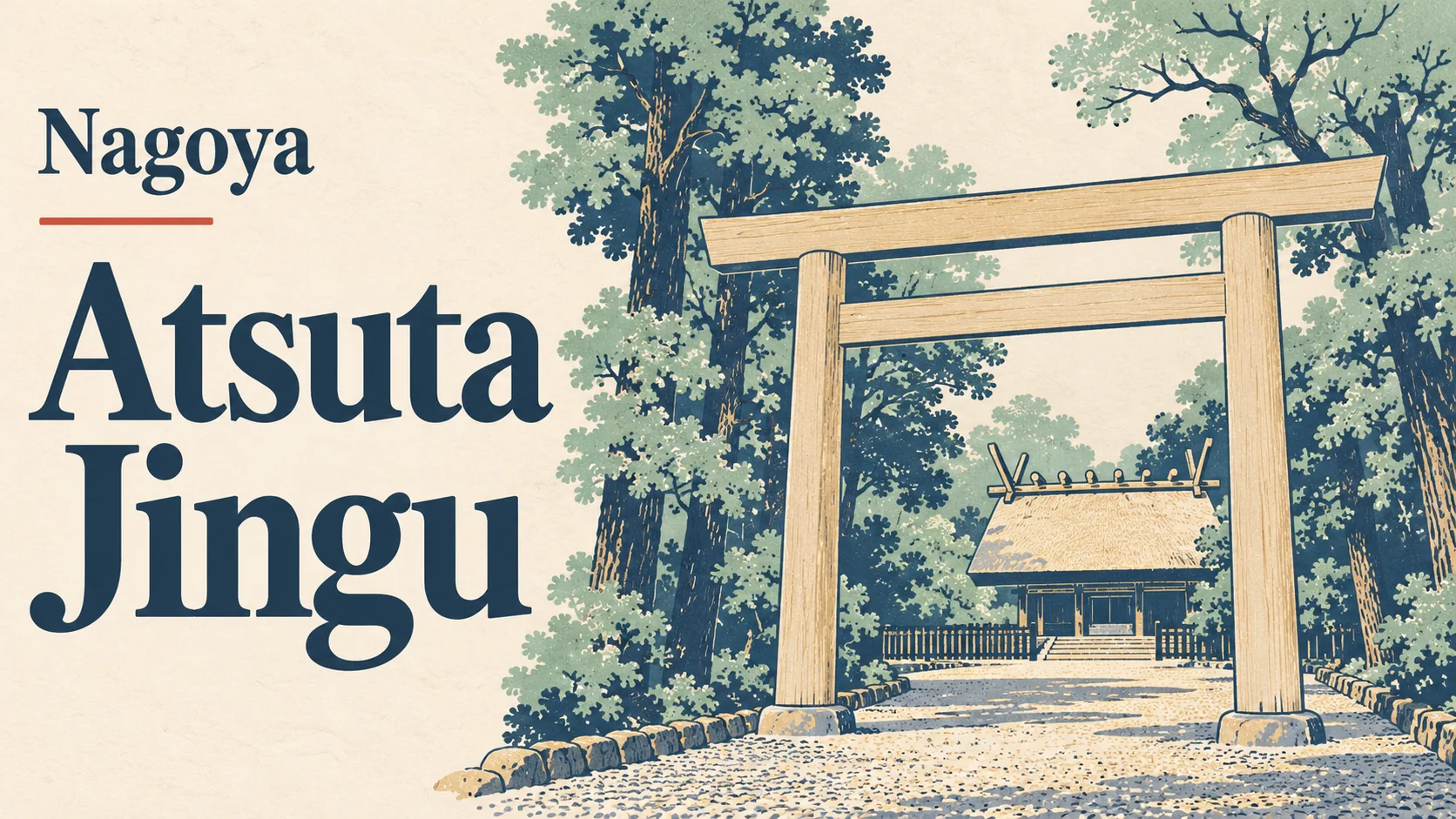
Atsuta Jingu is the great Shinto shrine of Nagoya, built around the Kusanagi sword, one of Japan’s three imperial regalia. Its official FAQ says you can visit 24 hours a day, and entry is free. The amulet office opens from about 7:00 until sunset, and the nearest stations are three to eight minutes away on foot. The sword itself is never shown.
What you’ll learn
- Who Atsuta no Okami is, why Amaterasu appears twice, and what the Kusanagi sword story says
- What to see in the grounds, from Nobunaga’s wall to the gate that is never opened
- Hours and fees for the Treasure Hall and the Kusanagi sword museum, plus amulet and prayer prices
- Which station and gate to use, and why the shrine’s own page still shows the old station names
- The main festivals, and why Atsuta scores Fire 75 in our five elements classification
Atsuta Jingu Shrine: What It Is and Who Is Enshrined
Atsuta Jingu, or Atsuta Shrine, is a Nagoya shrine for Atsuta no Okami, the sun goddess embodied in the Kusanagi sword.
A shrine is where kami, the deities of Shinto, are worshipped; a temple is a Buddhist site with images of the Buddha. Atsuta is a shrine, so visitors bow and clap at the main hall. The word jingu, a title given to shrines with close ties to the imperial house, is part of its name; the shrine’s history page dates the title to 1868, when Atsuta Jinja became Atsuta Jingu. The address is 1-1-1 Jingu, Atsuta Ward, Nagoya.
The shrine’s own introduction calls it second only to the shrine of Ise, and its English page says the same: “ranking second only to the Great Shrine of Ise”. Locals call it Atsuta-sama or simply Miya, “the shrine”. It was listed as a great shrine in the Engishiki register of the 10th century, and it is one of the 16 shrines that receive an envoy from the emperor at their main festival.
The deity page names one principal kami and five kami enshrined with it, called the “Five Gods”. Amaterasu appears twice: once as the identity of Atsuta no Okami and once among the five.
| Role | Kami | Who the kami is | Source |
|---|---|---|---|
| Principal | Atsuta no Okami | Amaterasu, the sun goddess, with the Kusanagi sword as her sacred vessel | Atsuta Jingu |
| Five Gods | Amaterasu-Omikami | Ancestral goddess of the imperial house | Atsuta Jingu |
| Five Gods | Susanoo-no-mikoto | Her brother, who took the sword from the eight-headed serpent | Atsuta Jingu |
| Five Gods | Yamato Takeru-no-mikoto | The prince who carried the sword east | Atsuta Jingu |
| Five Gods | Miyasuhime-no-mikoto | His wife, who enshrined the sword at Atsuta; an ancestor of the Owari clan | Atsuta Jingu |
| Five Gods | Takeinadane-no-mikoto | Her brother, who followed the prince east; an ancestor of the Owari clan | Atsuta Jingu |
The Kusanagi Sword
The Kusanagi sword is the shrine’s sacred object, one of the three imperial regalia, and it is kept out of sight in the main sanctuary.
The shrine’s founding story runs like this. Prince Yamato Takeru left the sword with his wife Miyasuhime at Mount Hikami, in today’s Midori Ward, and died at Nobono in Mie. She then enshrined it at Atsuta, “about 1,900 years ago”. The shrine’s timeline gives the year as 113. English Wikipedia also cites 192; that date does not appear on the shrine’s site.
The name means “grass-cutter”. By the shrine’s museum page, the prince was trapped in a burning field in the east, cut the grass with the sword and lit a counter-fire to escape. Before that, Susanoo is said to have drawn it from the tail of the eight-headed serpent. The shrine also records that a monk stole it in 668 and that it returned in 686.
You will not see it. The shrine calls the sword its goshintai, the object a kami resides in, and it gives no viewing schedule. English Wikipedia mentions that the sword was presumed lost at sea at Dan-no-ura in 1185, while noting that the shrine still holds it. Atsuta’s own history page does not mention Dan-no-ura.
From Owari Style to Shinmei Style
Atsuta’s main sanctuary has been built in the Shinmei style, the style of Ise, since 1893, and the present halls date from 1955.
Until 1893 the shrine was built in a local style called Owari-zukuri. The grounds guide says it was rebuilt in almost the same layout and scale as Ise because it holds one of the regalia. The air raids of March and May 1945 destroyed most buildings. The main sanctuary was rebuilt in October 1955, and renewed again in 2009 for the 1,900th anniversary.
What to See at Atsuta Jingu
Beyond the main sanctuary, look for Nobunaga’s wall, the Sakuma lantern, a gate that stays shut and a great camphor.
The shrine puts the grounds at about 190,000 square meters (47 acres), wooded with camphor, zelkova and oak. Counting the main sanctuary, it holds 45 shrines inside and outside the grounds. The south gate is the main gate, and from it the main approach, or sando, runs north under tall trees.
| Spot | What it is | Why stop |
|---|---|---|
| Hongu (main sanctuary) | Shinmei-style halls of Atsuta no Okami | You pray at the outer fence gate; the main hall stands behind several fences |
| Hakkengu | Detached shrine, founded 708 | Rites follow the main sanctuary; Nobunaga, Ieyasu and Tsunayoshi repaired it |
| Nobunaga-bei | Earthen wall given in 1560 | Thanks for victory at Okehazama; one of Japan’s three great earthen walls |
| Sakuma lantern | Stone lantern, 1630, about 8 m (26 ft) | One of Japan’s three great lanterns |
| Nijugocho-bashi | Bridge of 25 stone slabs | Said to be Nagoya’s oldest stone bridge; crossable since recent works |
| Seisetsu-mon | The “unopened gate” | Tied to the theft of the sword in 668 |
| Okusu | Great camphor tree | Said to be planted by the monk Kukai; over 1,000 years old by tradition |
| Minami-shingu-sha | Small shrine to Susanoo | The only vermilion-painted hall at Atsuta |
| Shimizu-sha | Shrine to a water goddess | A spring behind it; washing your eyes there is said to help them |
The Main Sanctuary and Hakkengu
You pray at the main sanctuary’s outer fence gate, then walk on to Hakkengu, a detached shrine with the same rites.
According to the grounds guide, the place of worship is the outer fence gate and the hall behind it, together called the haiden, or hall of worship. From there you see, deep inside, the roof of the main hall with its crossed finials and short logs on the ridge, the same marks you see at Ise. Most festivals, the main festival included, are held in the courtyard between the inner fences.
Hakkengu was founded in 708 when a sword was made by imperial order and enshrined there. Its buildings and yearly rites follow the main sanctuary. The guide lists repairs ordered by Oda Nobunaga in 1575, Tokugawa Ieyasu in 1599 and the shogun Tsunayoshi in 1686, and suggests visiting it after the main sanctuary.
Nobunaga’s Wall, the Sakuma Lantern and the Gate That Stays Shut
These three remains tell Atsuta’s history through warriors: a thank-you wall, a thank-you lantern and a gate closed after a theft.
The guide says Oda Nobunaga prayed here before the Battle of Okehazama in 1560 and, after winning, gave the Nobunaga-bei. It is clay and lime kneaded with oil and laid with thick rows of roof tiles. The shrine counts it among Japan’s three great earthen walls, with walls at Nishinomiya Shrine in Hyogo and Sanjusangendo in Kyoto.
The Sakuma lantern, where the main and east approaches meet, is said to have been given in 1630 by Sakuma Katsuyuki, who prayed to Atsuta during a disaster at sea and came through safely. It is hexagonal and about 8 meters tall, and a path now runs around it. Near the Kusunomimae-sha shrine stands the Seisetsu-mon. By tradition, a monk from Silla carried the sword out through this gate in 668. Ever since, the gate has been kept shut, either as unlucky or so the sword would never leave again.
The Great Camphor and the Smaller Shrines
The great camphor north of the water basin, said to be over 1,000 years old, stands near several small shrines worth a slower walk.
Before you pray, rinse your hands and mouth at the temizuya, the covered water basin west of the second torii. The camphor beside it is, by tradition, planted by the monk Kukai and over 1,000 years old. The shrine says several camphors on the grounds are thought to be around 1,000 years old.
The grounds guide notes three small shrines worth a look. Kusunomimae-sha has no hall at all: a fenced camphor is the shrine, and visitors write their zodiac sign and name on small torii from the amulet office. Shimizu-sha has a spring behind it. Minami-shingu-sha, for Susanoo, is the only vermilion hall at Atsuta. For noodles, the map also lists Miya Kishimen, a flat-noodle stand in the grounds.
The Treasure Hall and the Kusanagi Sword Museum
Atsuta’s two museums show swords and treasures given over the centuries; each costs ¥500 for adults, or ¥800 for both.
The Treasure Hall, opened in 1966, holds about 6,000 offerings from the imperial house, shoguns, lords and ordinary visitors. It lists 177 designated cultural properties: 1 National Treasure, 107 Important Cultural Properties and 69 Aichi Prefecture properties. The shrine’s general introduction says “over 170”. Displays rotate, so what you see changes.
The Kusanagi sword museum, the Tsurugi no Hoko Kusanagi-kan, opened in October 2021. It holds about 450 swords given to the shrine and keeps on display the two huge Magara swords, said to belong to a warrior father and son at the Battle of Anegawa. The National Treasure is a short sword by Rai Kunitoshi, dated 1316.
| Item | Treasure Hall | Kusanagi sword museum |
|---|---|---|
| Hours | 9:00–16:30, last entry 16:00 | 9:00–16:30, last entry 16:00 |
| Closed | Last Thursday of the month and the day before; Dec 25–31 | Ask before going; Nagoya’s tourism site gives the day before the Treasure Hall’s closing days and Dec 25–31 |
| Adults | ¥500 (approx. US$3) | ¥500 (approx. US$3) |
| Children (elementary and junior high) | ¥200 | ¥200 |
| Joint ticket | Adults ¥800, children ¥300; sold until 15:30; may change during special shows | |
| Source | Treasure Hall | Kusanagi-kan, Nagoya City |
Visiting Atsuta Jingu: Etiquette, Hours, Amulets and Prayers
The grounds never close, the amulet office keeps daylight hours, and prayers are taken from 8:30 to 16:00 without booking.
Our suggested etiquette for a first visit: bow once at the torii, keep to the side of the approach, rinse at the temizuya, then at the hall drop a coin as saisen, an offering, and bow twice, clap twice and bow once.
The shrine’s FAQ answers the practical questions directly. Parking is free, with about 400 spaces, but the shrine says car parks close at 17:00 in principle and fill on weekends.
| What | When or how much | Source |
|---|---|---|
| Visiting the grounds | 24 hours, free | FAQ |
| Amulet office (juyosho) | About 7:00 to sunset; open through the night Dec 31–Jan 5 (until 22:00 on Jan 5) | Amulets |
| Amulets (omamori) | Most ¥1,000 (approx. US$7); house talismans ¥1,200–¥3,000; no mail order | Amulets |
| Prayers and kagura | 8:30–16:00 daily, applied for at the amulet office on the day; ¥6,000, ¥8,000 or ¥10,000 and up; groups of 5+ from ¥10,000; no booking for individuals | Prayers |
| Goshuin | Not listed on the shrine’s site; ask staff on arrival | Visiting |
| Parking | About 400 spaces, free; close at 17:00 in principle | Access |
A goshuin is a hand-written seal and calligraphy given as a record of your visit. Atsuta’s site has no goshuin page, so it publishes no fee, counter or hours for one. We do not print a figure we could not confirm. Our goshuin guide explains how to ask and what to bring. Old amulets can be returned at the amulet office; at New Year a return point stands in front of the great camphor.
Getting to Atsuta Jingu Shrine in Nagoya
Four stations serve Atsuta Jingu in Nagoya; Jingu-mae on the Meitetsu line is closest, three minutes from the east gate.
Which station you use depends on which gate you want. The south gate is the main entrance and leads straight up the main approach. The east gate is closest to the Meitetsu and JR lines. Times below are from Nagoya City’s tourism site.
| Station | Line | Gate | On foot |
|---|---|---|---|
| Jingu-mae | Meitetsu Nagoya Main Line | East gate | 3 min |
| Atsuta Jingu Temmacho, Exit 1 | Subway Meijo Line | South gate (main) | 7 min |
| Atsuta Jingu Nishi, Exit 2 | Subway Meijo Line | West gate | 7 min |
| Atsuta | JR Tokaido Line | East gate | 8 min |
One trap for route planners: the shrine’s own access page still uses the old subway names, Temmacho and Jingu-nishi. Both were renamed on January 4, 2023, as reported at the time, so search for “Atsuta Jingu Temmacho” and “Atsuta Jingu Nishi”.
Avoid driving at New Year. For 2026, Travel Watch reported that all shrine car parks closed from December 31 until the morning of January 19, roads near the shrine closed to cars at set hours on January 1–3, and the Meijo Line ran all night on New Year’s Eve. The shrine stays open through the night.
Festivals Through the Year
Atsuta’s biggest day is the Atsuta Festival on June 5, but January and early May pack in most of the old rites.
The shrine’s festival page counts about 60 festivals and about 10 special rites a year, most of them tied to farming, the shrine says. The main festival on June 5 brings an envoy from the emperor; the FAQ adds that food stalls open on June 4 and 5, with fireworks at 19:45 on the 5th, postponed in rain. Visitors call it Atsuta Matsuri, a matsuri being a shrine festival.
| Date | Rite | What happens |
|---|---|---|
| January 1, 5:00 | Saitansai | First rite of the year; New Year visits fill the grounds |
| January 5, 0:00 | Hatsu-ebisu | Prayers for business at two small shrines in the Kamichikama shrine grounds |
| January 11 | Toka Shinji | Rite to calm the earth and drive off misfortune, in the manner of the Heian court |
| January 15 | Hosha Shinji | Archery rite; the crowd scrambles for the target |
| May 1 | Bugaku Shinji | Court dance on a vermilion stage all day |
| May 4, 19:00 | Eyodo Shinji | Lights go out and loud laughter marks the sword’s return |
| May 8 | Hoensai | Farmers read the year’s harvest from model fields |
| June 5 | Reisai (Atsuta Matsuri) | Main festival, imperial envoy, fireworks at 19:45 |
The laughing rite of May 4 is the one to plan around if you can. According to the festival page, the lights in the grounds are put out and laughter rises at four points, including the closed Seisetsu-mon, in joy that the stolen sword came home.
Five Elements Classification: Why Atsuta Jingu Is a Fire Shrine
Atsuta Jingu scores Fire 75 in our classification, because its kami is the sun goddess and the warrior prince is enshrined with her.
Kannavi sorts every shrine into one of five elements: Earth, Water, Fire, Wind and Void. This is our classification, not a teaching of the shrine and not a fortune. It reads three checkable layers: the deities, with 60 for the principal and 15 for each further deity; the geography, up to 25; and the lineage in the name, 15.
| Layer | What was matched | Category | Element | Points |
|---|---|---|---|---|
| 1. Deity | Atsuta no Okami, principal | Not in our deity list | — | 0 |
| 1. Deity | Amaterasu, counted as principal | Deities of the sun | Fire | 60 |
| 1. Deity | Susanoo | Deities of thunder and storm | Wind | 15 |
| 1. Deity | Yamato Takeru | Shrines to warriors | Fire | 15 |
| 1. Deity | Miyasuhime, Takeinadane | Not in our deity list | — | 0 |
| 2. Geography | South pond and the Shimizu-sha spring | River, pond or spring in the grounds | Water | 25 |
| 3. Lineage | Atsuta in the name | No lineage matched | — | 0 |
| Total | Fire 75; Water 25; Wind 15; Earth, Void 0 | Fire (high) | ||
One step needs explaining, so we show it. Our deity list has no entry for “Atsuta no Okami”, so the classifier scored the first kami it recognized, Amaterasu, as the principal. That matches how the shrine defines Atsuta no Okami, but it is our rule, not the shrine’s. Amaterasu is counted once, not twice. Run with Atsuta no Okami alone, the shrine comes out undetermined. The pond and spring were set by hand from the grounds map.
Whatever geography you choose, the result stays Fire 75, because the deities carry it. Fire is the same element as the inner shrine of Ise Jingu, which enshrines the same goddess. On our ring, Fire receives the flow from Earth and passes it on to Void.
Frequently Asked Questions
These six answers cover the sword, night visits, driving, goshuin, the June festival and how long to stay.
Q. Can you see the Kusanagi sword at Atsuta Jingu?
A. No. The sword is the shrine’s goshintai, the object the kami resides in, and the shrine publishes no viewing day. Its museum page adds a detail not told above: the prince’s aunt, Yamatohime, gave him the sword, then called Ame-no-Murakumo, and he lit the counter-fire with a flint. You can see swords given to the shrine in the museums instead.
Q. Can I visit Atsuta Jingu at night?
A. Yes. The shrine’s FAQ says you can visit 24 hours a day, free, and asks night visitors who drive to use the west gate car park. After dark the amulet office and museums are closed, so plan amulets and museum visits for daylight. The exception is New Year: from December 31 to January 5 the amulet office stays open through the night.
Q. Can I drive to Atsuta Jingu?
A. Yes, outside New Year. The shrine lists about 400 free spaces: 300 at the east gate, 60 at the south gate and 40 at the west gate, where tour buses park. Car blessings, kurumabarai, are given at a separate prayer hall with its own entrance on the west side. In 2026 the car parks stayed shut until January 19.
Q. Can I get a goshuin at Atsuta Jingu?
A. Atsuta’s website has no goshuin page, so it does not publish a fee, counter or hours. Ask shrine staff when you arrive; we do not name a counter or hours we could not confirm. Bring your own goshuin book if you have one. Our goshuin guide explains the manners for asking.
Q. When is the Atsuta Festival?
A. The Atsuta Festival, the shrine’s main festival, is held every year on June 5. An envoy from the emperor attends the morning rite at 10:00. Food stalls line the grounds on June 4 and 5, and fireworks start at 19:45 on June 5, postponed if it rains.
Q. How long do you need at Atsuta Jingu?
A. By our own estimate, allow about an hour for the main sanctuary, Hakkengu, Nobunaga’s wall and the great camphor at an easy pace. Add an hour or more if you want both museums, which close entry at 16:00. Starting at the south gate and leaving by the east gate puts you close to Jingu-mae Station for the trip back to central Nagoya.
Summary
Atsuta Jingu is Nagoya’s free, always-open shrine of the Kusanagi sword, three minutes from Jingu-mae Station, best seen with its sword museums.
- Atsuta Jingu enshrines Atsuta no Okami, Amaterasu embodied in the Kusanagi sword, with five more kami.
- The shrine dates its founding to 113 by tradition; it took the Shinmei style in 1893 and was rebuilt in 1955.
- Grounds open 24 hours; amulet office about 7:00 to sunset; prayers 8:30–16:00 from ¥6,000.
- Treasure Hall and Kusanagi sword museum 9:00–16:30, ¥500 each or ¥800 together.
- Jingu-mae (Meitetsu) is three minutes from the east gate; the subway stations were renamed in 2023.
- The Atsuta Festival is every June 5, with fireworks at 19:45.
- In the Kannavi classification, Atsuta Jingu is Fire 75, and stays Fire with or without the pond.
Next: Ise Jingu, the one shrine Atsuta places above itself; Meiji Jingu in Tokyo; Yasaka Shrine in Kyoto, also for Susanoo; Sumiyoshi Taisha in Osaka; Hie Shrine in Tokyo; the shrines in Kyoto and shrines in Osaka; or the full list of Japanese shrines.
Walk in under the camphors from the south gate, and remember that the sword at the heart of it all is the one thing here no visitor will ever see.