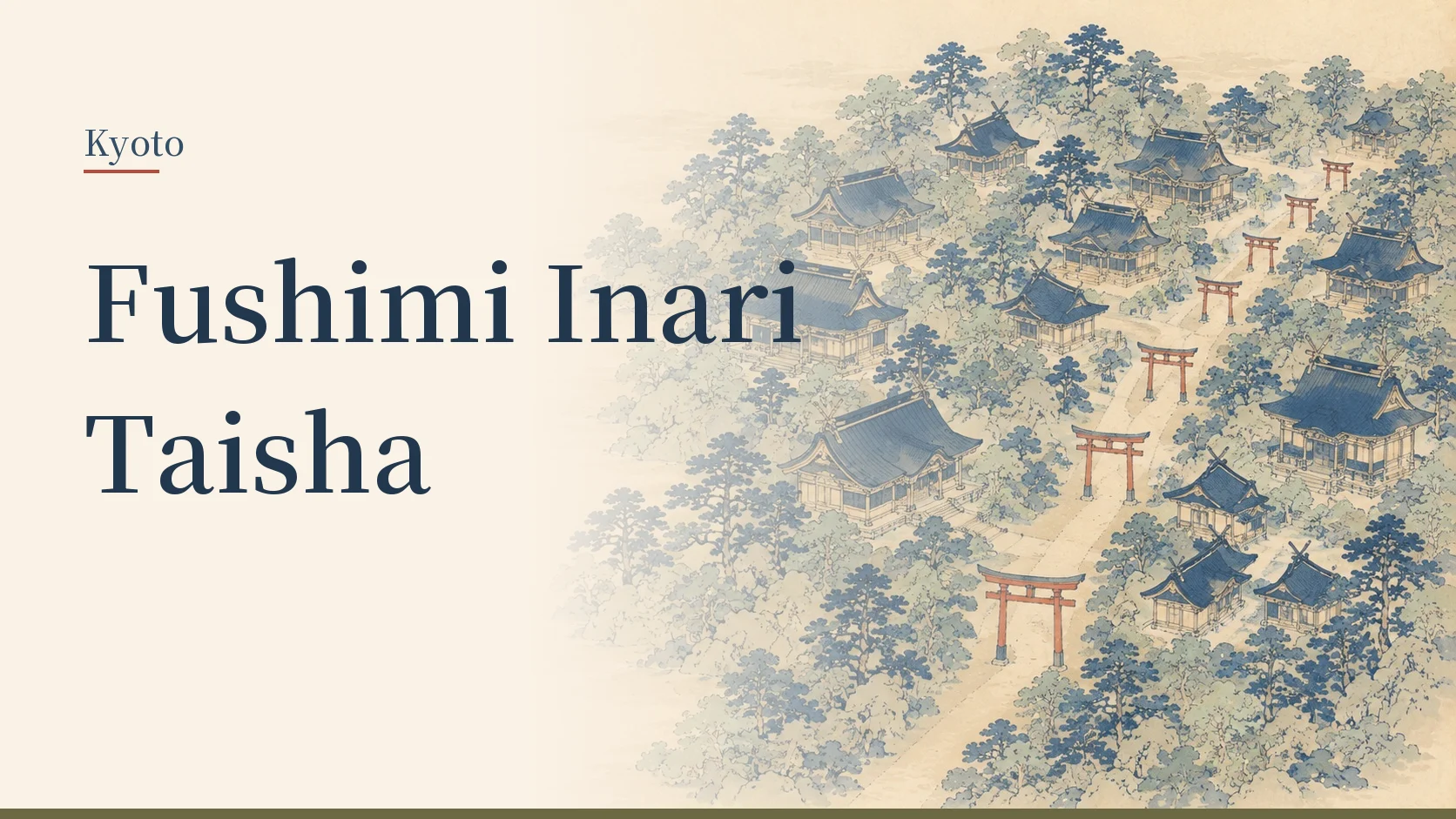
Fushimi Inari Taisha is the head shrine of around 30,000 Inari shrines in Japan, and one of the easiest major sites in Kyoto to reach: Inari Station on the JR Nara Line is five minutes from Kyoto Station, and the approach starts outside the ticket gate. Entry is free, there is no ticket window, and you do not have to climb to the summit to see the famous gates. A visit can take anything from twenty minutes to half a day, depending on how far up Mount Inari you walk.
What you’ll learn
- What the shrine is, which kami are enshrined there, and how a shrine differs from a temple
- How to get there from Kyoto Station, and how long the mountain walk really takes
- Why the gates are vermilion, and why there are thousands of them
- Which practical details the shrine publishes officially — and which it does not
What Is Fushimi Inari Taisha? The Head of 30,000 Inari Shrines
Fushimi Inari Taisha is a Shinto shrine in southern Kyoto, enshrined in 711 and dedicated to Inari Okami, the kami of rice, harvest and prosperity. It is the head shrine of about 30,000 Inari shrines across Japan, and its precinct covers the whole of Mount Inari — roughly 870,000 square metres.
The shrine dates its enshrinement precisely: the first Day of the Horse in the second month of 711, during the Nara period. It marked 1,300 years since that date in 2011. The name itself comes from an older story. A surviving fragment of the Yamashiro no Kuni Fudoki, an eighth-century provincial record, explains the name as ine ga natta — “the rice grew” — and the shrine still gives this as the origin of the word Inari.
One distinction is worth settling before you go. A jinja (shrine) is Shinto; a temple is Buddhist. At a shrine you bow twice, clap twice, and bow once more; at a temple you do not clap at all. Fushimi Inari Taisha is a shrine, and the head shrine of the Inari shrines, so the two claps belong here.
The Five Kami Enshrined Here
Five kami are enshrined in the main hall, not one, and English-language guides often shorten them to “Inari” alone.
The shrine treats the five names as aspects of a single divine presence, Inari Okami, rather than as five separate gods. All five sit in one building, an Important Cultural Property, in fixed positions:
| Kami | Hall | Position in the main hall |
|---|---|---|
| Uka-no-Mitama-no-Okami | Shimo-no-Yashiro (lower) | Centre |
| Sada-hiko-no-Okami | Naka-no-Yashiro (middle) | North |
| Omiya-no-Me-no-Okami | Kami-no-Yashiro (upper) | South |
| Tanaka-no-Okami | Tanaka-no-Yashiro | Far north |
| Shi-no-Okami | Shi-no-Okami-no-Yashiro | Far south |
The foxes you see everywhere are not the deity. The shrine describes them as kenzoku — messengers of Inari Okami — and adds that they are not the foxes of the hills, and are no more visible to us than the kami themselves. The stone pairs at the gates are representations, not portraits.
The Senbon Torii: Vermilion, Donations, and Why There Are So Many
The gates multiplied because people paid for them: each one is a thank-you offering for a wish that “passed through”.
The shrine explains the custom directly. A wish that tooru — passes, gets through — is thanked with a torii, and the practice spread from the Edo period onwards. That is why the gates keep arriving. Walk back down any tunnel and read the reverse of the gates: each carries the name of the company or person who donated it and the date it was raised.
The vermilion has its own reading. Red has long been used on palaces and religious buildings as a colour that resists malign force; at this shrine specifically, it is explained as the colour of Inari Okami’s abundance.
Two things often get merged in English. The Senbon Torii — “thousand torii” — refers to the two dense parallel tunnels just behind the main hall, which take only a few minutes to walk. The gates continue in looser groups for the whole mountain circuit, and that is a different, much longer walk. The shrine itself puts the total at around 10,000 gateways of all sizes along the mountain paths, and gates are added and replaced continuously.
How to Get to Fushimi Inari Taisha
Take the JR Nara Line from Kyoto Station to Inari Station: five minutes, and the shrine approach begins directly outside the ticket gate.
Three routes are official:
- JR Nara Line — Inari Station. Five minutes from Kyoto Station; the shrine is immediately outside.
- Keihan Main Line — Fushimi-Inari Station. A five-minute walk east.
- City bus, route South 5 — Inari Taisha-mae. A seven-minute walk east.
Do not plan on driving. The shrine asks visitors to use public transport and warns that the roads around its car park become badly congested; the precinct car park is closed entirely from 30 December to 6 January.
Walking the Senbon Torii and Mount Inari
You do not have to reach the summit: the walk divides into three natural stopping points — the Senbon Torii at twenty minutes, Yotsutsuji at about an hour, and the summit at two hours or more.
Deciding which of the three you are doing before you start is what keeps the visit pleasant.
The main hall and the Senbon Torii only. Twenty to thirty minutes. You see the main hall, the two dense gate tunnels, and the Okusha Hohaisho behind them. This is the photograph everyone comes for.
Up to Yotsutsuji and back. Roughly 45 minutes to an hour of steady stair-climbing from the main hall. Yotsutsuji is a four-way junction partway up with an open view west over southern Kyoto, and there are teahouses. It is the practical turnaround for anyone who does not want the full circuit.
The full circuit to Ichinomine, the summit. Two hours or more for the round trip, over a loop of about four kilometres. The shrine gives Inariyama as 233 metres above sea level, the southernmost of the thirty-six peaks of Higashiyama, with three summits — Sannomine, Ninomine and Ichinomine. The path is almost entirely stone steps. Above Yotsutsuji the crowds thin, and the gates give way in places to otsuka, stones on which worshippers have engraved their own names for Inari Okami. The shrine counts over 10,000 of them, and they are the part of Fushimi Inari that almost no guidebook shows.
Two practical notes. The shrine’s published list of prohibited acts includes discarding rubbish, bottles and cans, and eating or drinking outside the marked rest areas — including eating while you walk — so plan to sit down for food and to carry your rubbish back out. Separately, visitors report that the teahouses near the top generally take cash only.
Best Time to Visit: Early Morning, Late Afternoon and After Dark
Visitors consistently report that the quiet hours are before about 8am and after about 4pm, with the crowd heaviest through the middle of the day.
This is the one piece of planning that changes the visit most, and it costs nothing. Travellers describe the crowd building from around ten in the morning and holding until mid-afternoon, especially at weekends, with the two gate tunnels slowing to a queue. Arrive early and the same tunnels are quiet enough to hear your own footsteps.
The shrine is unusual in another way: it publishes no opening or closing time for the precinct, and there is no ticket gate. That is not a guarantee of access, and paths on the mountain can be closed in bad weather, but an early or late visit is possible here in a way it is not at ticketed sites. If you go up after dark, go only as far as you are comfortable descending stone steps, and take a torch.
The Five-Element Classification: Why Fushimi Inari Is Earth
Kannavi classifies every shrine into one of five elements using a fixed rule set, and publishes the full working. Fushimi Inari Taisha scores as Earth.
This is not fortune-telling. The classifier reads three verifiable layers — the enshrined kami and their divine category, the geography of the site, and the shrine’s lineage — and assigns points to each. We publish the score sheet so that you can disagree with it.
| Layer | What was matched | Category | Element | Points |
|---|---|---|---|---|
| 1. Enshrined kami | Uka-no-Mitama-no-Okami (principal) | Rice, food and harvest | Earth | 60 |
| 2. Geography | Sited on Mount Inari, with the mountain itself as the object of worship | Mountain siting | Earth | 25 |
| 3. Lineage | Inari shrine | Inari lineage | Earth | 15 |
| Total | Earth | 100 | ||
Water, Fire, Wind and Void all score zero, so there is no secondary element here — an unusually clean result. One honest gap is worth showing: Sada-hiko-no-Okami is widely identified with Sarutahiko-no-Okami, a Wind-category kami of roads and guidance, but our classifier matches on the name Sarutahiko and so awarded no points for that hall. The rule was not bent to fit. In the Kannavi scheme the five elements sit in a cycle — Earth, Fire, Void, Water, Wind — in which each element shifts the flow of the next rather than opposing it.
Etiquette, Costs and What the Shrine Does Not Publish
Entry is free, the etiquette at the hall is two bows, two claps and one bow, and the shrine publishes no precinct hours, no office hours and no goshuin amount.
At the temizuya, the covered basin near the entrance, rinse your left hand, then your right, then pour a little water into your left hand to rinse your mouth. At the main hall, put a coin in the saisen box, bow twice, clap twice, make your prayer, and bow once more. Money given at a shrine is hatsuho-ryo — an offering, originally of the season’s first rice — not a price, which is why amulets and a goshuin are described as given rather than sold.
Fushimi Inari publishes less than most large shrines, and it is more useful to say so than to guess.
| Detail | What the shrine states officially |
|---|---|
| Admission | Free; no ticket gate |
| Formal prayer rites (gokito) | 8:30–16:30, reception until about 16:00, at the desk to the left of the main hall |
| Precinct area | About 870,000 m², covering Mount Inari |
| Car park | Public transport requested; precinct car park closed 30 Dec – 6 Jan |
| Torii gateways | Around 10,000 of all sizes along the mountain paths |
| Precinct opening and closing times | No hours published on the official site |
| Shrine office hours | No hours published on the official site |
| Goshuin offering amount | No amount published on the official site |
Visitor reports put the main-hall office at roughly 8:00–18:00 and the Okusha office at roughly 8:30–16:00, with a further office higher up the mountain keeping shorter hours. Treat those as approximate and ask on the day. If you are collecting seals, our guide to the goshuin and how to ask for one covers the etiquette in full.
Frequently Asked Questions
These are the six questions first-time visitors ask most often, answered from the shrine’s own statements where it makes them.
Q. How long does it take to walk to the top of Mount Inari?
A. Allow two hours or more for the round trip from the main hall to Ichinomine, the summit at around 233 metres, on a loop of roughly four kilometres. Almost all of it is stone steps. If you only want the famous gate tunnels, twenty to thirty minutes is enough; Yotsutsuji and back takes about an hour.
Q. Is Fushimi Inari Taisha free to enter?
A. Yes, and there is no ticket gate. Custom is to put a coin in the offering box before you pray — a five-yen or hundred-yen coin is normal. Amulets, votive tablets and a goshuin are given in return for an offering, hatsuho-ryo, rather than sold at a fixed price. The one price list the shrine does publish is for formal prayer rites, which begin at ¥5,000 (approx. US$34).
Q. What time does Fushimi Inari Taisha open and close?
A. The official site publishes no opening or closing times for the precinct. The one time it does state is for formal prayer rites: 8:30 to 16:30, with reception closing around 16:00. Shrine offices and the teahouses on the mountain keep their own hours, which are also unpublished, so any figure you find online for them is a visitor report rather than a shrine statement.
Q. Why are there so many torii gates?
A. Because each one is a thank-you. The shrine explains that a wish which passes through is thanked with a donated gate, a custom that spread from the Edo period onwards and has never stopped. The reverse of every gate carries the donor’s name and the date, so the tunnels double as a directory of Japanese businesses. The shrine puts the current total at around 10,000 gateways of all sizes.
Q. Is Fushimi Inari a shrine or a temple?
A. A shrine — Shinto, not Buddhist. The practical difference is what you do at the hall: at a shrine you bow twice, clap twice, and bow once; at a temple you press your hands together and do not clap. The taisha in the name marks it as a head shrine, in this case of about 30,000 Inari shrines nationwide.
Q. Are there rules I should know before I go?
A. The shrine publishes a list of prohibited acts, and the ones that catch visitors out are practical rather than religious. Eating and drinking are allowed only in the marked rest areas, which rules out eating while walking; rubbish must be carried out; drones are banned, as is commercial photography; and you are asked not to block narrow paths while taking photographs. Pets other than assistance dogs are not admitted.
Summary
Fushimi Inari Taisha is free, five minutes from Kyoto Station, and worth as much of Mount Inari as you feel like walking.
- Enshrined in 711, dedicated to Inari Okami, and the head shrine of about 30,000 Inari shrines; the precinct is the whole of Mount Inari, roughly 870,000 m².
- Five minutes from Kyoto Station on the JR Nara Line, with the approach directly outside Inari Station. Entry is free.
- Twenty minutes gets you the Senbon Torii; an hour gets you Yotsutsuji and the view; two hours or more gets you the summit.
- Visitors report the quiet hours as before 8am and after 4pm; the shrine publishes no precinct opening or closing time.
- In the Kannavi classification the shrine scores 100 points as Earth, with the full working shown above.
Next: read our guide to goshuin, the seal and calligraphy given as a record of your visit, or return to the English guide to Japanese shrines.
Fushimi Inari is loudest at the bottom and quietest at the top. Somewhere above Yotsutsuji the crowd thins, the gates loosen into ones and twos, and the stones with their private names for a harvest deity start appearing between the trees. Thirteen centuries of people saying thank you, one gate at a time, still going up the hill.