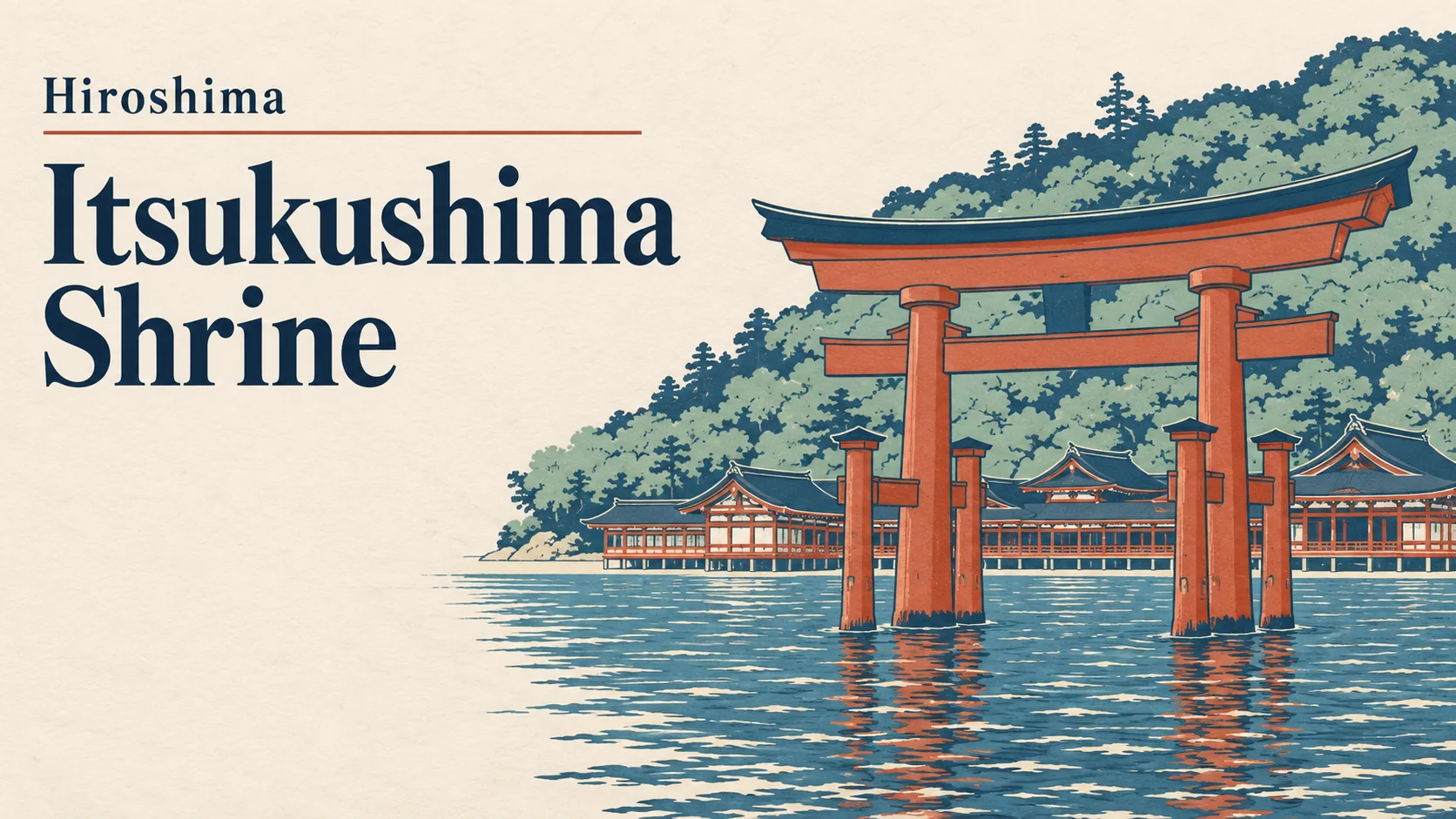
Hiroshima’s Itsukushima Shrine is the one built out over the sea, with a vermilion gate standing in the water in front of it. Whether you see it floating or walk out to the foot of that gate is decided by the tide on the day you go — and the two numbers that decide it are published in advance. Everything else, the trains and the ferry and the ¥300 at the entrance, is easy once you have picked your hour.
What you’ll learn
- The two tide levels that decide what you will actually see, and where to look them up
- How to get there from Hiroshima Station, what it costs, and which of the two ferries to take
- The official hours and fees, and what is under scaffolding through 2026 and 2027
- Who is enshrined here, how to worship, and why our classifier scores this shrine 130 as Water
What Is Itsukushima Shrine?
Itsukushima Shrine is a Shinto shrine on the island of Miyajima in Hiroshima Prefecture, Japan, built out over a tidal bay. Its halls stand on piles above the water, and its great torii stands in the sea in front of them at high tide. Founded by tradition in 593 and rebuilt by Taira no Kiyomori in 1168, it has been a UNESCO World Heritage Site since 1996.
The shrine’s own account is more specific than the usual summary. Saeki no Kuramoto, who governed the island, received an oracle, was led around the coast by a divine crow, and chose to build “at this place where the tide ebbs and flows” — in 593, the year Empress Suiko took the throne. The buildings you walk through today follow the 1168 rebuilding, in shinden-zukuri, the style used for the residences of Heian-period nobles rather than for shrines. That is why the place reads like a mansion laid over water instead of a compound behind a wall.
Miyajima or Itsukushima? The Island and the Shrine
They are the same island: Itsukushima is its formal name, Miyajima — “shrine island” — is the everyday one, and both are in current use.
So “Miyajima Itsukushima” is not two places but one, named twice. It matters when you buy tickets: trains and ferries are signed for Miyajima and Miyajimaguchi, while the shrine, its address and the World Heritage listing all say Itsukushima.
Why You See “Itsukushima Jinja Shrine”
Because jinja is simply the Japanese word for shrine, so that phrase says “shrine” twice.
The Japanese name is Itsukushima Jinja; English sources translate the second half and get Itsukushima Shrine, signage sometimes keeps both, and the doubled form sticks. The shrine’s own English site uses Itsukushima Shrine. You will meet the pattern across Japan — jingu and taisha are shrine titles too, which is why “Meiji Jingu Shrine” and “Fushimi Inari Taisha Shrine” also circulate.
Getting to Itsukushima Shrine from Hiroshima
From Hiroshima Station it is about 28 minutes by JR to Miyajimaguchi, a 10-minute ferry, and a 10-minute walk.
The train and the boat connect directly: the ferry terminal is reached from the JR Miyajimaguchi ticket gate through an underpass, so you do not cross a road. From the pier on the island, turn right and follow the shore. The shops and the deer start immediately; the shrine entrance is at the far end.
| Leg | Time | Adult fare |
|---|---|---|
| Hiroshima Station → Miyajimaguchi (JR Sanyo Line) | about 28 min | ¥420 (approx. US$2.80), or free on a Japan Rail Pass |
| Miyajimaguchi → Miyajima (ferry) | about 10 min | ¥200 (approx. US$1.35), or free on a Japan Rail Pass with the JR ferry |
| Miyajima Visitor Tax, charged on entering the island | — | ¥100 (approx. US$0.70) |
| Miyajima pier → shrine entrance (on foot) | about 10 min | — |
Two practical notes. The shrine states plainly that it has no car park, so leave the car at Miyajimaguchi. And the deer on the walk are wild animals under a city management plan built around a ban on feeding them; they will still go through an open bag, so keep tickets and paper maps out of reach.
Which Ferry, and the ¥100 Visitor Tax
Two companies run the same crossing in the same time for the same ¥200, and only one of them detours past the great torii.
JR West Miyajima Ferry runs what it calls the Otorii service: departures from Miyajimaguchi between 9:10 a.m. and 4:10 p.m. swing close to the great torii on the way over, and the view is off the right-hand side of the boat. Miyajima Matsudai Kisen, the other operator, does not. Inside those hours, that is the whole difference between the two.
The Miyajima Visitor Tax has applied since October 1, 2023: ¥100 per visit, or ¥500 for a year, collected by both ferry operators on top of the fare as you enter the island. Preschool children are exempt, as are school trips with a certificate and holders of Japanese disability certificates. A Japan Rail Pass covers the JR ferry but not the tax, which you pay at the counter or the machine.
Tides: What 250 cm and 100 cm Mean for Your Visit
Two figures decide your visit: from about 250 cm the shrine appears to float, and below about 100 cm you can walk to the torii.
Those figures come from the Miyajima Tourist Association, which publishes monthly and annual tide tables for exactly this purpose. They matter before you book a train, because the two things the shrine is famous for cannot happen at once: at high water the halls stand in the sea, and at low water the bay in front of them is a flat of wet sand you can cross on foot.
The association calls these rough guides, and gives a worked example that makes the point better than any warning: on a day when low water bottoms out at 146 cm, low tide is not low enough and you will not reach the foot of the gate. “Low tide” on a forecast is not the same as “under 100 cm.” Check the number for your date, not the label.
Planning One Day Around the Tide
Look up the tide table for your date first, then set the order of your day around it rather than the other way round.
The island is small enough that the order is the only real decision, so put the shrine where the tide puts it and fit the rest around it.
| What the tide table says for your day | What to do |
|---|---|
| 250 cm or more in the morning | Go straight to the shrine off the boat, then spend the afternoon on Mount Misen and in the town |
| 250 cm or more in the late afternoon | Ropeway and town first, shrine last, and stay after it to watch the water come up |
| 100 cm or less around the middle of the day | Arrive for low water and walk out to the gate first — the sand is the part with a deadline |
| Neither threshold is reached all day | Go whenever suits; the corridors are walkable at any level and the gate is visible either way |
The Great Torii: 60 Tonnes That Stands on Its Own Weight
The great torii is not fixed to the seabed at all: it weighs about 60 tonnes and holds its position by weight alone.
The Miyajima Tourist Association’s published figures put it at 16.6 m high, with a ridge 24.2 m long and main pillars 9.9 m around. The pillars are single natural camphor trunks, chosen for durability in salt water, and the present gate — the ninth in a line running back to the Heian period — was rebuilt in 1875. Its feet are not buried. They rest on the seabed over a bed of about a thousand short piles, and the box-shaped beam across the top is packed with roughly four tonnes of stones for ballast. The gate resists the sea by being heavy and by being allowed to shift, not by being anchored.
One correction if you have been reading older English pages: the gate is not under wraps. The restoration that hid it behind scaffolding from June 2019 was completed in December 2022, and the shrine records it as finished. Photographs of the sheeting still circulate; they are out of date.
Hours, Admission and the 2026 Restoration Work
The shrine opens at 6:30 a.m. every day of the year, and closes somewhere between 5:00 and 6:30 p.m. depending on the season. Entry to the shrine itself is ¥300 for an adult, or ¥500 on a combined ticket with the treasure hall.
Opening early is worth knowing about: the gate is open an hour and a half before most of the island’s shops and two hours before the treasure hall, so the first hour is the quiet one whatever the tide is doing.
| Period | Hours |
|---|---|
| January 1 | 12:00 a.m. – 6:30 p.m. |
| January 2–3 | 6:30 a.m. – 6:30 p.m. |
| January 4 – end of February | 6:30 a.m. – 5:30 p.m. |
| March 1 – October 14 | 6:30 a.m. – 6:00 p.m. |
| October 15 – November 30 | 6:30 a.m. – 5:30 p.m. |
| December | 6:30 a.m. – 5:00 p.m. |
| Ticket | Adult | High school | Elementary / junior high |
|---|---|---|---|
| Itsukushima Shrine | ¥300 | ¥200 | ¥100 |
| Treasure Hall | ¥300 | ¥200 | ¥100 |
| Combined ticket | ¥500 | ¥300 | ¥150 |
| Senjokaku (Hokoku Shrine) | ¥100 | — | ¥50 |
The combined ticket is only sold at the shrine entrance, so buy it there if you intend to see the treasure hall as well. The treasure hall keeps its own hours, 8:00 a.m. to 5:00 p.m., and Senjokaku 8:30 a.m. to 4:30 p.m.
Work is in progress on the site, and the shrine publishes the schedule itself. Its current notice lists structural reinforcement of the East Corridor — the walkway visitors go along — from April 2024 to December 2026, and restoration of the five-storied pagoda from January 2025 to November 20, 2027. Conservation dates move, so treat those as the shrine’s current plan, not a promise. The notice lists no closure of the shrine itself, and the great torii is not on it at all.
The Three Deities, and How to Worship Here
Three deities are enshrined at Itsukushima: Ichikishimahime-no-mikoto, Tagorihime-no-mikoto and Tagitsuhime-no-mikoto, the three goddesses of Munakata.
English guides often shorten this to one goddess, or drop it entirely. By the shrine’s own account the three were born when Amaterasu Omikami, goddess of the sun, and her brother Susanoo-no-mikoto made a pledge on the Celestial Plain using a jewel and a sword, and they have been venerated since ancient times as deities who safeguard the imperial house, guard the nation and protect people at sea. That last role is what the site is built around: a shrine to sea deities, put where the tide reaches it.
Worship is the ordinary Shinto form — bow twice, clap twice, bow once, at the offering box in front of the main hall. There is no fixed amount for the offering.
One warning comes from the shrine itself, and it is practical. The floorboards of the corridors have deliberate gaps cut between them to relieve the pressure of the sea pushing up from below at high tide; the shrine asks visitors to wear comfortable shoes and notes that high heels get caught in them. It is the clearest sign of what the building is: a structure designed to let the sea through rather than keep it out.
Shrine or Temple? What Changes at the Front
Itsukushima is a Shinto shrine, not a Buddhist temple, and the practical difference shows in one thing: whether you clap.
At a Shinto shrine you bow twice, clap twice and bow once. At a Buddhist temple you press your hands together and do not clap. The quick test on the way in is the gateway: a torii marks a shrine. Miyajima has both traditions side by side — Daishoin, a temple, is a short climb above the shrine — so it is a fair thing to get wrong, but the clapping belongs to the shrine.
Goshuin at Itsukushima
The goshuin desk sits inside the paid area near the main hall, so you need an admission ticket before you can ask for one.
A goshuin is a seal and calligraphy written into a goshuincho, a book kept for the purpose, as a record that you came and paid your respects — not a stamp-rally souvenir. Itsukushima Shrine does not publish a fee for one on its official site, so bring cash and expect the offering to be a few hundred yen. Our guide to goshuin covers how to ask for one.
Five Elements Classification: Why Itsukushima Scores 130 as Water
Itsukushima scores as Water with 130 points, because its deities, its site and its lineage all point the same way under our published rule set.
Kannavi classifies every shrine into one of five elements — Earth, Water, Fire, Wind and Void. This is our classification, not a teaching of the shrine and not a fortune. It reads three checkable layers — the deities enshrined and their category of divinity, the geography of the site, and the shrine’s lineage — each worth fixed points, and we print the score sheet so you can disagree with it line by line.
| Layer | What was matched | Category | Element | Points |
|---|---|---|---|---|
| 1. Enshrined deity | Ichikishimahime-no-mikoto (principal) | Deities of the sea and of voyages | Water | 60 |
| 1. Enshrined deity | Tagorihime-no-mikoto (joined) | Same category | Water | 15 |
| 1. Enshrined deity | Tagitsuhime-no-mikoto (joined) | Same category | Water | 15 |
| 2. Geography | Coast, island, headland | Sea siting | Water | 25 |
| 3. Lineage | Munakata / Itsukushima / Benten line | Lineage match | Water | 15 |
| Total | Water | 130 | ||
Earth, Fire, Wind and Void all score zero, so there is no secondary element, and 130 is as high as the rule set goes for one element: 60 for the principal deity, a capped 30 for those joined to it, 25 for geography and 15 for lineage. Every layer points the same way, which is unusual — Meiji Jingu scores 100 as Void and Fushimi Inari Taisha 100 as Earth, both with a layer left empty.
In the Kannavi scheme the five elements sit in a cycle — Earth, Fire, Void, Water, Wind — in which each shifts the flow of the next rather than opposing it. Water sits close to Wind and Void; Earth and Fire shift its flow instead. And the twenty-five points for geography here are as literal as scoring gets: the building is in the water.
Frequently Asked Questions
Q. Is Itsukushima Shrine the same as Miyajima?
A. Miyajima is the island, Itsukushima Shrine is the shrine on it, and Itsukushima is also the island’s formal name. Both names are correct, which is why timetables and guidebooks disagree without either being wrong.
Q. What time should I go to see the shrine floating?
A. Whenever the day’s tide reaches about 250 cm. That is a clock time, not a time of day: it shifts by roughly 50 minutes each day and can fall at night, so two consecutive dates can give completely different visits.
Q. How do I get to Itsukushima Shrine from Hiroshima, and what does it cost?
A. JR to Miyajimaguchi, ferry, walk — about 50 minutes each way. Paying cash it is ¥420 for the train, ¥200 for the ferry and ¥100 visitor tax, then ¥300 at the shrine. A Japan Rail Pass covers the train and the JR ferry but not the tax, which you pay at the pier.
Q. Is the great torii still under scaffolding?
A. No. The restoration ran from June 2019 to December 2022 and is finished. Photographs of the covered gate still circulate online; they show the work, not the current state.
Q. Is anything closed or covered in 2026?
A. The shrine’s own construction notice lists no closure of the shrine. It does list the East Corridor under reinforcement to December 2026 and the five-storied pagoda under restoration to November 2027, so expect scaffolding in your photographs.
Q. Can I walk back through for a second look?
A. Not really. The shrine sets a route through the building — in past the reception, along the East Corridor to the main hall, then out by the West Corridor and the arched bridge — so plan to see things on the way through rather than doubling back.
Q. How long should I allow, and what closes first?
A. Half an hour for the shrine itself, and longer for the island. Note the order things shut: the treasure hall closes at 5:00 p.m. and Senjokaku at 4:30 p.m., both before the shrine does, so do those first and leave the shrine for last.
Summary
Itsukushima Shrine is a half-hour walk through a building standing in the sea, and the sea decides what you get.
- Check the tide table first: about 250 cm and above for the floating view, about 100 cm and below to walk to the great torii. “Low tide” is not the same as under 100 cm.
- Hiroshima Station to the shrine is roughly 50 minutes door to door — JR to Miyajimaguchi, ferry, walk — at ¥420 plus ¥200 plus the ¥100 visitor tax, or ¥100 with a Japan Rail Pass.
- Open from 6:30 a.m. every day; ¥300 for adults, ¥500 with the treasure hall. No car park on the island.
- The great torii is 60 tonnes standing on its own weight over a bed of piles, and its restoration finished in December 2022.
- Three sea deities are enshrined here, and in the Kannavi classification the shrine scores 130 as Water, with every layer of the working agreeing.
Next: read our guide to goshuin, compare it with Fushimi Inari Taisha, or return to the English guide to Japanese shrines.
The oracle that chose this site named a place where the tide ebbs and flows, and the builders took that literally. They cut gaps into the floor so the sea could push through, set a gate in the water and left it unanchored, and accepted that the shrine would be half-submerged for part of every day. Nothing here was built to resist the water. It was built to be arranged around it — which is why the hour you arrive changes the building.