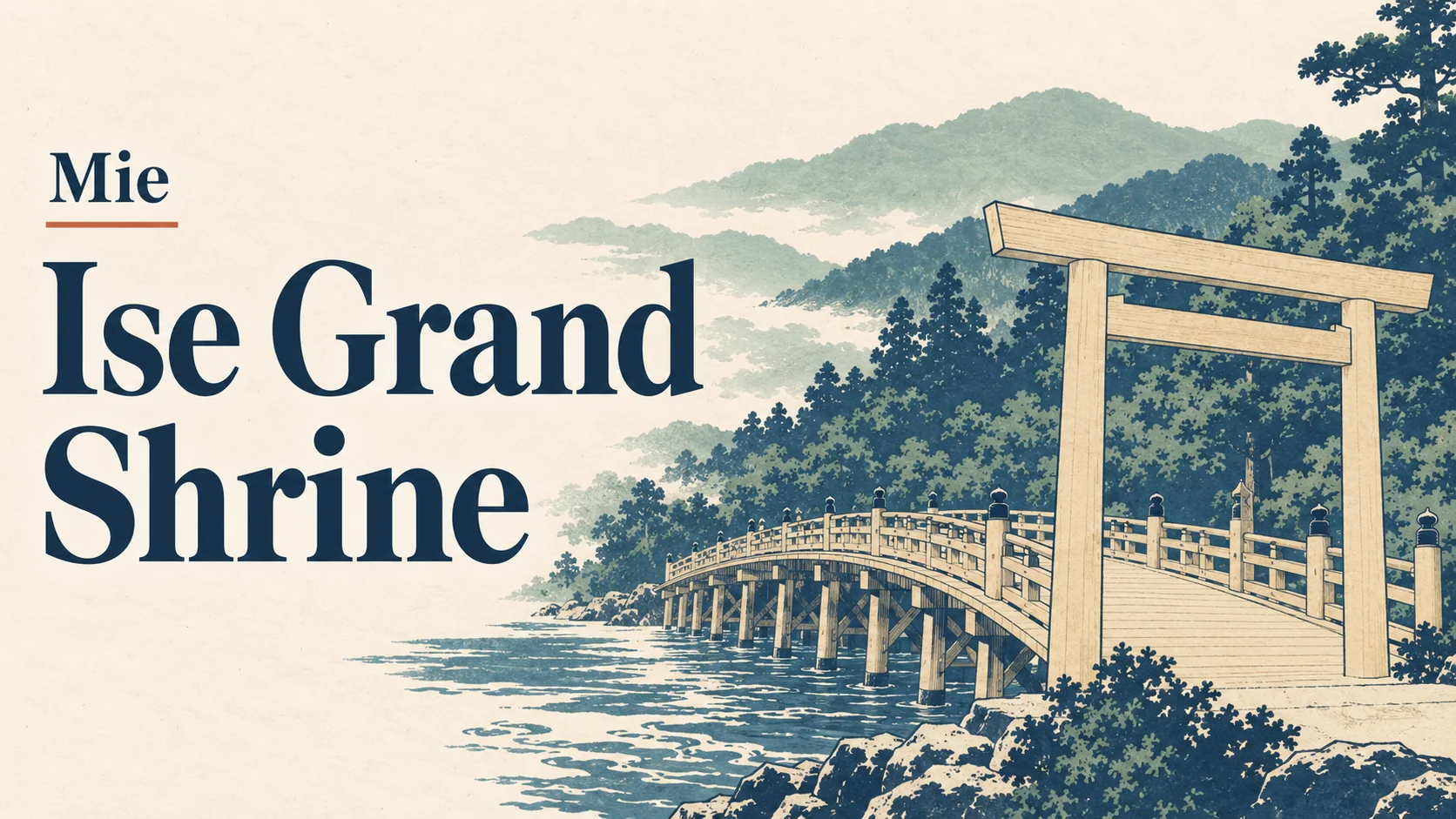
Ise Grand Shrine is not one building but 125 shrines in and around the city of Ise, Mie Prefecture, centered on two: Naiku, the Inner Shrine of the sun goddess Amaterasu, and Geku, the Outer Shrine of Toyo’uke, who provides her food. By long custom you visit Geku first. The gates open at 5 a.m. every day of the year, and the closing time moves with the month, from 5 p.m. late in the year to 7 p.m. in summer. It is a Shinto shrine, not a Buddhist temple.
What you’ll learn
- What Ise Grand Shrine is, why it is also called Ise Jingu, and what Naiku and Geku are
- Train times from Nagoya, Osaka and Kyoto, and how to get between the two shrines
- Opening hours by month, the visiting order, how long to allow, and where to get a goshuin
- Why the shrine is rebuilt every 20 years, where the 2033 rebuilding stands now, and why our classifier scores Naiku as Fire and Geku as Earth
What Is Ise Grand Shrine?
Ise Grand Shrine, officially just Jingu, is Japan’s most important Shinto shrine: a group of 125 shrines in Ise, Mie Prefecture, centered on Naiku, the Inner Shrine of Amaterasu, and Geku, the Outer Shrine of Toyo’uke, goddess of food.
The shrine’s own English pages name the two main shrines Kotaijingu (Naiku), dedicated to Amaterasu-Omikami, and Toyo’uke-daijingu (Geku), dedicated to Toyo’uke-no-Omikami. Toyo’uke, in the shrine’s words, joins Amaterasu as “her provider of companionship and sacred foods,” and is revered as the guardian of cloth, food and shelter. Inside Naiku’s main sanctuary is the Holy Mirror, the symbol of Amaterasu.
Both founding dates are shrine tradition. Naiku dates its enshrinement to the 26th year of Emperor Suinin, given as 4 BC; Geku dates its own to 478, following ninth-century shrine records. The shrine itself says it probably grew to the scale it has today under the emperors Tenmu and Jito, in the late seventh century.
Japan’s national association of shrines, Jinja Honcho, treats Ise as a special shrine it looks up to as its head. Visitors are many and rising. Ise City counted 7,725,414 visits to the two shrines in 2025, among them 114,750 from abroad, the most since its records began in 1989. The January–August 2026 preliminary total was 5,910,900, 113.3% of the same months a year earlier.
Ise Jingu, Ise Shrine or “Ise Temple”?
Ise Jingu, Ise Shrine and Ise Grand Shrine are one place; “Jingu” is the shrine’s formal name, and it already means a shrine.
The Japanese title jingu, a grade of shrine name, is reserved for shrines with especially deep ties to the imperial family, according to Jinja Honcho. That is why “Ise Jingu Shrine” says shrine twice, and why Tokyo’s Meiji Jingu, dedicated to an emperor, carries the same word. Search for “Ise temple” in English and the results are this shrine. Ise is a Shinto shrine, not a Buddhist temple, and at the front you clap.
125 Shrines: Naiku, Geku and the Ones Inside Their Grounds
By the shrine’s count, the 125 are two main shrines, 14 betsugu (shrines ranked just below them), 43 sessha, 24 massha and 42 shokansha, smaller shrines in descending rank.
Ten betsugu belong to Naiku and four to Geku. Five of them stand inside the grounds you will walk through anyway, and nine are elsewhere in Ise and the surrounding towns. Taga-no-miya, Geku’s first betsugu, sits on a low hill at the top of 98 stone steps.
| Shrine | Where | Enshrines | Goshuin |
|---|---|---|---|
| Naiku (Kotaijingu) | Naiku grounds | Amaterasu-Omikami | Yes, at Naiku’s Kaguraden |
| Aramatsuri-no-miya | Naiku grounds | The rough spirit (aramitama) of Amaterasu | No |
| Kazahinomi-no-miya | Naiku grounds | The wind deities Shinatsuhiko and Shinatobe | No |
| Geku (Toyo’uke-daijingu) | Geku grounds | Toyo’uke-no-Omikami | Yes, at Geku’s Kaguraden |
| Taga-no-miya | Geku grounds, up 98 steps | The rough spirit of Toyo’uke | No |
| Tsuchi-no-miya | Geku grounds | Otsuchi-no-mioya-no-kami, deity of the land | No |
| Kaze-no-miya | Geku grounds | The wind deities Shinatsuhiko and Shinatobe | No |
Getting to Ise Grand Shrine from Nagoya, Osaka and Kyoto
Ise Grand Shrine is in Ise, Mie Prefecture: by Kintetsu train about 1 hour 20 minutes from Nagoya, 1 hour 50 from Osaka-Uehommachi and 2 hours 10 from Kyoto, according to the shrine’s access page.
By train you arrive closest to Geku, a short walk from Iseshi Station. The shrine’s route maps give these times to the Ise stations; there is no direct figure from Tokyo, so from Tokyo travel to Nagoya and change there. From Osaka, the Kintetsu line leaves from Osaka-Uehommachi, not from the JR stations.
| From | Line | Time |
|---|---|---|
| Kintetsu Nagoya Station | Kintetsu to Iseshi or Ujiyamada | about 1 hr 20 min |
| Nagoya Station | JR to Iseshi | about 1 hr 40 min |
| Osaka-Uehommachi Station | Kintetsu | about 1 hr 50 min |
| Kyoto Station | Kintetsu | about 2 hr 10 min |
| Iseshi Station (Kintetsu, JR) | Walk to Geku | about 5 min |
| Ujiyamada Station (Kintetsu) | Walk to Geku | about 10 min |
| Isuzugawa Station (Kintetsu) | Bus or taxi to Naiku / walk | about 6 min / about 30 min |
The shrine’s English access page gives the addresses as 1 Ujitachi-cho, Ise city, Mie Pref. for Naiku and 279 Toyokawa-cho for Geku. Around New Year and the long holidays, park-and-ride shuttle buses run from temporary car parks, so driving in on those days is not the shortcut it looks.
Between Geku and Naiku: Bus, Taxi or a 50-Minute Walk
Naiku is about 10 minutes from Geku by bus or taxi, or about 50 minutes on foot, by the shrine’s access map.
The shrine lists Mie Kotsu’s Geku–Naiku Loop Line (Route 51 or 55) and the CAN Bus sightseeing loop. On Mie Kotsu’s own timetable search, the ride from the Gekumae stop to Naikumae costs ¥520 for an adult and takes 8 to 17 minutes depending on the service, so the shrine’s “about 10 minutes” is the fast end.
Hours, Visiting Order and How Long to Allow
Both shrines open at 5 a.m. and close at 5, 6 or 7 p.m. by month; visit Geku first, and allow about 10 minutes’ walk to Geku’s main sanctuary and 20 to Naiku’s.
The closing time is 6 p.m. from January to April and in September, 7 p.m. from May to August, and 5 p.m. from October to December, and the hours change at New Year. On order, the shrine is relaxed. “There is no rule,” its Japanese Q&A page says, but visiting Geku before Naiku is the old custom, matching the rites, which are held at Geku first. Allow about 10 minutes from Geku’s entrance to its main sanctuary and about 20 minutes from Naiku’s Uji Bridge to its own, each way, before any detours to the betsugu. The shrine does not post an admission charge; what costs money is formal prayer, amulets and the Sengukan museum.
| What | Hours | Note |
|---|---|---|
| Grounds (January–April, September) | 5:00 a.m. – 6:00 p.m. | Changed at New Year |
| Grounds (May–August) | 5:00 a.m. – 7:00 p.m. | |
| Grounds (October–December) | 5:00 a.m. – 5:00 p.m. | |
| Amulet office at the Kaguraden | 6:00 a.m. – 6:00 p.m. | Until 5:00 p.m. October–December |
| Formal prayer (gokito) | Reception 8:00 a.m. – 3:30 p.m. | No reservations. Food offering (mike) from ¥5,000; sacred dance (kagura) from ¥15,000 |
Goshuin at Ise Jingu
You can get a goshuin at the Kaguraden hall of Naiku and of Geku, and at five betsugu outside the grounds.
A goshuin is a stamped record of a visit, written into a goshuincho, a book kept for the purpose. By long custom, the shrine says, Ise’s is a simple one: the seal and the date, without the flowing calligraphy many shrines add. The five betsugu that give one are Tsukiyomi-no-miya near Isuzugawa Station, Takihara-no-miya, Izawa-no-miya, Yamatohime-no-miya, and Geku’s Tsukiyomi-no-miya near Iseshi Station, a different shrine written with different characters. The shrine does not publish the offering amount, so we do not give one. Our guide to goshuin covers how to ask.
Inside Naiku and Geku: Uji Bridge, the Main Sanctuaries and Etiquette
You enter Naiku over Uji Bridge, pray at both main sanctuaries from outside the fences, and follow ordinary Shinto etiquette: two bows, two claps, one bow.
The shrine’s English page says pilgrims pray in front of the gate of the third row of fences, and the courtyard inside is closed to visitors. By the shrine’s figures, Uji Bridge is a wooden bridge 101.8 meters long and 8.4 meters wide over the Isuzu River. Its two great torii gates, 7.44 meters tall, are reused timber: the inner one from the ridge-supporting pillars of Naiku’s previous main sanctuary, the outer one from Geku’s. From late November to late January the sun rises behind the torii at about 7:30 a.m., and around the winter solstice it comes up straight through it.
Past the bridge, the path reaches the Isuzu River itself at the Mitarashi, a stone-paved landing said to have been donated in 1692 by Keishoin, mother of the shogun Tsunayoshi. You can rinse your hands in the river here, as you would at a temizuya, the covered basin other shrines use.
The main sanctuaries are built in yuitsu-shinmei-zukuri, a style used for Ise alone: plain unpainted wood, a gabled roof, the entrance on the long side, and pillars set directly into the ground. The same English page asks: “Please do not take a picture at the area to pray.” Its maps mark no photography at the top of the stone steps at Naiku’s main sanctuary, in front of Geku’s, and at both Kaguraden halls. Drones and live streaming are banned throughout.
The shrine’s etiquette page adds a few rules that differ from other shrines. Keep left at Geku and keep right at Naiku. Smoking is not allowed in the sacred grounds, eating and drinking are discouraged, and pets may not come in. There is no omikuji, the paper fortune sold at most shrines, and Ise does not hold weddings.
The shrine holds more than 1,500 rites a year. Among the major ones are the Kannamesai, which the shrine calls its most time-honored, from October 15 to 25, and the Niinamesai from November 23 to 29. In 2026 the autumn Kagura festival offers public court dances (bugaku) in Naiku’s garden at 11 a.m. on September 22, 23 and 24.
Worth the detour at Geku is the Sengukan, a museum by Magatama Pond with a full-size model of Geku’s main sanctuary. It opens 9 a.m. to 4 p.m. with viewing until 4:30, charges ¥300 for adults, and closes on the second and fourth Tuesday of each month. Overseas visitors can borrow a voice pen with English commentary free of charge against a ¥1,000 deposit.
Shikinen Sengu: Why Ise Is Rebuilt Every 20 Years
Every 20 years Ise builds its main sanctuaries anew on the neighboring site and moves the deities in, a rite called Shikinen Sengu; the 63rd move is planned for October 2033.
The first Sengu was held at Naiku in 690 and at Geku in 692. The 62nd was in October 2013. The cycle was interrupted for more than 120 years in the late Muromachi period. Why 20 years? The shrine is candid: there is no settled answer. Each time it is not only the buildings that are renewed. The 63rd Sengu calls for 714 kinds of sacred robes and treasures, 1,576 items in all, and about 8,500 cubic meters of timber.
The cycle is already running. The shrine’s 63rd Sengu schedule sets out 33 rites and events from 2025 to the move in the autumn of 2033, and the first ones are done:
| Date | Rite or event | Status |
|---|---|---|
| May 2, 2025 | Yamaguchi-sai | Held |
| June 3, 2025 | Misoma-hajime-sai, first felling of sacred timber | Held |
| September 17 and 19, 2025 | Mifunashiro-sai | Held |
| April 12–13, 2026 | Okihiki-zome-shiki, first hauling of timber | Held |
| April 21, 2026 | Kozukuri-hajime-sai, start of carpentry | Held |
| May–July 2026 / May–July 2027 | Okihiki events, first and second rounds: timber hauled into the shrines | First round began May 9, 2026; second planned |
| November 2029 | First crossing of the new Uji Bridge | Planned |
| July–August 2033 | Oshiraishi-mochi: white stones carried to the new site | Planned |
| October 2033 | Sengyo, the transfer of the deities | Planned |
The Chunichi Shimbun reported that the first round of Okihiki hauling began on May 9, 2026, with 72 hauling groups taking part. The shrine’s own timetable gives only months, so we give no daily schedule here.
Five Elements Classification: Naiku Scores 75 as Fire, Geku 60 as Earth
Naiku scores 75 as Fire, because Amaterasu is a sun deity; Geku scores 60 as Earth, because Toyo’uke is a deity of food and harvest.
Kannavi classifies every shrine into one of five elements — Earth, Water, Fire, Wind and Void. This is our classification, not a teaching of the shrine and not a fortune. It reads three checkable layers — the deities enshrined and their category of divinity, the geography of the site, and the shrine’s lineage — each worth fixed points, and we print the score sheet so you can disagree with it line by line. Ise is scored as two shrines, not one, because Naiku and Geku are separate main shrines with different deities; merged, Toyo’uke would count only as a secondary deity.
| Shrine | Layer | What was matched | Category | Element | Points |
|---|---|---|---|---|---|
| Naiku | 1. Enshrined deity | Amaterasu-Omikami | Deities of the sun | Fire | 60 |
| Naiku | 2. Geography | Isuzu River and the Mitarashi | River, pond or spring in the grounds | Water | 25 |
| Naiku | 3. Lineage | Kotaijingu | Shinmei / Daijingu line | Fire | 15 |
| Naiku total | Fire 75 / Water 25 | Fire (high) | |||
| Geku | 1. Enshrined deity | Toyo’uke-no-Omikami | Deities of rice, food and harvest | Earth | 60 |
| Geku | 2. Geography | Magatama Pond | River, pond or spring in the grounds | Water | 25 |
| Geku | 3. Lineage | Toyo’uke-daijingu | Shinmei / Daijingu line | Fire | 15 |
| Geku total | Earth 60 / Water 25 / Fire 15 | Earth (medium) | |||
Neither shrine has a secondary element: Water’s 25 is less than half of the leading score in both. The classifier rates its confidence high for Naiku and medium for Geku. The shrine does not name the other deities enshrined alongside Amaterasu and Toyo’uke, so we score the principal deity alone rather than borrow names from secondary sources.
Compare the other shrines we have scored: Fushimi Inari Taisha scores 100 as Earth, Meiji Jingu 100 as Void, Itsukushima 130 as Water and Yasaka 75 as Wind. In the Kannavi scheme the five elements sit in a cycle, in which each shifts the flow of the next rather than opposing it. Fire sits close to Earth and Void, and Earth close to Fire and Wind, so Ise’s two shrines stand on each other’s side of the cycle. For Naiku’s Fire, Water and Wind shift the flow; for Geku’s Earth, Water and Void do.
Frequently Asked Questions
These answer the questions the sections above leave open, from the shrine’s own pages unless another source is named.
Q. Can I visit Ise Grand Shrine early in the morning or at night?
A. Early, yes: the gates open at 5 a.m. all year. At night, no. The grounds close at 5, 6 or 7 p.m. depending on the month, and the evening rites of festivals such as the Kannamesai, held October 15–25, cannot be watched once visiting hours have ended.
Q. Can I take photos at Ise Jingu?
A. Away from the places of prayer, yes. Not at the places of prayer themselves: the top of the steps at Naiku’s main sanctuary, the front of Geku’s, and both Kaguraden halls. Tripods kept in one spot, stepladders, drones, live streaming and commercial filming are all banned.
Q. Is there omikuji, or a place to pray for personal wishes?
A. There has never been omikuji at Ise. The shrine describes itself as “a sanctuary to pray for public happiness.” Personal prayers are made by asking for a kagura dance at the Kaguraden, from ¥15,000.
Q. Is there a luggage locker?
A. Only at Naiku, at the guard post by the entrance: ¥500 large, ¥400 medium, ¥300 small. Geku has none, so plan your luggage before you start there.
Q. Can visitors see the Sengu events now?
A. The shrine’s timetable put the first round of Okihiki timber hauling in May to July 2026, and sets the second for May to July 2027, both by month only. The 2026 opening rite is over, and the transfer itself is set for October 2033.
Q. How crowded is Ise Jingu at New Year?
A. Very. The Ise Shimbun reported 426,544 visitors over the first three days of 2026. Hours change at New Year and park-and-ride buses replace driving, so check the shrine’s notices before you go.
Summary
Ise Grand Shrine is 125 shrines around two, and most of a visit is simply getting from Geku to Naiku in the right order.
- It is a Shinto shrine, formally Jingu: Naiku enshrines Amaterasu, Geku enshrines Toyo’uke.
- From Nagoya it is about 1 hour 20 minutes by Kintetsu; from Osaka-Uehommachi about 1 hour 50; from Kyoto about 2 hours 10. Geku is 5 minutes’ walk from Iseshi Station.
- Gates open at 5 a.m. and close at 5, 6 or 7 p.m. by month. Visit Geku first, then take the bus to Naiku, 8 to 17 minutes for ¥520.
- Goshuin are given at both Kaguraden halls and five outer betsugu, as a seal and a date.
- The shrine is rebuilt every 20 years; the 63rd transfer is set for October 2033, and timber hauling has begun.
- In the Kannavi classification, Naiku scores 75 as Fire and Geku 60 as Earth.
Next: read our guide to goshuin, compare Ise with Meiji Jingu in Tokyo, or return to the English guide to Japanese shrines.
In 1705, a Japanese encyclopedia records, some 3.62 million people walked to Ise in a single wave of pilgrimage. The buildings they saw are gone, and the ones standing now will be gone in 2033. What stays is the practice: plain wood, the same plan, the same river, built again by people who hauled the timber themselves. At Ise the shrine is less a monument than a promise kept every 20 years.