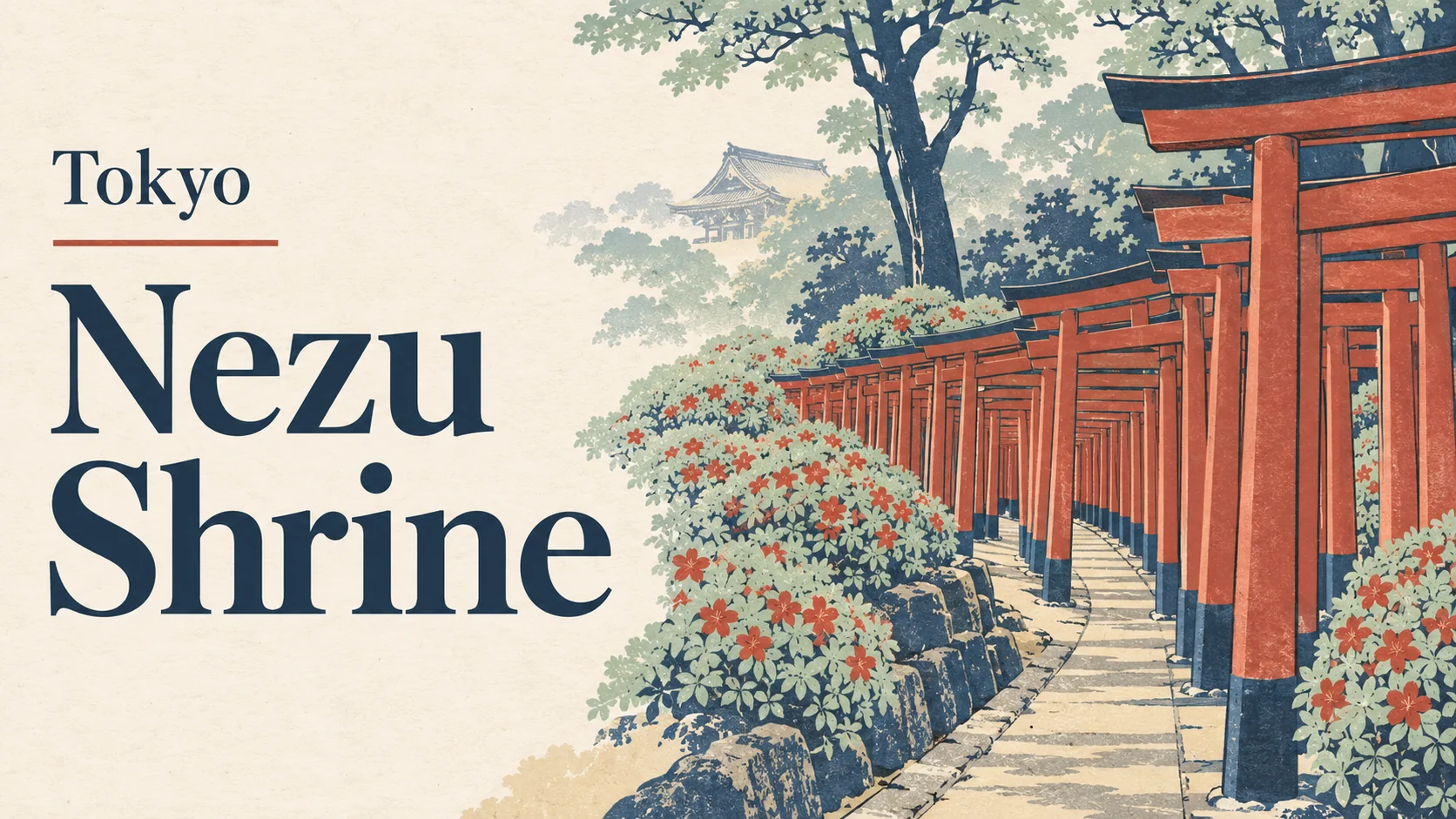
Nezu Shrine (Nezu Jinja) is a Shinto shrine in Bunkyo, Tokyo, a five-minute walk from Nezu or Sendagi Station. Its lacquered halls, gates and fence were completed in 1706 under the shogun Tsunayoshi and still stand, registered as seven Important Cultural Properties. It is also known for a tunnel of red torii at its Otome Inari shrine and for an azalea garden that opens only in April. The shrine publishes no admission charge for the grounds; the April azalea garden is one of the few things here that costs money.
What you’ll learn
- What Nezu Shrine is, why it is also called Nezu Jinja, and why it is not a temple
- Which station exit leads to which approach, and where to park
- Karamon gate and amulet office hours by month, goshuin prices and photo rules
- When the azalea garden opens, what happens at the September festival in 2026, and why our classifier scores the shrine 60 as Wind
What Is Nezu Shrine in Tokyo?
Nezu Shrine is a Shinto shrine in Bunkyo, Tokyo, whose halls, gates and fence, completed in 1706, are seven Important Cultural Properties.
The shrine names five deities. The three principal ones are Susanoo-no-mikoto, Oyamakui-no-mikoto and Hondawake-no-mikoto; enshrined alongside them are Okuninushi-no-mikoto and Sugawara Michizane.
Its standing in Japan rests on two designations. In 1868 the Emperor Meiji named 12 shrines in and around Tokyo junchokusaisha, shrines to which imperial envoys were sent, and Nezu was one of them. In 1975 it became one of the Tokyo Jissha, ten shrines inside the 23 wards grouped into a pilgrimage circuit. The grounds cover 7,000 tsubo, an old unit of area, or about 23,000 square meters (5.7 acres). Nezu Shrine is a Shinto shrine, not a Buddhist temple. For the other Tokyo shrine we cover, see our guide to Meiji Jingu.
Nezu Jinja, Nezu Shrine or “Nezu Temple”?
Nezu Jinja and Nezu Shrine are the same place; jinja is the Japanese word for a Shinto shrine, so “Nezu Jinja Shrine” says shrine twice.
The shrine’s own web address spells the name nedujinja, a different romanization of the same sound. Search for “Nezu temple” in English and the results are this shrine, and its history explains the slip. Before 1868, when Shinto and Buddhism were practiced together, it was called Nezu Gongen-sha or Nezu Sansha Daigongen. Gongen was a title for a kami seen through Buddhist eyes. The shrine also used the manji (卍), a Buddhist symbol, as its crest, and its crest today is still a twisted manji. When Buddhism and Shinto were separated in the Meiji era, the name became Nezu Jinja. At the front you bow and clap, as at any shrine: two bows, two claps, one bow.
From Sendagi to Nezu: The Shogun’s Birthplace and the 1706 Buildings
The shrine moved here in 1706, when the shogun Tsunayoshi built new halls on the estate where his heir, the future shogun Ienobu, was born.
By shrine tradition, the prince Yamato Takeru founded the shrine more than 1,900 years ago in nearby Sendagi. More firmly, the warrior Ota Dokan built a hall for it in the Bunmei era (1469–87). The present site was the estate of Tokugawa Tsunashige, and his son Tsunatoyo, later renamed Ienobu, was born here. Tsunayoshi adopted Ienobu as his heir in 1704. The estate was then given to the shrine, and the new buildings went up as what the shrine calls a tenka-bushin, a construction project on a national scale. In 1706 the deities were moved from the old site in Sendagi, and the shrine was granted lands worth 500 koku of rice a year. Ienobu became the sixth shogun in 1709.
The shrine’s own history says part of the buildings was damaged in the war in 1945, so what stands today is the 1706 complex repaired, not rebuilt.
Getting to Nezu Shrine: Nezu, Sendagi, Todaimae and Hakusan
The shrine is a five-minute walk from Nezu or Sendagi on the Chiyoda Line, and from Todaimae on the Namboku Line.
The two Chiyoda Line stations bring you in by different approaches, or sando, the paths leading to a shrine. From Nezu Station, take Exit 1 and turn left at the Nezu-jinja-iriguchi traffic light to reach the main approach. From Sendagi Station, take Exit 1 and turn right at the Sendagi 2-chome crossing to reach the north approach. The walking times below are the shrine’s own, from its access page.
| From | Line | Exit | You arrive by | Walk |
|---|---|---|---|---|
| Nezu Station | Tokyo Metro Chiyoda Line | Exit 1 | Main approach (left at the Nezu-jinja-iriguchi light) | 5 min |
| Sendagi Station | Tokyo Metro Chiyoda Line | Exit 1 | North approach (right at Sendagi 2-chome) | 5 min |
| Todaimae Station | Tokyo Metro Namboku Line | Not given | Not given | 5 min |
| Hakusan Station | Toei Mita Line | Not given | Not given | 10 min |
| Nezu Jinja Iriguchi bus stop | Toei Bus Ue 58 | — | Not given | 1 min |
Nezu Shrine Hours: The Karamon Gate and the Amulet Office by Month
The hours Nezu Shrine publishes are for its Karamon gate, which opens between 5:00 and 6:00 a.m. and closes between 5:00 and 6:00 p.m., depending on the month.
The Karamon is the inner gate set in the lacquered fence around the halls. The shrine gives no opening or closing time for the outer grounds, so we print only what its opening hours page prints. The amulet office keeps shorter hours and opens at 9:00 a.m. on Sundays and public holidays. Outside its hours, while the Karamon is open, the shrine says to press the intercom.
| Month | Karamon gate | Amulet office |
|---|---|---|
| January | 6:00 – 17:00 | 9:30 – 16:30 |
| February | 6:00 – 17:30 | 9:30 – 17:00 |
| March | 6:00 – 18:00 | 9:30 – 17:30 |
| April, May | 5:30 – 18:00 | 9:30 – 17:30 |
| June–August | 5:00 – 18:00 | 9:30 – 17:30 |
| September | 5:30 – 18:00 | 9:30 – 17:30 |
| October | 5:30 – 17:30 | 9:30 – 17:00 |
| November, December | 6:00 – 17:00 | 9:30 – 16:30 |
| January 1 | 0:00 – 19:00 | Not given |
The shrine publishes no admission charge for the grounds. Charged extras include the April azalea garden and a viewing of paintings of the Thirty-Six Immortal Poets during the azalea festival.
Goshuin, Amulets and Prayers
By the shrine’s price list, the amulet office right of the halls gives three goshuin at ¥500 each: Nezu Shrine, Otome Inari and Komagome Inari.
A goshuin is a stamped and handwritten record of a visit, collected in a goshuincho, a book kept for the purpose; the shrine’s own book costs ¥2,000 with a goshuin included. Among the omamori, or amulets, are a Senbon Torii amulet at ¥2,000 and a white snake amulet at ¥700, released in limited numbers from the 15th of each month. The shrine has an English page for its amulets. Our guide to goshuin explains how to ask for one.
For a formal prayer, or gokito, no reservation is needed. The offering starts at ¥5,000, or ¥10,000 for a baby’s first shrine visit, Shichi-Go-San and Jusan-mairi, and the rite takes about 20 minutes. Photography inside the hall is not allowed. On September 27, 2026, the festival day, no prayers are offered.
Inside the Grounds: Seven Important Cultural Properties, the Torii Tunnel and Otome Inari
Inside stand the 1706 buildings: the joined halls, the Karamon and West gates, the Romon gate and the lacquered fence, plus Otome Inari’s torii tunnel.
The Agency for Cultural Affairs counts seven buildings. The main hall (honden), the offering hall (heiden) and the worship hall (haiden) count as one, because they are joined. This is gongen-zukuri, a plan in which the main hall and the worship hall are linked by a middle hall; the main hall of Nikko Toshogu is an example, and the name comes from Tosho Gongen, the deified Tokugawa Ieyasu. The fence counts as three. The first four buildings were designated in 1931, and the rest were added in 1956 to make seven. According to the shrine, all seven are finished in real urushi lacquer.
| Building | What it is | Designated |
|---|---|---|
| Main hall, offering hall and worship hall | One building in gongen-zukuri | December 14, 1931 |
| Karamon gate | Inner gate in the fence | December 14, 1931 |
| Romon gate | Two-story gate; the only one of the seven with a tiled roof | June 28, 1956 |
| West Gate (Nishimon) | Munemon, a simple ridged gate of a kind few of which survive | June 28, 1956 |
| Sukibei fence | Lacquered openwork fence, counted as three buildings | June 28, 1956 |
The Romon, the two-story gate at the front, is the only tower gate left at a shrine within old Edo, the shrine says. Of the two guardian figures in it, the one on the right is said to be Mito Komon, the popular name of the lord Tokugawa Mitsukuni. The fence runs 200 meters (656 ft), and its foundations reach 8 meters (26 ft) underground.
Otome Inari, dedicated to Ukanomitama-no-mikoto, is built in butai-zukuri, a stage-like structure, overlooking a pond. The path to it is lined with torii, the gateways that mark sacred ground, donated by worshippers. This is the tunnel people call Senbon Torii, “a thousand torii”; the shrine does not give a count. For the best-known torii paths in Japan, see our guide to Fushimi Inari Taisha in Kyoto.
Komagome Inari guarded the estate in Tsunashige’s day and still carries the Tokugawa hollyhock crest on its roof. Near Otome Inari is the mound where Ienobu’s placenta was buried. The Bungo no Ishi, the “writers’ stone,” is where Mori Ogai and Natsume Soseki, both parishioners, are said to have sat on their walks; the Mori Ogai Memorial Museum notes that the shrine appears in Ogai’s Seinen and in Soseki’s Sanshiro and Michikusa. Maihime no Ie, the house in which Ogai wrote Maihime, was moved here and completed at the end of June 2025. It opens on Saturdays, Sundays and holidays, 10:00 a.m. to 4:30 p.m. (last entry 4:00), for ¥300, or ¥100 for elementary and junior high school students.
Photo Rules and Manners
Personal photos need no permit, but the stone pavement in front of the halls is off limits, and photographing without worshipping is not allowed.
The torii pillars carry the names and wishes of the people who gave them, so the shrine asks you to photograph the tunnel from the other side, or to blur the names before posting. Cosplay, wedding costumes you bring yourself and large equipment are not permitted. Inside the lacquered fence, keep quiet, do not smoke, because the listed buildings are a fire risk, and do not bring dogs or other pets.
The Azalea Festival and the Reitaisai: Nezu Shrine Through the Year
The shrine’s two big seasons are April, when the azalea garden opens for the Bunkyo Azalea Festival, and September, around the annual festival.
The 55th Bunkyo Azalea Festival runs from April 1 to 30, 2026. The garden holds about 3,000 plants of 100 varieties and opens only during the festival, from 9:00 a.m. to 5:30 p.m., or from 11:00 on April 1. Admission is a donation of ¥500 to ¥1,000, set by the date, and children 12 and under enter free. Pets, food, tripods and re-entry are not allowed. The shrine says the most flowers are usually out by around mid-April, and that this changes from year to year. The festival has run since 1970. The azaleas go back further: in Tsunashige’s time, Kirishima azaleas were brought from Tatebayashi, and after the war 3,000 plants were added to the hill.
The annual festival, the Reitaisai, falls on September 21. In 1714, the shrine records, every town in Edo sent a float, and the festival was counted a tenka matsuri alongside the Sanno and Kanda festivals. Three great mikoshi, portable shrines, given by Ienobu at that time still survive. The ceremony is held on the 21st, while the festivities fall on a nearby weekend, as on September 14 and 15 in 2024. In 2026 the portable shrine procession, held once every four years, leaves at 9:00 a.m. on September 27 and returns at 4:00 p.m.
| Date | Event |
|---|---|
| February 3 | Setsubun festival |
| April 1–30 | Bunkyo Azalea Festival; azalea garden open |
| June 30 | Oharae purification and chinowa, walking through a ring of grass |
| July 1 – August 31 | Natsumode Kazaguruma festival (pinwheels) |
| September 21, 2026 | Reitaisai ceremony |
| September 26–27, 2026 | Festival events |
| September 27, 2026 | Shinkosai procession, 9:00 a.m. – 4:00 p.m. (every four years); no prayers that day |
| November 23 | Niinamesai harvest rite |
Five Elements Classification: Nezu Shrine Scores 60 as Wind
Nezu Shrine scores 60 as Wind in the Kannavi classification, because its first principal deity, Susanoo, falls in our category of storm and thunder deities.
Kannavi classifies every shrine into one of five elements — Earth, Water, Fire, Wind and Void. This is our classification, not a teaching of the shrine and not a fortune. It reads three checkable layers — the deities enshrined and their category of divinity, the geography of the site, and the shrine’s lineage — each worth fixed points, and we print the score sheet so you can disagree with it line by line.
| Layer | What was matched | Category | Element | Points |
|---|---|---|---|---|
| 1. Enshrined deity | Susanoo-no-mikoto (principal) | Deities of storm and thunder | Wind | 60 |
| 1. Enshrined deity | Oyamakui-no-mikoto | Deities of mountains, soil and the land | Earth | 15 |
| 1. Enshrined deity | Hondawake-no-mikoto | Shrines to people renowned in arms | Fire | 15 |
| 1. Enshrined deity | Okuninushi-no-mikoto, Sugawara Michizane | Not scored (cap for other deities reached) | — | 0 |
| 2. Geography | The pond below Otome Inari | River, pond or spring in the grounds | Water | 25 |
| 3. Lineage | Nezu Jinja | No match | — | 0 |
| Total | Wind 60 / Water 25 / Earth 15 / Fire 15 | Wind (medium) | ||
Other deities can add at most 30 points between them, so Okuninushi and Michizane add nothing once Oyamakui and Hondawake have scored. Water’s 25 is less than half of Wind’s 60, so there is no secondary element, and the classifier rates its confidence medium. For geography we scored the pond, which the shrine’s guide describes, rather than the azalea hill, which is not where the halls stand. Scored as a hill site, Nezu would still lead with Wind at 60.
Compare the other shrines we have scored: Yasaka Jinja in Kyoto, also Susanoo’s shrine, scores 75 as Wind, Fushimi Inari Taisha 100 as Earth, Meiji Jingu 100 as Void, Itsukushima 130 as Water, and Ise’s Naiku 75 as Fire. In the Kannavi scheme the five elements sit in a cycle — Earth, Fire, Void, Water, Wind — in which each shifts the flow of the next rather than opposing it. Wind sits close to Earth and Water; Fire and Void shift its flow instead.
Frequently Asked Questions
These answer the questions the sections above leave open, from the shrine’s own pages unless another source is named.
Q. Is Nezu Shrine free to enter?
A. The shrine publishes no admission charge for its grounds. What is charged: the azalea garden in April, ¥500 to ¥1,000 depending on the date, free for children 12 and under; Maihime no Ie, ¥300 on weekends and holidays; and a paintings viewing during the azalea festival.
Q. How many torii gates are in the tunnel at Nezu Shrine?
A. The shrine does not publish a number, and we do not repeat the counts found elsewhere. Each torii was donated, and many carry the giver’s name and wish, which is why the shrine asks you to photograph from the other side or blur the names.
Q. When is the best time to see the azaleas?
A. The garden opens only during the festival, April 1 to 30 in 2026. The shrine says the most flowers are usually out by around mid-April but that this varies by year, so it gives no fixed peak date. Cars cannot park in the grounds that month.
Q. Did Nezu Shrine survive the war?
A. Mostly. The shrine’s history says part of the buildings was damaged in 1945; restoration was finished in 1959 and the gates and fence were repaired by 1962. The buildings themselves are the 1706 originals, which is why they remain Important Cultural Properties.
Q. Can I come by car?
A. There is a paid car park on the north approach side. The free spaces in the grounds are only for people who come to worship, receive a prayer or hold a wedding. In April, during the azalea festival, no cars can park in the grounds and large buses are refused.
Q. Is Nezu Shrine connected to Mori Ogai and Natsume Soseki?
A. Yes. Both were parishioners, and a stone in the grounds is said to be where they sat. Maihime no Ie, the house where Ogai wrote Maihime, opens here on weekends and holidays for ¥300.
Summary
Nezu Shrine is a complete 1706 complex in a quiet corner of Bunkyo, and a visitor mainly needs the right exit and month.
- It is a Shinto shrine, not a temple, with five deities led by Susanoo; before 1868 it was Nezu Gongen.
- Nezu and Sendagi stations (Chiyoda Line, Exit 1) are each 5 minutes away, to the main and north approaches.
- The published hours are the Karamon gate’s, opening 5:00 to 6:00 a.m. and closing 5:00 to 6:00 p.m. by month.
- Three goshuin are given at ¥500 each; photograph the torii tunnel from the side without names.
- The azalea garden opens only in April; the 2026 portable shrine procession is on September 27.
- In the Kannavi classification, Nezu Shrine scores 60 as Wind.
Next: read our guide to goshuin, compare Nezu with Yasaka Jinja, visit Ise Grand Shrine, or return to the English guide to Japanese shrines.
A shogun’s heir was born on this ground, and the shogun who chose him gave the estate to the deities. Three centuries on, the lacquer is still real. Only the season changes: azaleas in April, a procession every fourth September. Nezu keeps its buildings the way a family keeps a house, repaired rather than replaced.