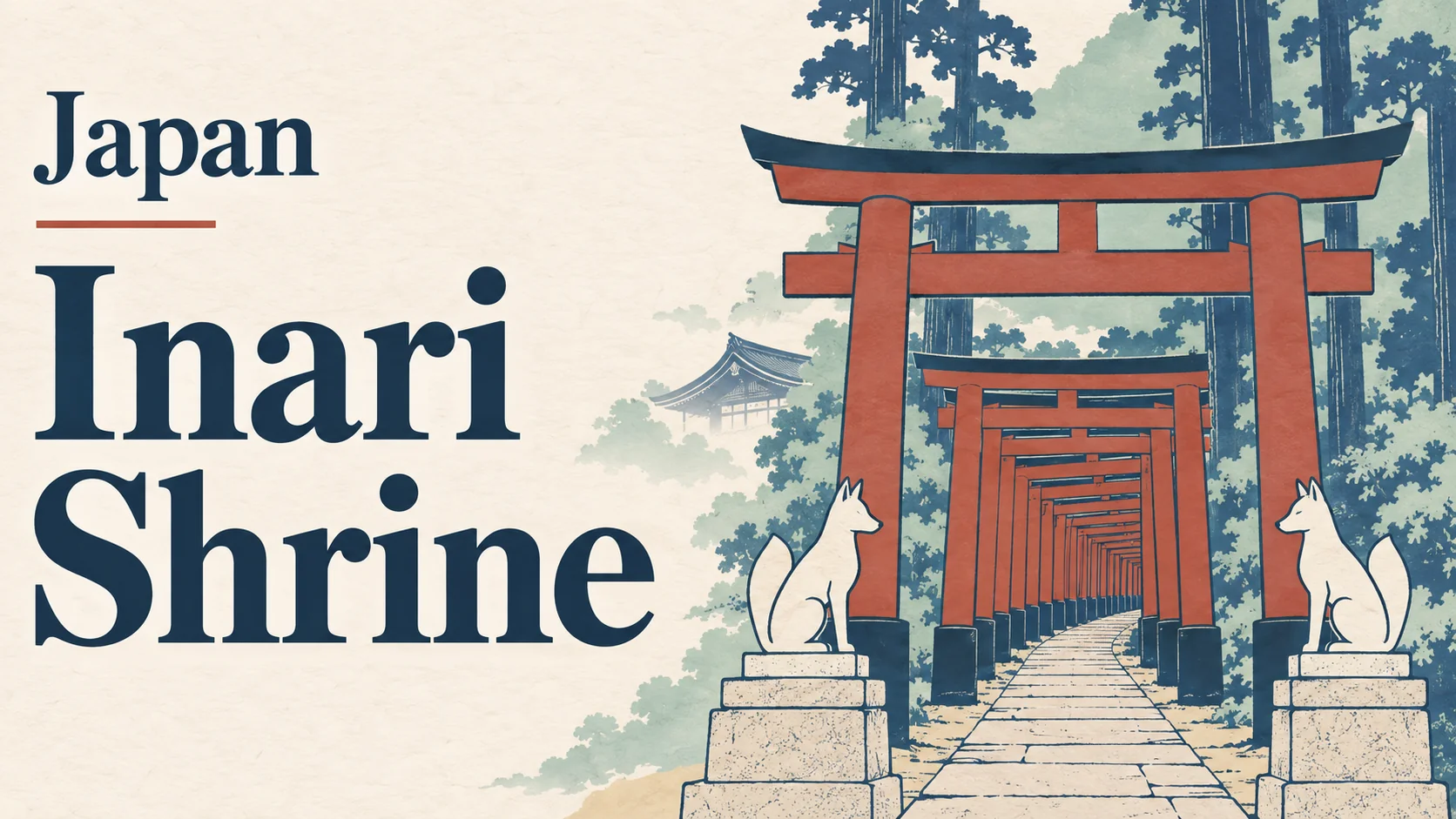
An Inari shrine is a Shinto shrine that enshrines Inari Okami, and the head shrine says Inari shrines “outnumber any other type of shrine in Japan”, with around 30,000 of them. You know one by sight: gateways painted vermilion, often in a row, and a pair of stone foxes where other shrines put lion-dogs. The fox is the part most often got wrong: Inari Okami is a deity of rice and food, and the head shrine, Fushimi Inari Taisha in Kyoto, states plainly that the foxes are messengers, not the deity.
What you’ll learn
- Which deities it enshrines, and why three different counts of these shrines are all correct
- What the head shrine says about foxes, and why it will not say what the statues hold
- Why the gates are vermilion, and what the paint is made of
- Why one famous “Inari” is a Zen temple, and why the head shrine will not name the three great Inari shrines
- Why every Inari shrine comes out as Earth before anyone looks at the site
What Is an Inari Shrine?
An Inari shrine enshrines Inari Okami, a deity of rice and food, and the head shrine says around 30,000 stand in Japan.
Inari is not one place but a lineage: thousands of separate shrines, from precincts of many hectares down to a single small gate on a shop roof, all affiliated with one head shrine. That is Fushimi Inari Taisha in Kyoto, which calls itself on its own English pages “the head shrine with which all the others are affiliated”.
The name comes from rice. The shrine’s FAQ traces it to the Yamashirokoku Fudoki, an ancient provincial report presented to the emperor, in which the phrase is ine ga narimashita, “rice has grown”. It adds that other explanations exist.
Who Inari Okami Is
Inari Okami is five deities, not one, and the first of them is Uka-no-Mitama-no-Okami, a deity of rice and food.
The head shrine’s Enshrined Deity page names all five and gives each a fixed seat: Uka-no-Mitama-no-Okami in the central seat of the lower shrine, Sadahiko-no-Okami in the northern seat of the middle shrine, Omiyanome-no-Okami in the southern seat of the upper shrine, Tanaka-no-Okami in the northernmost seat, and Shi-no-Okami in the southernmost. All five together are called Inari Okami, so a roadside Inari with a single hall is not enshrining a lesser version of anything.
How Many Inari Shrines There Are
Three published counts exist, and they differ because each counts a different set of shrines, not because any of them is wrong.
The gap is a matter of what is being divided by what, so the denominators are printed below rather than averaged away.
| Figure | Out of what (the denominator) | Who publishes it |
|---|---|---|
| Around 30,000 | All Inari shrines throughout the country; no denominator given | Fushimi Inari Taisha, the head shrine |
| About 30,000, just under 40% | Of about 80,000 shrines belonging to the Association of Shinto Shrines | Heibonsha World Encyclopedia, revised edition |
| 30,750-odd | Of the shrines listed in Inari Jinja Ryakki, a register of Inari shrines | Shogakukan Encyclopedia Nipponica |
The head shrine is equally careful about ranking: asked in its own FAQ what the three biggest Inari shrines are, it answers that it cannot determine the other two, since shrines are described differently in different areas. Several shrines do call themselves one of the three; we do not print a list the head shrine declines to print.
Is Inari a Fox? What the Head Shrine Says
No. The head shrine’s own FAQ says foxes are the messengers of Inari Okami, and that Inari Okami is not a fox.
The wording on the English FAQ leaves no room: “Foxes are said to be the messengers (kindreds) of Inari Okami. But these are not the foxes you see in the mountains — like Inari Okami, these messengers cannot be seen either.” Because they cannot be seen, they are called byakkosan, “white foxes”. Then: “Of course, this does not mean that Inari Okami is a fox!”
So the stone animals are images of an invisible messenger, not portraits of the deity or of a real animal. We use them as the identifying mark on this site: a pair of foxes rather than lion-dogs is what tells you the shrine is an Inari shrine.
You will read elsewhere that whatever a fox statue holds in its mouth means a specific thing. The head shrine publishes no such list, and neither do we. The fox connection itself is folk belief: Daijisen describes a popular idea that attached itself to Inari worship rather than a doctrine handed down.
The same belief is why a food carries the shrine’s name. Encyclopedia Nipponica gives two explanations for inarizushi, rice in a pouch of fried tofu: that foxes are said to like fried tofu, and that the fox is the deity’s messenger. It dates the dish to the Tempo era (1830–44) in Nagoya. That is an account of a name, not of anything the shrines offer.
How to Read an Inari Shrine: Vermilion, Torii and Why They Are There
Vermilion carries two meanings at the head shrine: an amulet against evil forces, and the abundant harvests Inari Okami gives.
Most English writing gives only the first. The FAQ gives both: vermilion red “is considered an amulet against evil forces”, and, specific to this shrine, “it is described as a color that expresses bountiful harvests that Inari Okami gives us”. It also says what the colour is made of — a pigment of mercury and red earth, used since ancient times to preserve wood. At the head shrine the gates and the halls take the same finish, which its guide to the Senbon Torii calls inari-nuri, Inari lacquering.
Why the Gates Are Donated
A torii is donated either as a wish that a prayer will pass, or as thanks that it did.
The FAQ explains the rows directly: “Torii gateways had become widely used as an offering by the start of the Edo period (1603–1868), to symbolize a wish for or acknowledgement of the ‘passing’ of prayers from people to the deity.” The FAQ covers both directions, the wish and the acknowledgement, and the pun does the work: a wish “passes”, and a gate is a thing you pass through. The Senbon Torii took shape from exactly this, from donations along the approach to the Myobu-sha already accumulating in the Edo period. Donations are still accepted, at the shrine office or the mountain teahouses, but the sum is not published, so we print none.
Inari Shrine or Inari Temple?
Not every Inari is a shrine: Toyokawa Inari is a Soto Zen temple, founded in 1441, with a Buddhist principal image.
Search in English for “Inari temple” and you are mostly shown Inari shrines, which hides the one real case. Toyokawa Inari in Aichi is properly Myogonji. Its own English page says it was founded as a Soto Zen temple in 1441, with Senju Kannon as its principal image. “Inari” in the name is its guardian deity, not Inari Okami. Our scope here is shrines, so what follows is the distinction, not a guide to a temple.
| An Inari shrine | Toyokawa Inari (Myogonji) | |
|---|---|---|
| Tradition | Shinto | Soto Zen Buddhism |
| What is enshrined | Inari Okami, five deities led by Uka-no-Mitama-no-Okami | Senju Kannon as the principal image; Toyokawa Dakini Shinten as guardian |
| Beginning | 711 at Inariyama, by shrine tradition | 1441, founded by the priest Tokai Gieki |
| Word for the place | jinja or taisha, shrine | ji or tera, temple |
| Foxes present? | Yes, as messengers of Inari Okami | Yes, but with Dakini Shinten, who is shown riding one |
Both are old, both are open, and both are called Inari. Only one of them is a shrine.
Why a Temple Is Called Inari
Its guardian deity is shown carrying rice ears and riding a white fox, and that image drew the same name.
The temple’s history page describes Toyokawa Dakini Shinten bearing rice ears and riding a white fox — exactly the pair that identifies an Inari shrine — and says the name followed from it. The Kokugakuin University Encyclopedia of Shinto records that the Buddhist deity Dakiniten was combined with Inari, and that Inari worship spread in the Edo period partly through shrines built in daimyo residences and later opened to commoners. The Meiji separation of Shinto and Buddhism pulled apart institutions, not names. Toyokawa kept its.
What People Pray For, and What Gets Offered
Rice came first: the head shrine lists business prosperity, safe households, safe travel and the performing arts among today’s prayers.
The sequence in its FAQ reads as history rather than as a menu. First the imperial court prayed for harvests, and for rain to come or stop. Then, in the Heian period (794–1185), for good matches in marriage. Only over the years did the modern list arrive.
The etiquette in front is ordinary shrine etiquette, and the Association of Shinto Shrines states it in English: toss some coins in the offering box, bow twice deeply, clap your hands twice, and bow once again.
The Year at an Inari Shrine
The head shrine’s year turns on four events, and the two biggest fall on a moving day rather than a fixed date.
The First Day of the Horse, hatsuuma, is the anniversary of the enshrinement; it is set by a traditional way of naming days that shifts every year, and the shrine says the day has been called that for around 1,300 years. A visit on it is fuku-mairi. The 2026 date was not published at the time of writing, so we give none.
| Event | When | What it is |
|---|---|---|
| Hatsuuma-taisai | The First Day of the Horse in February, from 8:00; the date moves each year | The anniversary of the enshrinement. Shirushi no sugi, a cedar token for business prosperity and household safety, is given |
| Inari-sai and Shinko-sai | The Sunday nearest April 20, from 11:00 | The portable shrines leave the precinct for the streets below |
| Motomiya-sai | July, with the eve rite from 18:00 | The night festival for worshippers from around the country |
| Ohitaki-sai | November | Wooden hitaki-gushi sticks sent in from across Japan are burned; the shrine counts them in the hundreds of thousands |
The cedar token is not chosen at random: the cedar is the sacred tree of the Inari faith, and Inari Okami is thought to reside in the cedars on the mountain, though the FAQ adds that no particular sacred trees are planted in Inari precincts.
Mount Inari and the Head Shrine
The mountain is the shrine: Inari Okami is said to have settled on Inariyama, 233 metres high, in the year 711.
The history page puts the beginning on the first Day of the Horse of the second month of 711, when Hata no Irogu, acting on an imperial order from Empress Genmei, enshrined three deities in three mountains. The shrine’s page on Inariyama gives its height as 233 metres, and the FAQ adds that it is the southernmost of Kyoto’s thirty-six Higashiyama mountains.
In 827 sacred trees on the mountain were cut for timber to build Toji, which the history records with the trouble said to follow. In 1499 the halls were rebuilt after the Onin war burned them. The shrine on the summit, burned in the same war, was never permanently restored — attempts were made and typhoons took them — so what remains is a shinseki, a site where a shrine once stood and the deity is held to remain. For the walk up, see our guide to Fushimi Inari Taisha.
How Many Torii, Really
The head shrine publishes two different figures for its torii, and a third number is often mistaken for them.
The first is in the FAQ: “Today, there are around 10,000 torii gateways of all sizes along the mountain paths leading to Fushimi Inari Taisha.” That counts gates of every size over the whole mountain. The second is on the shrine’s page about Inariyama, which says several thousand vermilion torii stand along the approach — a narrower stretch, and a smaller number for it. They count different lengths of path.
The third number belongs to something else. The mountain is covered with otsuka, stones on which worshippers engraved the names under which they worshipped Inari Okami; the shrine counts those at around ten thousand. They are stones, not gates. And “Senbon Torii” is the name of one passage, not a count.
Five Elements: Why Every Inari Shrine Comes Out as Earth
Every Inari shrine scores at least 75 as Earth before its site is looked at, so its main element cannot change.
Kannavi sorts every shrine into one of five elements — Earth, Water, Fire, Wind and Void. This is our classification, not a teaching of any shrine and not a fortune. It reads three checkable layers, each worth fixed points: the enshrined deities, worth 60 for the principal one; the geography of the site, worth 25; and the lineage, worth 15. We print the score sheet so you can disagree line by line.
| Layer | What was matched | Category | Element | Points |
|---|---|---|---|---|
| 1. Enshrined deity | Uka-no-Mitama-no-Okami (principal) | Deities of rice, food and abundance | Earth | 60 |
| 1. Enshrined deity | Sadahiko, Omiyanome, Tanaka, Shi-no-Okami | No category matched by name | — | 0 |
| 2. Geography | Depends on the site | See the section below | Varies | up to 25 |
| 3. Lineage | The name Inari | Inari shrines | Earth | 15 |
| Fixed total before geography | Earth 75 | Earth (high) | ||
Two lines do the work: the principal deity falls in our category of rice, food and abundance, for 60, and the name Inari matches the Inari lineage, for 15. Both are Earth. That is 75 before the ground is examined, and 75 is the threshold at which our classifier calls its confidence high. The four other deities score nothing, because our rules match a deity’s name to a category and those four match none — a limit of the method, printed rather than hidden.
What the Remaining 25 Points Do
Only the geography is still open, and its 25 points either raise Earth or open a second element beside it.
A mountain site adds 25 to Earth, for 100: that is Fushimi Inari Taisha, where the mountain is the object of worship. Water in the grounds, or a long approach under open sky, leaves Earth at 75 with a second colour beside it.
Even then no second element is named: our classifier names one only when it reaches 80% of the leader, and 25 is a third of 75. An Inari shrine is Earth, and the only question is how much. Its neighbours are not so fixed — Nezu Shrine scores 60 as Wind although it keeps an Otome Inari and a tunnel of red gates, because a sub-shrine does not change the score of the shrine housing it. Compare Meiji Jingu at 100 as Void and Ise’s Naiku at 75 as Fire.
Frequently Asked Questions
These answer what the sections above leave open, from the head shrine’s own pages unless another source is named.
Q. Is Inari a god of foxes?
A. No. Inari Okami is a deity of rice and food. The head shrine’s FAQ calls foxes the messengers, and adds: “Of course, this does not mean that Inari Okami is a fox!” The messengers are held to be invisible, hence byakkosan, white foxes.
Q. Why are the torii red?
A. For two reasons at once. The head shrine says vermilion is an amulet against evil forces, and that here it also expresses the bountiful harvests Inari Okami gives. It adds that vermilion is used at many other shrines too, so the colour alone does not prove you are at an Inari shrine.
Q. How many torii are there on Mount Inari?
A. Around 10,000 of all sizes along the mountain paths, by the head shrine’s FAQ. Its page on the mountain describes several thousand along the approach, a shorter stretch. The otsuka counted at ten thousand are engraved stones, not gates. The 10,000 is “of all sizes”, so small donated gates count too.
Q. Is Toyokawa Inari a shrine?
A. No. It is Myogonji, a Soto Zen temple founded in 1441, whose principal image is Senju Kannon. The “Inari” is its guardian deity, Toyokawa Dakini Shinten, shown with rice ears and a white fox. Foxes appear there too: the temple keeps a Reikozuka, a mound of fox figures.
Q. What do I do when I stand in front of one?
A. What you do at any Shinto shrine. The Association of Shinto Shrines puts it as: toss some coins in the offering box, bow twice deeply, clap twice, and bow once again. There is no separate procedure for the foxes.
Q. Why is inarizushi called that?
A. Encyclopedia Nipponica gives two explanations: that foxes are said to like fried tofu, and that the fox is the Inari deity’s messenger. It dates the dish to the Tempo era (1830–44) in Nagoya, and records that Matsuyama makes it triangular.
Summary
An Inari shrine is read by three things: vermilion, a pair of foxes, and a deity of rice rather than foxes.
- It enshrines Inari Okami, five deities led by Uka-no-Mitama-no-Okami; the head shrine is Fushimi Inari Taisha.
- Around 30,000 are said to stand in Japan, and the three published counts differ because each divides a different pool.
- The foxes are invisible messengers, and the head shrine does not say what the statues hold.
- Vermilion means both an amulet against evil and abundant harvests; a gate is given for a wish, or for a wish granted.
- Toyokawa Inari is a Zen temple, and the head shrine will not name the three great Inari shrines.
- In the Kannavi classification, every Inari shrine scores at least 75 as Earth.
Next: walk the mountain with our guide to Fushimi Inari Taisha, find the Otome Inari inside Nezu Shrine, read what to do with a goshuin, or return to the English guide to Japanese shrines.