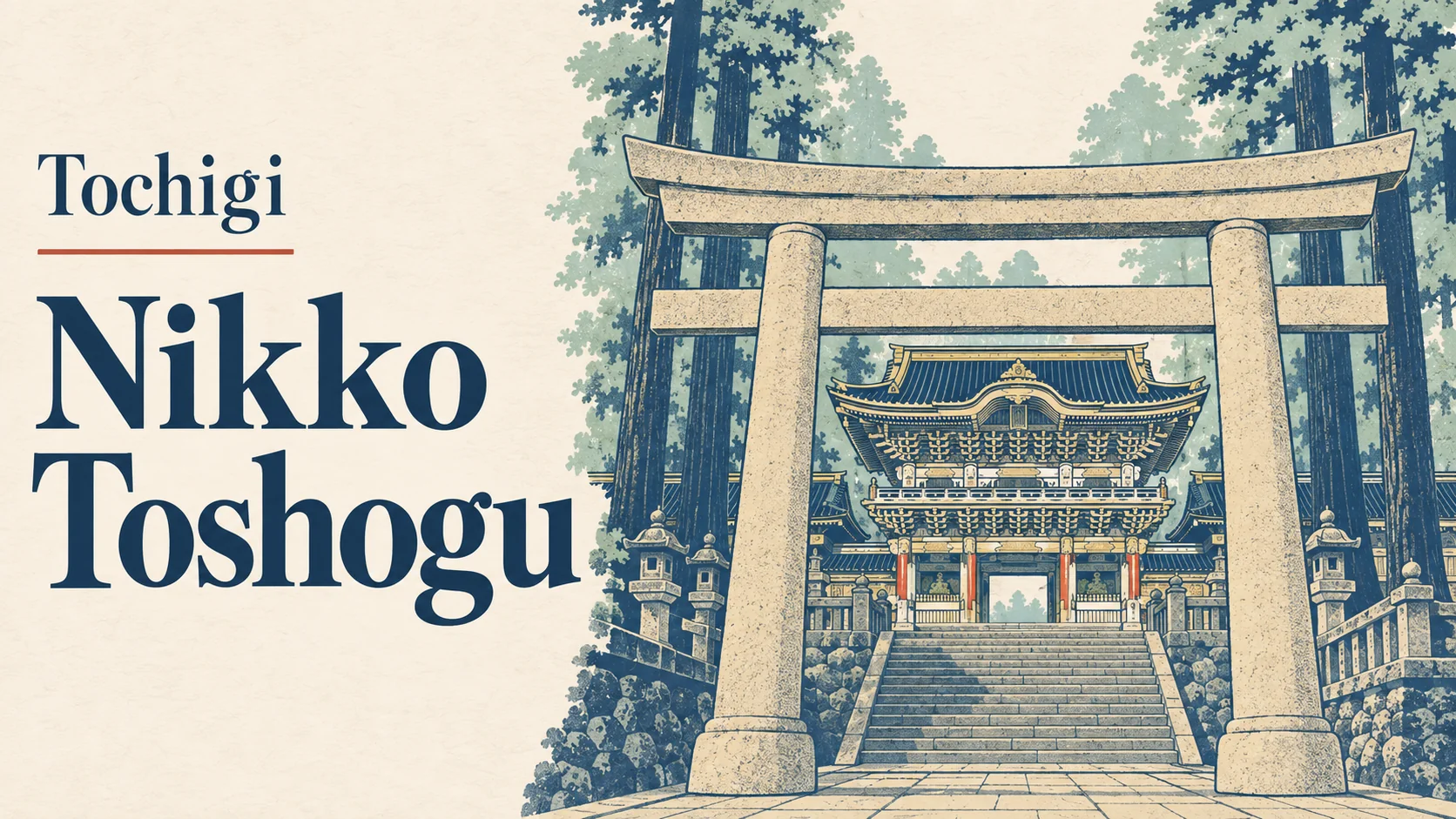
Nikko Toshogu (Nikkō Tōshō-gū) is the shrine where the first Tokugawa shogun is enshrined, in cedar forest two hours north of Tokyo. Its 1636 rebuilding raised 55 buildings in 17 months, and eight are National Treasures. The shrine publishes no English pages of its own, so this page prints what its Japanese pages and the prefectural record say: who else shares the hall, what is behind scaffolding, and why our classification returns Fire.
What you’ll learn
- What the official site says about its deity, and the two names it leaves out
- What the 1636 rebuilding cost, and how long it took
- Hours, tickets, the route from Tokyo, and what is under repair
- Why it scores 90 as Fire, and why Minamoto no Yoritomo scores nothing
What Nikko Toshogu Is
Nikko Toshogu is the Shinto shrine where Tokugawa Ieyasu, the first Tokugawa shogun, is enshrined as a deity.
It stands at Sannai in Nikko, Tochigi Prefecture. The shrine’s account of its origins dates the founding to 1617 and says the halls you see were rebuilt in 1636 by his grandson, the third shogun Iemitsu. By Nikko City’s count, eight of its buildings are National Treasures and 34 more Important Cultural Properties.
One line to carry, because Nikko makes it hard to see: a shrine is Shinto and enshrines kami, deities, and you bow twice, clap twice and bow once at one; a temple is Buddhist, and you do not clap. Toshogu is a shrine with a Buddhist pagoda inside it.
From Sunpu to Nikko: How Ieyasu Came to Be Enshrined Here
Ieyasu died at Sunpu in 1616 and was buried at Kunozan, and his own instructions moved him to Nikko a year later.
The shrine gives the sequence in dates. Born at Okazaki in 1542, he died at Sunpu Castle on the seventeenth of the fourth month of 1616, aged 75, and was buried at Kunozan at once. By his will he was moved here a year later, as Tosho-sha. In 1645 the court granted the title gu, marking imperial rank.
The 1636 Rebuilding, in Numbers
The 1636 rebuilding raised 55 buildings in 17 months, and the shrine still publishes the bill from the period ledger.
| Item | Figure |
|---|---|
| Buildings raised | 55, including the Yomeimon |
| Gold | 568,000 ryo, the gold unit of the period |
| Silver | 100 kanme, a weight rather than a coin count |
| Rice | 1,000 koku |
| Time taken | 1 year 5 months |
| In charge | Akimoto Yasutomo, director; Kora Munehiro, master carpenter |
The shrine’s page on the buildings names its source for the money, the Gozoei Gomokuroku, the record of the work. We leave the units unconverted: putting 568,000 ryo into yen needs a chosen rate between two coinages three centuries apart, and the rate would decide the answer.
Who Is Enshrined at Nikko Toshogu
The shrine’s official site names one deity, Tokugawa Ieyasu, and the prefectural shrine agency records two more beside him.
The shrine’s pages on its origins and buildings name Ieyasu and no one else. Neither mentions Toyotomi Hideyoshi or Minamoto no Yoritomo, so we do not put a list in the shrine’s mouth.
The other record is the prefecture’s. Tochigi-ken Jinjashi, compiled by the Tochigi Prefecture Shrine Agency in 2006, says at page 192 — quoted in the National Diet Library’s reference database — that on June 9, 1873 Toshogu was raised to betsukaku kanpeisha, a class of nationally supported shrine, and Yoritomo and Hideyoshi enshrined as aidono-no-kami, deities sharing the main hall.
| Who | Position in the hall | Which record says so |
|---|---|---|
| Tokugawa Ieyasu (1542–1616) | Principal deity | The shrine’s own site |
| Toyotomi Hideyoshi and Minamoto no Yoritomo | Sharing the hall, from June 9, 1873 | Tochigi-ken Jinjashi (2006) p.192 |
| Sanno-shin and Matara-shin | Left and right at the founding; no longer enshrined | Yajima Kiyofumi, Nikko Toshogu (1961) pp.18–19 |
Yoritomo founded Japan’s first shogunate, at Kamakura; Hideyoshi ruled the generation before the Tokugawa. Neither belonged to Ieyasu’s house. The hall holds three warrior rulers from three centuries, one of whom is on the shrine’s public list. It was altered in 1873; the account has not followed.
Why Hideyoshi and Yoritomo Are Here
At the founding the shrine kept two other deities beside Ieyasu, and that pair was replaced under Meiji.
Yajima Kiyofumi’s Nikko Toshogu of 1961 says it in one sentence at pages 18 to 19: at the founding, Sanno-shin and Matara-shin were enshrined left and right, and by the Meiji separation of Shinto and Buddhism the shrine now enshrines Yoritomo and Hideyoshi alongside Ieyasu. It gives the occasion and no motive, so we supply none.
The replacements were not arbitrary. Takato Haruyoshi, writing in 1979, notes at pages 142 to 143 that under Sanno Ichijitsu Shinto — the doctrine of the monk Tenkai, under which Ieyasu was enshrined — Sanno-shin was identified with Hideyoshi and Matara-shin with Yoritomo before Meiji. In 1873 that reading became the label.
Summaries of this episode circulate with 1869. The passage actually quoted from the prefectural record reads the sixth year of Meiji, sixth month, ninth day, so we take that side.
Nikko Shrines and Temples: Why One Site Holds Three
The World Heritage site called Shrines and Temples of Nikko is three institutions, not one, and Toshogu is a third of it.
Nikko City publishes the figures. The property covers 103 buildings — 9 National Treasures and 94 Important Cultural Properties — belonging to Toshogu, Futarasan-jinja and Rinnoji at Sannai, inscribed on December 2, 1999 at the 23rd session of the World Heritage Committee in Marrakesh.
Two are shrines and one is a temple. Rinnoji is Buddhist, and this site covers shrines, so we name it only to say which gate is which. Toshogu’s own ticket admits you to Toshogu; its set tickets add Toshogu’s museums.
Toshogu holds eight National Treasure buildings and the property holds nine, so one shrine accounts for eight of the nine.
Why There Is a Pagoda Inside a Shinto Shrine
A five-storey pagoda stands inside the shrine because Shinto and Buddhism were not separated at Nikko until the Meiji period.
The pagoda, an Important Cultural Property, was donated in 1650 by Sakai Tadakatsu, lord of Obama in Wakasa, burned in 1815 and was rebuilt in 1818 by Sakai Tadasusumu of the same domain. It is a Buddhist form in a shrine precinct because when it was given, the line that later divided the two was not drawn where it is now.
The fusion reaches the foundation itself: Ieyasu was enshrined under Tenkai’s Sanno Ichijitsu Shinto, which read Shinto deities and Buddhist figures as the same presences under different names. That is why nikko temple is a reasonable thing to type; the answer is a shrine holding that record.
What to See: Yomeimon, the Three Monkeys and the Sleeping Cat
Four things carry most of the visit: the Yomeimon gate, the three monkeys, the sleeping cat, and the tomb beyond it.
| Building or carving | Designation (ICP = Important Cultural Property) | What to look at |
|---|---|---|
| Ishi-dorii, the stone gateway | ICP | Donated 1618 by Kuroda Nagamasa; the stone came by ship to Oyama, then overland by hand |
| Omotemon, the front gate | ICP | The first gate; a pair of guardian figures is why it is also the Niomon |
| Shinkyusha, the sacred stable | ICP | Eight monkey panels; the famous three are one of them |
| Yomeimon | National Treasure | Over 500 carvings; also the Higurashi-no-mon, the gate at which the day runs out |
| Karamon | National Treasure | White throughout in gofun, a pigment ground from shell |
| Gohonsha: honden, ishi-no-ma, haiden | National Treasure | The most important building; the Shogun’s Seat and the Imperial Abbot’s Seat flank the haiden |
| Nemuri-neko, the sleeping cat | National Treasure | Attributed by tradition to Hidari Jingoro; the path to the Okumiya begins here |
| Okumiya | ICP | Ieyasu’s burial place: worship hall, cast-bronze gate, reliquary |
The Yomeimon’s second name is about attention rather than style: nobody tires of its carvings of old tales, sages and worthies, so it is the gate where the day runs out. Its name is said to have come from the main gate of the imperial palace. Inside it the white Karamon is the opposite move, and beyond that the Gohonsha is three rooms in one: the honden, the inner hall; the ishi-no-ma; and the haiden, where worship happens.
The Three Monkeys Are Three of Eight
The see-no-evil monkeys are one panel of eight above the stable, and the eight together run through a human life.
The shrine says it plainly: eight monkey carvings sit above the beam and a human life is satirised across them, the best known being see no evil, speak no evil, hear no evil. The building is the Shinkyusha, where the sacred horses are kept, and monkeys are said to protect horses. Photographs crop one panel; seven more are beside it.
What the 2013–2017 Repainting Actually Did
The Yomeimon’s repainting ran from July 19, 2013 to March 24, 2017 and used six broad classes of colouring technique.
The contractor, Konishi Decorative Arts, records the job with those dates and roughly six colouring methods on the surface. The one it calls particular to Nikko runs in a fixed order: lacquer repair of the timber, a lacquer ground, lacquer coats, gold leaf, then colour on top. Around the bracket complexes it differs, the gold leaf being laid in lacquer.
We print no cost. A figure near 1.2 billion yen circulates in travel media, and none of the parties that would know it — shrine, conservation foundation, contractor — publishes one. The dates and methods have a primary source; the money does not.
Planning Your Visit: Hours, Tickets and What Is Closed
Gates open at 9:00 all year and close at 17:00 from April to October, 16:00 otherwise, with admission ending 30 minutes earlier.
| Item | Detail |
|---|---|
| Hours | 9:00–17:00 April 1 to October 31; 9:00–16:00 November 1 to March 31 |
| Admission desk | Closes 30 minutes before the gate |
| Ticket | ¥1,600 adults and high-school students; ¥550 elementary and junior-high |
| With the Treasure Museum | ¥2,400 adults; ¥870 children |
| Groups of 35 or more | ¥1,440 / ¥495, or ¥2,240 / ¥815 with the museum |
| Audio guide | ¥500 a day; counter 9:00–16:00 April to October, 9:00–15:00 November to March |
| Car park | ¥600 a car, 200 spaces, no reservation, paid on the way out |
| Ticket covers | Omotemon to the Okumiya: Yomeimon, haiden, sleeping cat, Honjido |
| Under repair now | The National Treasure east and west sukibei, the openwork fences, and six further buildings |
The last row changes what you see, and it does not come from the shrine. The Nikko Cultural Assets Conservation Foundation, which carries out the work, lists that repair as under way, so expect scaffolding on the route.
No time-of-day crowd figures are published, so we name no best hour. A late start costs the audio-guide counter first, then the admission desk.
Goshuin, the seal and calligraphy given as a record of a visit, are written here, but no fee or hours appear on the shrine’s site or the tourist association’s. The figures circulating come from blogs, and one, an 8:00 start, contradicts the shrine’s own 9:00 opening, so we print no fee. Read what a goshuin is.
The Audio Guide Covers 29 Buildings
The shrine rents an audio guide for ¥500 a day, in English, covering 29 buildings inside the precinct.
The counter is straight ahead through the Omotemon and individual visitors need no reservation. It runs 9:00 to 16:00 April to October, 9:00 to 15:00 November to March, in Japanese, English and Chinese.
It earns the ¥500 because the shrine has no English pages: nothing it says about its 55 buildings reaches an English reader before arrival, and 29 buildings is a different visit from the four or five in photographs.
Getting to Nikko Toshogu from Tokyo
The limited express from Asakusa reaches Tobu-Nikko in about one hour 50 minutes, and the shrine is ten minutes further by bus.
| From | Service | Time | Arrives |
|---|---|---|---|
| Asakusa | Tobu limited express Kegon | about 1 h 50 min | Tobu-Nikko |
| Shinjuku | JR limited express Nikko | about 2 h | Tobu-Nikko |
| Utsunomiya | JR Nikko Line | about 45 min | Nikko |
| By car | Tohoku Expressway to Utsunomiya IC, then the Nikko-Utsunomiya Road | 2 km from Nikko IC | Shrine car park |
| Station to shrine | World Heritage loop bus | about 10 min | Omotesando stop, 5 min on foot; or Shinkyo, 15 min |
Tobu Bus, which runs that last leg, sells a World Heritage loop pass at ¥600 for an adult and ¥300 for a child, valid on the day of purchase only, from the Tobu Nikko station tourist centre (8:20 to 16:20) or as a mobile ticket. It pays only if you get off more than twice.
You pass a designated monument on the way in. The shrine’s front page describes the Nikko cedar avenue as planted from around 1625 and given to Toshogu as an offering; it is a National Special Historic Site and Special Natural Monument, about 12,500 trees survive, and it is in the Guinness Book. The same page says combined pollution is killing close to 50 a year.
Five Elements Classification: Why Nikko Toshogu Is a Fire Shrine
Nikko Toshogu scores 90 as Fire, because both warrior deities our rules recognise are Fire and so is the lineage.
Kannavi sorts every shrine into one of five elements — Earth, Water, Fire, Wind and Void. This is our classification, not a teaching of any shrine and not a fortune. It reads three checkable layers: the deities, 60 for the principal and 15 per further match; the geography, 25; the lineage in the name, 15.
| Layer | What was matched | Category | Element | Points |
|---|---|---|---|---|
| 1. Deity | Tokugawa Ieyasu (principal) | People who made their name in war | Fire | 60 |
| 1. Deity | Toyotomi Hideyoshi (shares the hall) | People who made their name in war | Fire | 15 |
| 1. Deity | Minamoto no Yoritomo (shares the hall) | No category matched by name | — | 0 |
| 2. Geography | The slope at Sannai, cedar forest, steps to the Okumiya | Mountain or summit | Earth | 25 |
| 3. Lineage | The name Toshogu | Toshogu shrines | Fire | 15 |
| Total | Fire 90, Earth 25 | Fire (high) | ||
The zero is the line to read. Yoritomo scores nothing, not because our rules rank him lower but because the classifier matches a name against a list of categories and his is not on it, although he is a warrior ruler like the two above him. We print the limit rather than hide it.
A second element is named only when the runner-up reaches 80 percent of the leader, which here would take 72 points. Earth has 25, so Toshogu is Fire alone. Relations run around a ring — Earth to Fire to Void to Water to Wind and back — in which each shifts the flow of the next rather than opposing it.
The comparison is inside this bundle. Meiji Jingu also enshrines a person yet comes out at 100 as Void, its deity falling into another category. Fushimi Inari Taisha reaches 100 as Earth, and Ise’s Naiku is Fire at 75. Enshrining a famous person does not settle the element.
Frequently Asked Questions
These take up what the sections above leave open, from the shrine’s own pages unless another source is named.
Q. Is Nikko Toshogu a shrine or a temple?
A. A shrine — and the English name Nikko Toshogu Shrine doubles the word, since gu already means shrine. It enshrines Tokugawa Ieyasu as a deity, and you bow twice, clap twice and bow once there. The confusion is fair: a Buddhist pagoda stands in the grounds, and the two faiths were not separated at Nikko until the Meiji period.
Q. How much does it cost to enter Nikko Toshogu?
A. ¥1,600 for adults and high-school students, ¥550 for elementary and junior-high. A set ticket with the Treasure Museum is ¥2,400 and ¥870, and groups of 35 or more pay less. The car park is ¥600 a car, paid as you leave, and the audio guide ¥500 a day.
Q. How long do you need at Nikko Toshogu?
A. The shrine publishes no figure, so use the ones it does. The ticket runs from the Omotemon to the Okumiya, the audio guide describes 29 buildings, and the Yomeimon alone carries over 500 carvings. Time it from the back: the guide counter shuts an hour before the gate, the desk half an hour before.
Q. Can you visit Nikko Toshogu as a day trip from Tokyo?
A. Yes, on the published times. Asakusa to Tobu-Nikko is about one hour 50 minutes by limited express, Shinjuku about two hours; then ten minutes on the loop bus and five on foot. Against a 9:00 opening and last admission at 16:30 or 15:30, the return fits inside a day.
Q. Is Tokugawa Ieyasu actually buried at Nikko?
A. His tomb is here, and it was not his first. The shrine’s account is that he died at Sunpu in 1616 and was buried at Kunozan at once, and that by his own instructions he was moved to Nikko a year later. The Okumiya, past the sleeping cat, is that burial place.
Q. Is any part of Nikko Toshogu closed for restoration?
A. Yes. The Nikko Cultural Assets Conservation Foundation lists repair of the National Treasure east and west openwork fences and six further buildings as under way, so expect scaffolding on the route. The shrine’s own page on its modern repairs carries no content, so check the foundation.
Summary
Nikko Toshogu is a shogun’s tomb built as 55 buildings, and its hall quietly gained two more rulers in 1873.
- Founded in 1617 for Tokugawa Ieyasu; the halls you see were rebuilt in 1636 by the third shogun Iemitsu, 55 in 17 months.
- Eight buildings are National Treasures and 34 more Important Cultural Properties, in a World Heritage property of 103 shared with Futarasan-jinja and Rinnoji.
- Its own site names one deity; the prefectural record puts Hideyoshi and Yoritomo beside him from June 9, 1873.
- ¥1,600 to enter, 9:00 to 17:00 or 16:00 by season, and a ¥500 audio guide covering 29 buildings in English.
- About one hour 50 minutes from Asakusa, then a ten-minute bus; openwork fences and six buildings under repair.
- In the Kannavi classification, Nikko Toshogu is Fire 90 with no sub-element, and Minamoto no Yoritomo scores nothing.
Next: another shrine to a famous man at Meiji Jingu, plain timber instead of gold leaf at Ise Jingu, lacquer that survived in Tokyo at Nezu Shrine, the goshuin, or the English guide to Japanese shrines.
Most of this page is about decoration, because that is what is in front of you. The list of who is inside is the more interesting thing: the shrine’s account of itself names one man and stops, and a prefectural record adds two more, with a date and a page. The gold leaf is what a photograph carries; the revision is what you would have to look up.