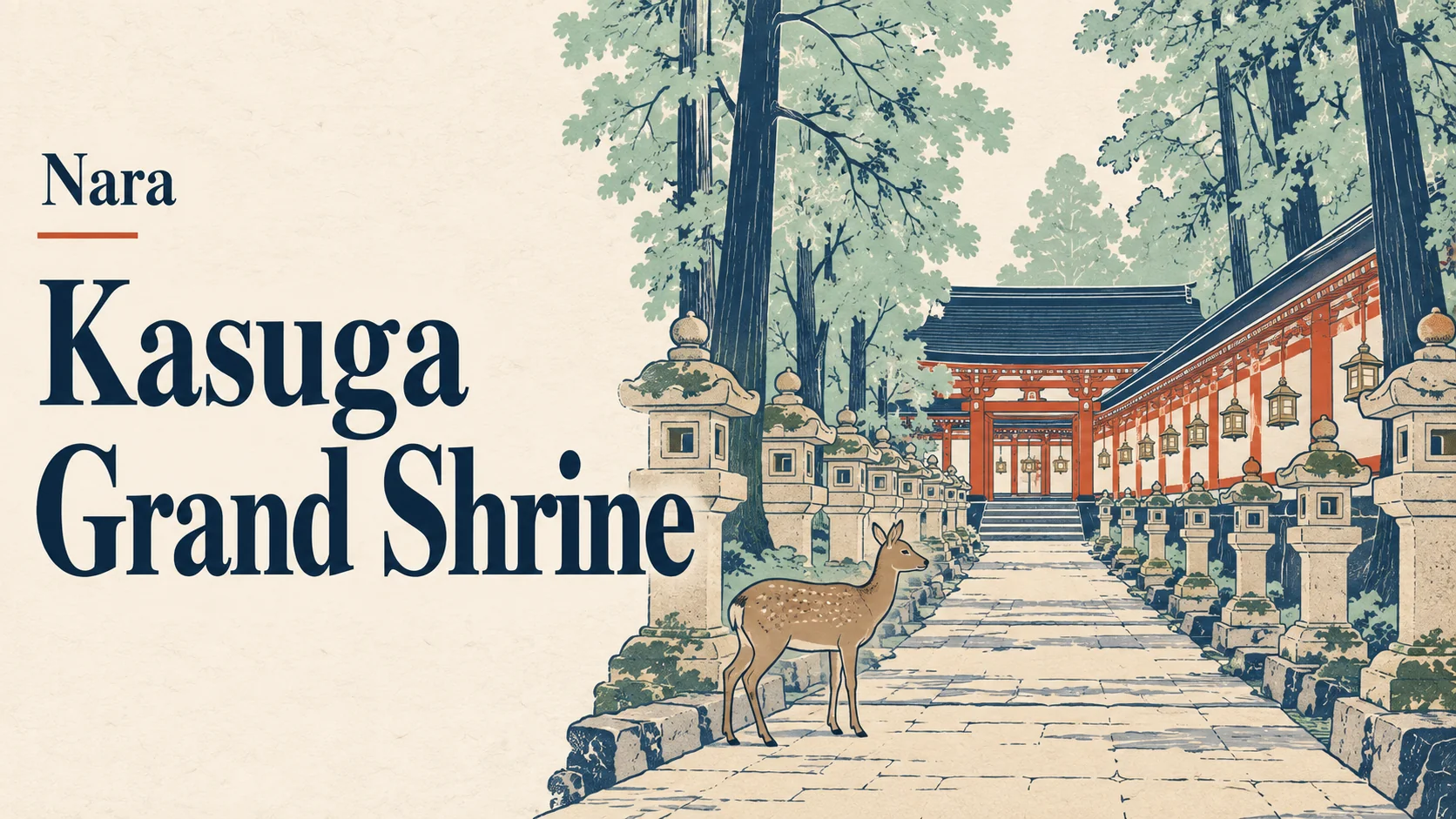
Kasuga Taisha (Kasuga Grand Shrine) is the shrine at the eastern edge of Nara Park, founded in 768 and famous for about 3,000 lanterns and the deer. The outer worship area is free; the inner cloister costs ¥700. This page names its four deities, explains why the lanterns are all lit on only three nights a year, using the shrine’s own figures, and shows why our classification returns Wind.
What you’ll learn
- Who the four deities are, where each came from, and which hall is whose
- How many lanterns there are, and the three nights they are all lit
- Hours, the ¥700 fees, the days the inner cloister is shut, and the bus from Nara Station
- Why it scores 90 as Wind, and why two of its four deities score nothing
What Kasuga Taisha Is
Kasuga Taisha is the Shinto shrine at the foot of Mount Mikasa in Nara, founded in 768 and head of about 3,000 Kasuga shrines.
The shrine’s own account calls it the head shrine of some 3,000 Kasuga shrines across Japan, and counts more than 2,200 rites performed in a year. Its halls sit where Nara Park meets the forested hills, a short walk east of Todaiji.
It belongs to a World Heritage property. UNESCO inscribed the Historic Monuments of Ancient Nara in 1998, the city having been Japan’s capital from 710 to 784. Nara City notes that the Kasugayama Primeval Forest behind the shrine is included with it, and that hunting and logging there were banned in 841. The shrine describes the forest as a Special Natural Monument.
One line to carry, because the park mixes the two: a shrine is Shinto and enshrines kami, deities, and you bow twice, clap twice and bow once; a temple, such as Todaiji or Kofukuji next door, is Buddhist, and you do not clap.
768: Four Deities from Three Provinces
The shrine dates its founding to the ninth day of the eleventh month of 768, when four deities were given halls here.
Its guide to the precinct takes the date from the Koshaki, the oldest surviving record of the shrine’s origins, written in the early Kamakura period. The sequence it gives is gradual. First Takemikazuchi was brought from Kashima, in present-day Ibaraki, to the summit of Mount Mikasa. Then Futsunushi came from Katori, in Chiba, and Ame-no-Koyane and Himegami from Hiraoka Shrine, in Osaka. In 768, by order of Empress Shotoku, the four were given halls side by side.
The shrine’s English page tells the same story: Takemikazuchi came to guard the new capital, Heijo-kyo. Ame-no-Koyane is the ancestral deity of the Fujiwara, the court family that dominated Nara and Heian politics.
Renewed Every 20 Years, 60 Times Over
The main halls are renewed by major repair on a 20-year cycle, and the shrine says this has now been carried out 60 times.
The ceremony is called shikinen zotai, the scheduled renewal of the halls. The shrine’s own account says it has now been carried out 60 times, a count the shrine says only Ise Jingu also reaches. The 60th renewal began in 2007; the deities were returned to the main halls on November 6, 2016, and the work extended to the 62 auxiliary shrines in the precinct.
One change from that renewal is visible. The guide to the precinct says the gate behind the main halls, closed for about 140 years, was opened on the occasion of the 60th renewal.
Who Is Enshrined at Kasuga Taisha
Four deities are enshrined in four halls standing in a row, numbered one to four from Takemikazuchi to Himegami.
| Hall | Deity | Brought from | In the shrine’s account |
|---|---|---|---|
| First hall | Takemikazuchi-no-mikoto | Kashima (Ibaraki), first to Mount Mikasa’s summit | Came first, to guard the capital; said to have arrived riding a white deer |
| Second hall | Futsunushi-no-mikoto | Katori (Chiba) | Enshrined after Takemikazuchi |
| Third hall | Ame-no-Koyane-no-mikoto | Hiraoka Shrine (Osaka) | Distant ancestor of the Fujiwara family |
| Fourth hall | Himegami | Hiraoka Shrine (Osaka) | Ame-no-Koyane’s consort; with him, parent of Wakamiya |
The hall numbers and origins are from the shrine’s guide to the precinct. The free worship area lets you pray from outside the cloister. The ¥700 special worship takes you inside it, past the hanging lanterns, to pray in front of the Chumon, the gate directly before the four halls.
The shrine’s account gives the reason for the deer here: Takemikazuchi is said to have come from Hitachi province riding a white deer, so the deer are treated as messengers of the deity.
Wakamiya, the Child Deity to the South
Wakamiya is the child of the third and fourth deities, born in 1003 and given its own hall to the south in 1135.
The shrine’s renewal pages date the birth to 1003 and the move to the present hall to the 27th day of the second month of 1135. A year later, in 1136, the Wakamiya’s own festival, the On-matsuri, began, and it still runs every December. The shrine places the Wakamiya 100 m south of the main precinct, at the foot of Mount Mikasa.
The 3,000 Lanterns and the Three Nights They Are All Lit
Kasuga Taisha holds about 3,000 lanterns, roughly 2,000 in stone and 1,000 in bronze, and lights them all on three nights.
The shrine’s page on the lantern festival gives the split: about 2,000 stone lanterns, ishidoro, along the approaches, and about 1,000 hanging lanterns, tsuridoro, under the eaves of the cloisters. It names two of the oldest. The Ruri-doro, a hanging lantern said to have been given by Fujiwara no Yorimichi, is dated 1038; a stone lantern of the Yunoki type, dated 1136, is said to be the second-oldest in Japan.
The event that lights every one is the Mantoro, the ten-thousand-lantern festival.
| Night | Lanterns lit | Inner cloister |
|---|---|---|
| Setsubun, the day before spring by the old calendar (early February) | About 18:00 | ¥700 |
| August 14 | About 19:00 | ¥700 |
| August 15 | About 19:00 | ¥700 |
The times and fee are from the lantern festival page and the shrine’s August page. A worshipper can have a lantern lit in their name with an offering of ¥3,000 or more. On any other night the lanterns are dark.
How Many of Japan’s Old Lanterns Are Here? The Shrine Gives Three Answers
The shrine’s pages give three different shares for its medieval lanterns, and each share is of a different whole.
| Shrine page | Share stated | Share of what |
|---|---|---|
| Guide to the precinct | Over 60% | Surviving lanterns from the Muromachi period or earlier |
| Renewal pages | Two thirds | Muromachi-period lanterns dedicated to shrines and temples across Japan |
| About the shrine | Nearly 70% | Muromachi-period lanterns in Japan |
The Muromachi period ran roughly from 1336 to 1573. Because the three wholes differ, the three figures do not contradict each other outright, and we do not pick one. What they share is the claim that more than half of Japan’s Muromachi-period lanterns stand at this shrine.
What to See: From the First Torii to the Inner Cloister
The route runs east from Nara Park through two torii to the South Gate, then into the cloister and south to Wakamiya.
| Stop | Fee | What to look at |
|---|---|---|
| Approach from the first torii | Free | Stone lanterns on both sides of the path |
| Nanmon, the South Gate | Free | 12 m, the largest tower gate at the shrine |
| Sunazuri-no-fuji, the wisteria | Free | Blooms in early May, clusters over 1 m, said to be more than 700 years old |
| The great cedar | Free | 8.7 m round, 25 m tall; a roof below has a hole cut for it |
| Chumon and its corridor | ¥700 (inner cloister) | About 10 m high, directly before the main halls; hanging lanterns along the cloister |
| Kaze-no-miya | ¥700 (inner cloister) | A shrine to two wind deities in the north-west corner of the cloister |
| Wakamiya and Meoto Daikoku-sha | Free; pilgrimage ¥1,500 | The child deity’s hall and a shrine to a married pair of Daikoku |
The figures are from the shrine’s guide to the precinct, which also says the Chumon, the middle gate, is the building people mistake for the main hall. It is a gate. The main halls are behind it and lower. The corridor on either side of the Chumon was where, the guide says, monks from Kofukuji once chanted sutras continuously, a reminder that shrine and temple were run together for centuries.
The great cedar grows beside the naorai-den, a hall for the meal shared after rites, and the shrine cut a hole in that roof to let the tree live. At Kaze-no-miya, the guide says, purification at Kasuga is held to be the wind deities’ power blowing impurity away. Wakamiya has its own circuit: the fifteen-shrine pilgrimage there costs ¥1,500, with the desk open 9:00 to 15:00. The shrine calls Meoto Daikoku-sha the only shrine in Japan to enshrine Daikoku as a married couple.
The Deer: Messengers of the Deity, 1,687 by the Latest Count
The Nara Deer Preservation Foundation counted 1,687 deer in Nara Park in July 2026, the most in its counts so far, Kansai TV reported.
The survey was held on July 16, 2026, by 38 people counting by eye, and Kansai TV reported it as the fifth year in a row of increase; the foundation said it believed the number had peaked. In the shrine’s account the deer are here because of Takemikazuchi’s white deer, which makes them messengers of the deity rather than park animals.
The count is the foundation’s, not the shrine’s; the shrine’s own page carries an older round figure, and we use the newer survey. Pets, drones and smoking are banned throughout the grounds, according to its visitor information.
Planning Your Visit: Hours, Fees and Closed Days
The outer worship area is free and opens at 6:30 from March to October; the paid inner cloister opens at 9:00.
| Item | Hours | Fee |
|---|---|---|
| Outer worship area | 6:30–17:30 March to October; 7:00–17:00 November to February | Free |
| Special worship in the inner cloister | 9:00–16:00 | ¥700 |
| Amulets and goshuin desk | 9:00 to gate closing | Goshuin ¥500 |
| Kokuhoden, the treasure museum | 10:00–17:00, last entry 16:30 | ¥700 |
| Manyo Botanical Garden | 9:00–16:30, last entry 16:00; closed Tuesdays June to March unless a holiday | ¥700 |
| Morning worship | Gather about 8:50; about 20 minutes | Free |
| Car park | 100 cars | ¥1,500 a car |
The inner cloister is closed all day from about March 8 to March 13, from December 20 to January 7, and on Coming of Age Day, and on the 1st, 11th and 21st of each month and several other dates it is shut in the morning. Those dates are on the shrine’s English visitor page, which matches the Japanese one.
The treasure museum holds 354 National Treasures and 2,528 Important Cultural Properties and shows a dadaiko, a ceremonial drum 6.5 m high. The botanical garden opened in 1932, grows about 300 plants named in the eighth-century poetry anthology Man’yoshu, and has around 200 wisteria of 20 varieties. The shrine’s own pages give ¥700 for each.
The morning worship, chohai, is open to anyone, free, except on festival days. The shrine publishes no time-of-day crowd figures, so we name no quiet hour.
Goshuin and the Deer Omikuji
A goshuin costs ¥500 since April 1, 2023, and for the main shrine only it is written in your own book from 9:00 to 17:00. On days the shrine expects crowds, it is given on paper only.
A goshuin is the seal and calligraphy given as a record of a visit. The fee and the hours are from the shrine’s goshuin notice, which adds that the goshuin of Wakamiya, Meoto Daikoku-sha and Kinryu Shrine are given on paper only, at the Meoto Daikoku-sha desk. The fortune it is known for is the deer omikuji, a paper fortune: a small carved deer holding the slip in its mouth, ¥600 for the brown one or the white one, on the shrine’s amulet page.
Festivals: What You Can Watch and What Is Closed
The Kasuga Festival on March 13 is closed to visitors; the On-matsuri in December is the one you can watch.
The Kasuga Festival, the Kasuga-sai, is held on March 13 with an envoy from the Emperor, is said to date from 849, and is one of Japan’s three imperial festivals with the Aoi and Iwashimizu festivals. The shrine marks it not open for viewing.
The On-matsuri runs December 15 to 18, centred on the 17th. It began in 1136, draws a procession of about 1,000 participants and some 50 horses, and was designated an Important Intangible Folk Cultural Property of Japan in 1979. Its core rite starts at midnight on the 17th: the deity is carried to a temporary shrine in about 50 minutes, in darkness, with photography and lights forbidden.
Getting to Kasuga Taisha from Nara Station
A Nara Kotsu bus from JR or Kintetsu Nara Station reaches the shrine in about 11 to 15 minutes.
| From | How | Time | Get off at |
|---|---|---|---|
| JR Nara or Kintetsu Nara | Nara Kotsu bus bound for Kasuga Taisha Honden | About 11–15 min | Kasuga Taisha Honden, at the shrine |
| JR Nara or Kintetsu Nara | City loop bus, outer line | About 9–13 min, then 10 min on foot | Kasuga Taisha Omotesando |
| Kintetsu Nara | On foot through Nara Park | About 25 min | — |
| By car | Shrine car park | — | ¥1,500 a car, 100 spaces |
The routes and times are from the shrine’s visitor information. The fare is Nara Kotsu’s flat city fare, which the Nara Shimbun reported would rise from ¥220 to ¥250 on February 1, 2024.
Our advice: walk if you want to see the stone lanterns; the bus to the Honden stop sets you down at the shrine and skips the approach.
Five Elements Classification: Why Kasuga Taisha Is a Wind Shrine
Kasuga Taisha scores 90 as Wind, because its first two deities are thunder and storm deities and so is the Kasuga lineage.
Kannavi sorts every shrine into one of five elements — Earth, Water, Fire, Wind and Void. This is our classification, not a teaching of any shrine and not a fortune. It reads three checkable layers: the deities, 60 for the principal and 15 per further match; the geography, 25; the lineage in the name, 15.
| Layer | What was matched | Category | Element | Points |
|---|---|---|---|---|
| 1. Deity | Takemikazuchi (principal, first hall) | Thunder and storm deities | Wind | 60 |
| 1. Deity | Futsunushi (second hall) | Thunder and storm deities | Wind | 15 |
| 1. Deity | Ame-no-Koyane (third hall) | No category matched by name | — | 0 |
| 1. Deity | Himegami (fourth hall) | No category matched by name | — | 0 |
| 2. Geography | The foot of Mount Mikasa, a sacred mountain | Mountain or summit | Earth | 25 |
| 3. Lineage | Kashima, Katori and Kasuga shrines | Kasuga lineage | Wind | 15 |
| Total | Wind 90, Earth 25 | Wind (high) | ||
The two zeros are the line to read. Ame-no-Koyane and Himegami, the Fujiwara ancestors who give the shrine its best-known identity, score nothing, not because our rules rank them lower but because the classifier matches a name against a list of categories and theirs are not on it. We print the limit rather than hide it.
A second element is named only when the runner-up reaches 80 percent of the leader, which here would take 72 points. Earth has 25, so Kasuga is Wind alone. Relations run around a ring — Earth to Fire to Void to Water to Wind and back — in which each shifts the flow of the next rather than opposing it.
Separately from the score, the precinct has a wind shrine of its own. Kaze-no-miya enshrines Shinatsuhiko and Shinatsuhime, deities of wind, and the shrine says purification here works by the wind blowing impurity away. Auxiliary shrines are not an input to the classification, so it adds nothing to the 90; it is a coincidence worth knowing, not the reason.
The comparison is inside this bundle. Yasaka Shrine in Kyoto is Wind at 75 and Nezu Shrine in Tokyo Wind at 60, so Kasuga is the strongest Wind shrine we have classified. On the ring, Wind comes after Water, as at Itsukushima Shrine, and before Earth, as at Fushimi Inari Taisha.
Frequently Asked Questions
The six questions below answer whether Kasuga Taisha is worth visiting, what it costs, how long it takes and what is open to visitors. Figures are from the shrine’s own pages unless another source is named.
Q. Is Kasuga Taisha worth visiting?
A. Yes, if you are already in Nara Park: the outer worship area is free and a short walk east of Todaiji. It holds about 3,000 lanterns, four halls renewed every 20 years, 60 times so far, and a World Heritage forest behind it. The ¥700 inner cloister is the part to judge, and it is where the bronze lanterns hang.
Q. How much does it cost to enter Kasuga Taisha?
A. Nothing for the outer worship area. The special worship in the inner cloister is ¥700, 9:00 to 16:00, and the treasure museum and the Manyo Botanical Garden are ¥700 each. The Wakamiya fifteen-shrine pilgrimage is ¥1,500, and the car park ¥1,500 a car. A goshuin is ¥500.
Q. How much time do you need at Kasuga Taisha?
A. The shrine publishes no figure, so build it from the ones it does. The walk from Kintetsu Nara is about 25 minutes, the morning worship about 20, and the inner cloister closes at 16:00, the museum’s last entry at 16:30. Add Wakamiya, 100 m south, if you want the full circuit.
Q. Is Kasuga Taisha a temple?
A. No, it is a Shinto shrine, and taisha means grand shrine. It stands in the same park as the Buddhist temples Todaiji and Kofukuji, and for centuries Kofukuji monks chanted sutras in the shrine’s Chumon corridor. You bow twice, clap twice and bow once at the shrine; you do not clap at the temples.
Q. Can you see the lanterns lit on a normal night?
A. No. The shrine lights all of its roughly 3,000 lanterns only on three nights: Setsubun in early February, from about 18:00, and August 14 and 15, from about 19:00. On other nights they stay dark, and the grounds close at 17:00 or 17:30 depending on the season.
Q. Can visitors attend the Kasuga Festival on March 13?
A. No. The shrine marks the Kasuga Festival not open for viewing, and the inner cloister is closed from about March 8 to 13 around it. The festival you can watch is the On-matsuri, December 15 to 18, whose procession of about 1,000 people and 50 horses runs through the city on the 17th.
Summary
Kasuga Taisha is a shrine of four deities founded in 768, lit by 3,000 lanterns on three nights a year.
- Founded in 768 for four deities from Kashima, Katori and Hiraoka; head of about 3,000 Kasuga shrines.
- Its halls are renewed every 20 years, 60 times so far; the latest reinstallation was November 6, 2016.
- About 2,000 stone and 1,000 hanging lanterns, all lit only at Setsubun and on August 14 and 15.
- Outer area free; inner cloister, treasure museum and botanical garden ¥700 each; inner cloister closed around March 13 and at New Year.
- 11 to 15 minutes by bus from Nara Station; 1,687 deer in the park at the July 2026 count.
- In the Kannavi classification, Kasuga Taisha is Wind 90 with no sub-element, and two of its four deities score nothing.
Next: another Wind shrine at Yasaka Shrine in Kyoto, the other shrine that renews its halls 60 times at Ise Jingu, lanterns of a different kind at Nikko Toshogu, the goshuin, or the English guide to Japanese shrines.
The deer and the lanterns are what a first visit sees, which is fair; both are in front of you. The quieter fact is in the list of halls. A shrine best known as the Fujiwara family’s is, by the order of its own halls, first the house of a deity who came from the east on a white deer, and the family’s ancestors stand third and fourth.