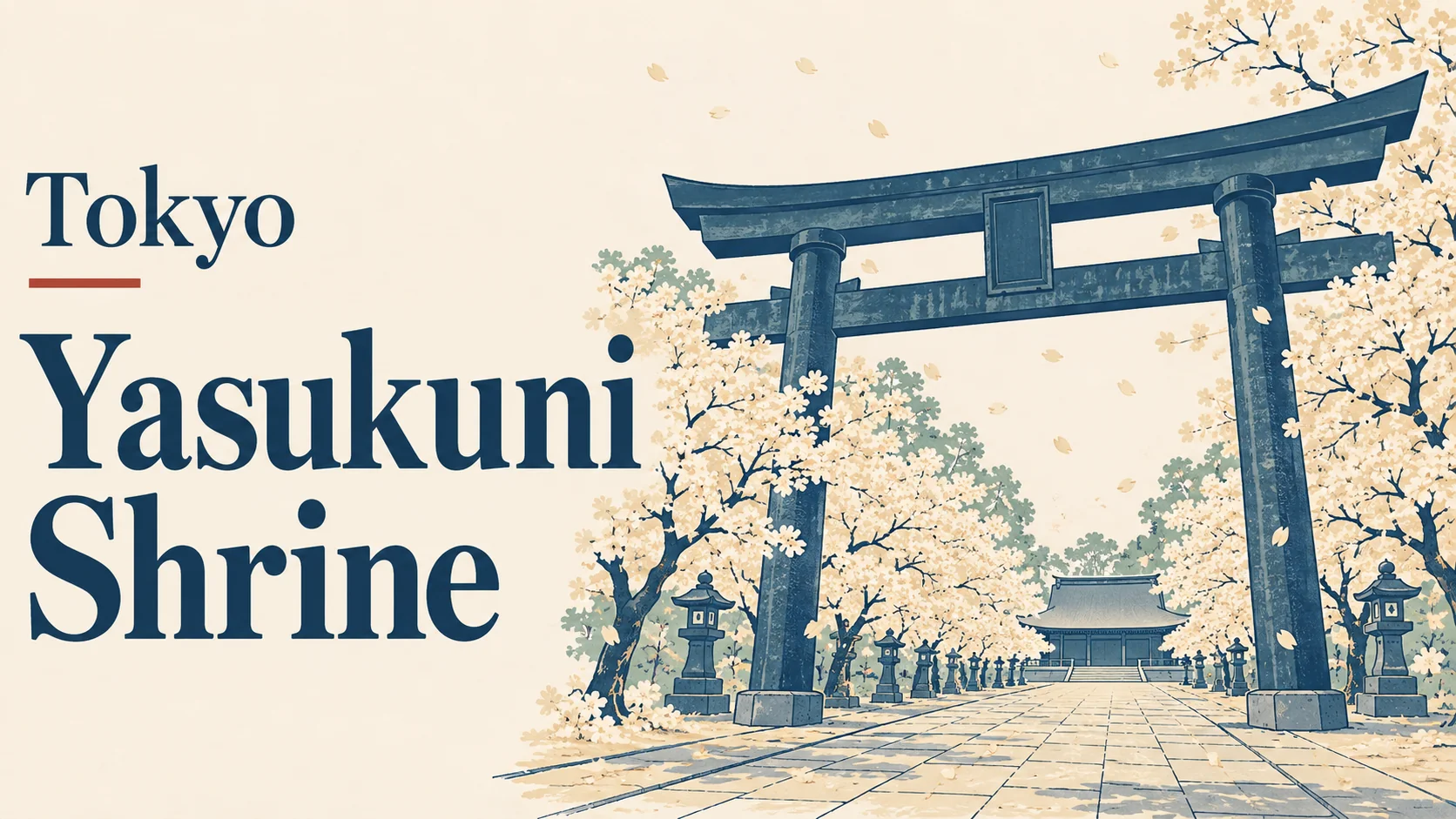
Yasukuni Shrine, or Yasukuni Jinja, is a Shinto shrine in Chiyoda, Tokyo, founded in 1869, by its own account, to enshrine those who died for the state, and now listing more than 2,466,000 enshrined spirits. The grounds carry no listed fee, the Yushukan museum charges adults ¥1,000, and Kudanshita Station is five minutes away. Encyclopedias tie a long political dispute over it to the enshrinement in 1978 of 14 men convicted as Class A war criminals.
What you’ll learn
- Why the shrine was founded, who is enshrined, and what each side in the dispute has said, with sources
- Prime ministers’ visits and offerings from 1985 to August 2026
- Yushukan fees by age, its 2026 closures, and the three rule changes of 2026
- Station exits, cherry blossom dates, and why our classification returns Fire
What Yasukuni Shrine Is
Yasukuni Shrine is a Shinto shrine in central Tokyo that honours the war dead of Japan’s wars from 1868 to 1945 as kami.
Jinja means a Shinto shrine, so Yasukuni Jinja and Yasukuni Shrine are the same place. A shrine is where kami, the deities of Shinto, are worshipped; a temple is a Buddhist site that houses images of the Buddha. The shrine’s history page says the name was chosen by Emperor Meiji and means “to bring peace to the nation”. Its English page gives five million visitors a year.
By the shrine’s own list, Yasukuni worships people rather than a deity from myth: those who died in Japan’s conflicts. In its English wording, the shrine considers them completely equal regardless of rank or social standing.
From Tokyo Shokonsha to Yasukuni
The shrine began on June 29, 1869 as Tokyo Shokonsha, a shrine for the war dead, and took the name Yasukuni Jinja in 1879.
A shokonsha is a shrine where the spirits of the dead are honoured. The shrine says it was built at the wish of Emperor Meiji at the top of Kudan slope, on a site chosen by Omura Masujiro, founder of Japan’s modern army. The Britannica encyclopedia on Kotobank says it first enshrined 3,588 people who died for the new government in the Boshin War and other conflicts. On June 4, 1879 it was renamed and given the rank the shrine translates as Imperial Shrine of Special Status.
The Nihon Daihyakka encyclopedia on the same page says that before 1945 it came under the army and navy, with the army doing most of the running. After the war, Britannica and the Yamakawa dictionary say, it left state control and became an independent religious corporation, and the Mypedia encyclopedia adds that it does not belong to the Association of Shinto Shrines. The Nihon Daihyakka entry on the Yasukuni question ties the change to the Shinto Directive issued by the occupation authorities in December 1945.
Who Is Enshrined
The shrine lists more than 2,466,000 enshrined spirits, from the Boshin War of 1868 to the Second World War, including civilians.
The shrine’s list runs through the Boshin War, the Satsuma Rebellion, the wars with China and Russia, the First World War, the Manchurian Incident and what it calls the Greater East Asia War. It also names men of the 1860s such as Sakamoto Ryoma and Yoshida Shoin. The same page includes people from Taiwan and the Korean Peninsula who fought and died as Japanese at the time, soldiers who died in Siberian detention, and those executed at the end of the war as so-called war criminals.
One small shrine on the grounds is for those who are not enshrined: Chinreisha, built in 1965, which the shrine says honours people at home and abroad who died in wars and incidents but are not enshrined at Yasukuni.
Why Yasukuni Shrine Is Controversial
Encyclopedias and government statements place the dispute on the 14 Class A war criminals enshrined in 1978 and on visits by Japanese leaders.
The Mypedia encyclopedia on Kotobank says that in 1978 the shrine enshrined 14 Class A war criminals who had been executed or had died in prison. The Nihon Daihyakka entry names Tojo Hideki among them and says they were enshrined as “Showa martyrs”. The shrine’s website gives no year; its history page says those executed as so-called war criminals are enshrined like everyone else.
The second part is official visits by government leaders to what is now a religious body. When Prime Minister Nakasone Yasuhiro made what Mypedia calls the first official visit by a postwar prime minister in 1985, his chief cabinet secretary said the day before that it would be made in a form showing it had no religious significance. Mypedia says it drew strong protests from South Korea and China. A year later the government announced that the prime minister would not make an official visit.
| Date | Who | What they did | Source |
|---|---|---|---|
| Aug 15, 1985 | PM Nakasone | First official visit by a postwar prime minister | Mypedia (Kotobank) |
| Aug 14, 1986 | Chief cabinet secretary Gotoda | Announced no official visit the next day | Government statement |
| 2001–2006 | PM Koizumi | Visited six times; on August 15 in 2006 | Nihon Daihyakka (Kotobank) |
| Dec 26, 2013 | PM Abe | Visited, and also visited Chinreisha | Prime minister’s office |
| Aug 15, 2024 | PM Kishida | Offering as party president; no visit | Jiji Press |
| Oct 2024, Apr 2025 | PM Ishiba | Sent a masakaki offering; no visit | Jiji Press; Nikkei |
| Aug 15, 2025 | PM Ishiba | Offering; a cabinet minister visited | Korea Herald |
| Apr 21–22, 2026 | PM Takaichi | Masakaki, then a private offering; no visit | Kyodo |
| Aug 15, 2026 | PM Takaichi | Offering as party president; four ministers visited | Jiji Press; Seoul Economic Daily |
Each side has stated its position in its own words. In his statement of December 26, 2013, Prime Minister Abe Shinzo said some people criticise the visit as paying homage to war criminals, and that his purpose was to renew the pledge that Japan must never wage war again. The US Embassy in Tokyo said the same day that the United States was “disappointed” by an action that would raise tensions with Japan’s neighbours.
For a memorial without a religious side, Mypedia notes that in 1959 the state opened the Chidorigafuchi National Cemetery, about 12 minutes on foot from Kudanshita Exit 2. The Ministry of the Environment, which manages it, says it holds the remains of 371,008 war dead who died overseas, as of May 2025.
Prime Ministers and the Shrine Since 2024
In the reports we checked from 2024 to 2026, no prime minister visited in person; each sent offerings during festivals instead.
A masakaki is a sacred evergreen offering placed at a festival. Prime Minister Takaichi Sanae sent a masakaki in her title as prime minister on April 21, 2026 and paid a private offering the next day, without visiting, Kyodo reported. China’s foreign ministry spokesman called Japan’s moves “a blatant provocation against international justice”. On August 15, 2026, the anniversary of the end of the war, she paid an offering as party president, and four cabinet ministers, among them Defence Minister Koizumi Shinjiro, visited, Jiji Press reported. South Korea’s foreign ministry deplored the offerings and visits the same day.
What to See: Gates, Halls and the Yushukan
The main axis runs west from Kudanshita through three torii and the Shinmon gate to the worship hall, with the Yushukan museum beside it.
A torii is the gateway that marks the way into a shrine. The first, at the Kudanshita end of the approach, is 25 metres high. Dates come from the shrine’s guide to the grounds; names in brackets from its English guide. The worship hall, haiden, is where visitors pray; the main sanctuary behind it, honden, is entered only for formal worship.
| Feature | Year | What the shrine says |
|---|---|---|
| First torii (Daiichi Torii) | 1921; removed 1943; rebuilt 1974 | 25 m high; the 1974 gate was given by war veterans |
| Second torii (Daini Torii) | 1887 | The largest bronze torii in Japan |
| Shinmon gate | 1934 | Chrysanthemum crests 1.5 m across on its doors |
| Great water basin | 1940 | Granite, over 18 tonnes; given by Japanese living in the United States |
| Worship hall (Haiden) | 1901 | Offering box in front; prayers are said here |
| Main sanctuary (Honden) | 1872 | Roof restored 1986–1989 |
| Noh stage (Nogakudo) | Built 1881; moved here 1903 | First stood in Shiba Park |
| Motomiya | Given in 1931 | Built in Kyoto for men who died before the Meiji Restoration |
| Chinreisha | 1965 | For war dead at home and abroad not enshrined here |
Inside the Yushukan Museum
The Yushukan is the shrine’s museum, opened in 1882, with 22 exhibition rooms; adults pay ¥1,000 and need one to one and a half hours.
The museum’s page says the first building opened its doors on February 25, 1882, and that a new wing with two video halls was added in 2002. Its large hall, where photography is allowed, shows a Type 52 Zero fighter and the C56 No. 31 steam locomotive. Since January 2025, the shrine says, the captions in its permanent rooms carry English alongside the Japanese.
| Who | Standard fee | After formal worship |
|---|---|---|
| Adults | ¥1,000 | ¥500 |
| University and college students | ¥500 | ¥300 |
| Junior and senior high school students | ¥300 | ¥200 |
| Elementary pupils | Free | Free |
| Groups of 20 or more | 20% off | — |
| Disability certificate holders | Free, with one carer | — |
| Hours | 9:00–16:30, last entry 16:00 | |
| Closed in 2026 | June 23–25 and December 22–27 | |
The 2026 closures are on the shrine’s notice. Photography is not allowed in the exhibition rooms, except in the entrance hall and the large hall.
Visiting Yasukuni Shrine: Hours, Fees, Goshuin and Rules
The grounds open at 6:00 every day and close at 18:00 from March to October, or 17:00 in the other four months.
Tourists and anyone else may visit. The shrine’s questions page says visitors who are not bereaved families can pray at the worship hall and also take part in formal worship, and that small groups need no booking. Bow twice, clap twice and bow once, both in front of the hall and inside.
| Item | Hours | Fee |
|---|---|---|
| Grounds | 6:00–18:00 (Mar–Oct); 6:00–17:00 (Jan, Feb, Nov, Dec) | No fee listed |
| Shrine office | 9:00–17:00 | — |
| Formal worship in the main sanctuary | On the hour, 9:00–16:00; register 15 min before; about 40 min | From ¥5,000; ¥10,000 with your name brushed on the talisman |
| Goshuin (Sanshuden desk) | Autumn 2026 seal in your own book: 9:00–16:45 | Autumn 2026 seal ¥1,000; regular price not listed |
| Goshuin book | — | ¥1,200 |
| Yushukan | 9:00–16:30 | Adults ¥1,000 |
| Car park | 8:00–22:00 | ¥300 per 30 min; free after formal worship |
Since May 1, 2026, formal worship has run once an hour on the hour, by the shrine’s notice; fill in a form at the Sanshuden hall and a priest leads you in, with no booking, says the fee page. A goshuin is the seal and calligraphy given as a record of your visit; the shrine gives it at the Sanshuden desk. The autumn 2026 seal is on a separate notice and ends when stock runs out.
Photos, Dress and the 2026 Rules
Snapshots and social media posts need no permission, but photography is banned in the main sanctuary, and costumes have been banned since August 2026.
The shrine’s photography page, revised in April 2026, says visitors may take souvenir photos and post them on social media without applying; work shoots, including influencers’, need permission. Its list of rules bans drones, picnic sheets and dog walking in the inner grounds. On August 7, 2026 the shrine banned cosplay costumes and military dress anywhere on the grounds, all year; serving personnel in their own uniform are exempt. For formal worship, the shrine asks visitors to avoid revealing clothes and bare feet.
Getting to Yasukuni Shrine
Take the Tozai, Hanzomon or Toei Shinjuku line to Kudanshita Station and walk about five minutes from Exit 1.
| From | Exit or route | Time given by the shrine |
|---|---|---|
| Kudanshita Station (Tozai, Hanzomon, Toei Shinjuku) | Exit 1 | About 5 min on foot |
| Ichigaya Station (JR, subway) | Subway Exit A4 | About 10 min on foot |
| Iidabashi Station (JR) | West exit | About 10 min on foot |
| Kudanue bus stop | Kudanshita–Takadanobaba route | About 1 min |
| Tokyo Station | Subway or JR | About 6 min by subway, 10 by JR, 15 by taxi |
| Haneda / Narita Airport | Train | About 40 / 60 min, transfers not included |
The times come from the shrine’s access page and, for Narita, its English access page; the Chiyoda tourism association gives the same walking times. Tokyo Metro’s station page marks Exit 1 as having limited hours.
Cherry Blossoms, Mitama Matsuri and the Shrine’s Year
Yasukuni holds Tokyo’s official cherry tree, the Mitama Matsuri lantern festival in July, and two annual festivals in April and October.
The Japan Meteorological Agency’s Tokyo office has used a Somei Yoshino tree on the grounds as the city’s sample tree since 1966. In 2026 it opened on March 19, five days before the average of March 24, and full bloom on March 28, against an average of March 31. The shrine traces its cherries to a planting in 1870; its English guide gives about 600 trees.
A matsuri is a shrine festival. The Mitama Matsuri began in 1947 and runs every July 13 to 16, when the shrine’s calendar says more than 30,000 lanterns large and small hang in the grounds. Food stalls were suspended from 2015, a local paper reported; the shrine’s calendar does not mention stalls, so check before you go.
| Date | Event | What it is |
|---|---|---|
| Late March | Cherry blossoms | Tokyo’s sample tree; in 2026 open March 19, full March 28 |
| April 21–23 | Annual Spring Rites | An envoy of the Emperor attends; sumo is offered beforehand |
| July 13–16 | Mitama Matsuri | 30,000+ lanterns; grounds open 6:00–21:30 |
| October 11–12, 2026 | Awa dance; Kusajishi archery | Dance on the approach; an old archery rite by the Noh stage |
| October 17–19, 2026 | Annual Fall Rites | Saturday to Monday; grounds open 6:00–20:00 |
| October 26–November 8, 2026 | Chrysanthemum show | About 200 pots by the Noh stage; free |
| December 31 | New Year | For 2026 the gates opened at 23:30 on New Year’s Eve |
Sources: the 2026 autumn notice and the 2026 New Year notice.
Five Elements Classification: Why Yasukuni Shrine Is a Fire Shrine
Yasukuni Shrine scores 60 as Fire, because its enshrined spirits fall in our category of people who made their name in arms.
Kannavi sorts every shrine into one of five elements. This is our classification, not a teaching of the shrine and not a fortune. It reads three checkable layers: the principal deity, 60, with 15 for each further deity; the geography, up to 25; the lineage in the name, 15.
| Layer | What was matched | Category | Element | Points |
|---|---|---|---|---|
| 1. Deity | Eirei, the spirits of the war dead | Shrines to people who made their name in arms | Fire | 60 |
| 2. Geography | On a rise at the top of Kudan slope | Hill or plateau, reached by steps | Earth | 15 |
| 3. Lineage | No match in the name | — | — | 0 |
| Total | Fire 60; Earth 15; Water, Wind, Void 0 | Fire (medium) | ||
The deity row depends on the word used. The history page speaks of 2,466,000 divine spirits, and entered in that form the classifier returns undetermined. The shrine’s home page calls them eirei, the spirits of those who fell for the nation, and that word matches our category of warriors, which returns Fire.
The geography row takes one reading, capped at 25. Read as a shrine on a rise, it adds Earth 15. Read as a shrine with a long approach and wide grounds, it adds Void 25 instead. We ran both: Fire stays first, because a second element would need 80 percent of the leader, here 48.
On the ring of five, each element shifts the flow of the next. The other Fire shrines in this guide are Nikko Toshogu, where the first Tokugawa shogun is enshrined, and Tsurugaoka Hachimangu in Kamakura, both at 90.
Frequently Asked Questions
Anyone may visit, the grounds carry no listed fee, and encyclopedias tie the dispute to the 1978 enshrinement and official visits.
Q. Can tourists visit Yasukuni Shrine?
A. Yes. The shrine says anyone may pray at the worship hall, and visitors who are not bereaved families may also take part in formal worship without booking. Souvenir photos and social media posts need no permission. Photography is banned inside the main sanctuary, and since August 7, 2026 cosplay costumes and military dress are banned on the grounds all year. It also asks photographers to keep off the centre of the approach and the top of the steps.
Q. Why is Yasukuni Shrine controversial?
A. Encyclopedias say 14 Class A war criminals were enshrined in 1978, and visits by prime ministers have drawn protests from China and South Korea since 1985. Prime ministers who visited, such as Abe in 2013, have said they went to honour the war dead and pledge never to wage war again. Critics, including China’s foreign ministry, have called such acts a provocation. Lawmakers also go as a group: Kyodo counted more than 120 at the spring festival of 2026.
Q. Is Yasukuni Shrine free to enter?
A. The shrine lists no fee for the grounds, which open at 6:00 and close at 18:00 from March to October, or 17:00 from November to February. The Yushukan museum charges adults ¥1,000, less for students, and nothing for elementary pupils. Formal worship starts at ¥5,000. The flower shows by the Noh stage, such as the autumn chrysanthemums, are free, the shrine says.
Q. How long do you need at the Yushukan museum?
A. The museum itself suggests one to one and a half hours for its 22 exhibition rooms and two video halls. It opens from 9:00 to 16:30, with last entry at 16:00, and in 2026 it closes June 23 to 25 and December 22 to 27. Since January 2025 its captions have carried English. The shrine says the collection holds about 100,000 items, from paintings to armour.
Q. When do the cherry blossoms bloom at Yasukuni Shrine?
A. In late March, on the averages. The weather agency’s sample tree for Tokyo stands here, and its average dates are March 24 for opening and March 31 for full bloom. In 2026 it opened on March 19 and reached full bloom on March 28. The Chidorigafuchi moat, by Kudanshita Exit 2, held its 2026 cherry festival from March 5 to April 22, with lights from March 26 to April 6.
Q. Is Yasukuni Shrine a temple?
A. No. Yasukuni is a Shinto shrine, where the war dead are worshipped as kami; a temple is a Buddhist site with images of the Buddha. Since the end of the war it has been an independent religious corporation outside the Association of Shinto Shrines, according to the Britannica and Mypedia encyclopedias.
Summary
Yasukuni Shrine is Tokyo’s shrine to the war dead, founded in 1869; in 2026 China and South Korea again protested offerings made there.
- Founded as Tokyo Shokonsha in 1869, it lists more than 2,466,000 enshrined spirits.
- Encyclopedias date the enshrinement of 14 Class A war criminals to 1978; from 2024 to 2026 prime ministers sent offerings rather than visiting.
- The grounds open 6:00 to 18:00, or 17:00 in winter, with no listed fee; the Yushukan charges adults ¥1,000.
- Kudanshita Exit 1 is five minutes away; Tokyo’s sample cherry tree blooms here in late March.
- In the Kannavi classification, Yasukuni Shrine is Fire 60, with Earth 15 behind it.
Next: the other Fire shrines, Nikko Toshogu and Tsurugaoka Hachimangu; Meiji Jingu, the shrine to the emperor who founded Yasukuni; Nezu Shrine and the rest of the shrines in Tokyo; Inari Shrine; what to ask for in the goshuin guide; or the English guide to Japanese shrines.
Read what each side says, then walk up from Kudanshita and see it yourself.