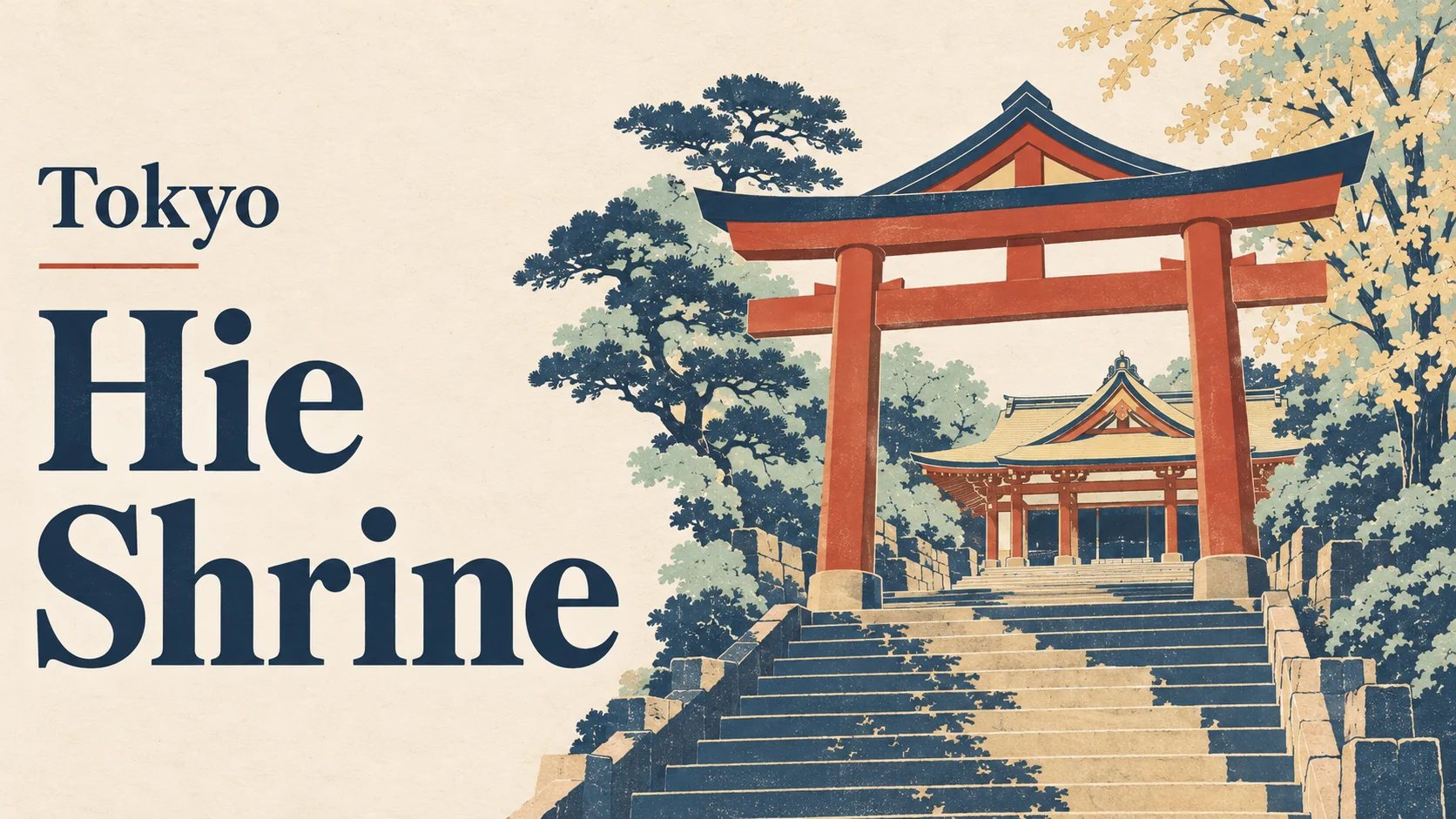
Hie Shrine in Tokyo is the Shinto shrine on a small hill in Nagatacho, next to Akasaka, that once guarded Edo Castle and still hosts the Sanno Matsuri. Its official access page puts it three minutes on foot from Exit 2 of Akasaka Station or Exit 7 of Tameike-Sanno Station. Entry is free. The gates open from 6:00 to 17:00, but the office that writes goshuin closes at 16:00.
What you’ll learn
- Who the four kami of Hie Shrine are, and how the shrine moved from Edo Castle to Nagatacho
- What makes the Sanno torii, the monkey guardians and the Inari torii path worth the climb
- Gate, office and prayer hours, fees, goshuin and the treasure hall’s 31 swords
- Which exit to take from four subway stations, and the 2026 Sanno Matsuri dates
- How it differs from Hie Shrine in Takayama, and why it scores Earth 105
Hie Shrine Tokyo: What It Is and Who Is Enshrined
Hie Shrine, also called Hie Jinja or Akasaka’s Sanno-san, is a Shinto shrine for Oyamakui, a mountain god, and three kami enshrined beside him.
A shrine is where kami, the deities of Shinto, are worshipped; a temple is a Buddhist site with images of the Buddha. Hie Shrine is a shrine, so visitors bow and clap at the main hall. The address is 2-10-5 Nagatacho, Chiyoda, a few minutes from the National Diet, and English guides file it under both Akasaka and Nagatacho.
The shrine’s history page lists one principal kami and three kami in the same hall. Its English page names only Oyamakui, so a guide that follows it lists one deity. The table follows the Japanese page.
| Role | Kami | Who the kami is | Source |
|---|---|---|---|
| Principal | Oyamakui-no-kami | Mountain god of Mount Hiei; the Kojiki also places him at Matsuo in Kyoto | Hie Shrine |
| Enshrined with him | Kuninotokotachi-no-kami | One of the first kami to appear when heaven and earth began | Hie Shrine |
| Enshrined with him | Izanami-no-kami | Mother of the Japanese islands in the creation myth | Hie Shrine |
| Enshrined with him | Tarashinakatsuhiko-no-mikoto | The legendary Emperor Chuai | Hie Shrine |
Oyamakui and the Sanno Faith
Oyamakui is the god of Mount Hiei near Kyoto, and the faith built around him there is called Sanno, “king of the mountain”.
The head shrine of this faith is Hiyoshi Taisha at the foot of Mount Hiei. Its official site calls it the head of about 3,800 Hiyoshi, Hie and Sanno shrines across Japan. The Tokyo shrine’s history page quotes the Kojiki, which places Oyamakui on Mount Hiei and at Matsuo, and describes him as a god of mountains and water who protects growth. Today, the shrine says, people come to him for protection from misfortune, safe childbirth, marriage and business.
That last point fits the setting. Hie Shrine sits among ministries, hotels and office towers, and the shrine offers prayers for companies as well as for families.
From Edo Castle to Nagatacho
Hie Shrine was brought into Edo Castle in 1478, moved outside it in the early 1600s, and has stood on its present hill since 1659.
The shrine’s history page tells it in steps. In the Kamakura period the Edo clan worshipped a Sanno shrine here. In 1478 the warlord Ota Dokan brought the Sanno kami of Kawagoe into his new Edo Castle. After Tokugawa Ieyasu took the castle in 1590, the shrine became its guardian and the guardian of Edo’s people. When the second shogun rebuilt the castle, the shrine moved outside, to the area around today’s National Theatre. The English page dates that move to 1607; the Japanese page gives no year. Wikipedia mentions an older record from 1362, an account the shrine does not use.
The great Meireki fire of 1657 burned the shrine. In 1659 the shogun Ietsuna gave it the present hill, a lord’s estate overlooking the Tameike pond. That building became a National Treasure and was lost in the air raids of May 1945. Only the small Sanno Inari shrine survived. The main hall was rebuilt in 1958.
The name changed too. Until 1868 the shrine was known as Hiyoshi Sanno Gongen or Edo Sanno Gongen; the shrine says it has used the name Hie Jinja since that year. It was ranked among the highest government shrines before the Second World War, a ranking abolished after it.
What to See at Hie Shrine
The highlights of Hie Shrine are the Sanno torii, the monkey guardians, the Inari torii path and the painted hall ceiling.
| What | Where | Why look | Source |
|---|---|---|---|
| Sanno torii | Entrances | A torii with a peaked frame on top, the shrine’s landmark | Hie Shrine |
| Shinen monkeys | Either side of the main hall | A mother monkey with her baby and a father monkey, in place of lion-dogs | Sanno Matsuri site |
| Inari torii path | Leading to the Sanno Inari shrine | A line of vermilion torii down the slope | Hie Shrine |
| Sanno Inari, Yasaka and Sarutahiko shrines | Inside the grounds | Three smaller shrines; Sanno Inari’s hall dates from 1659 | Hie Shrine |
| Ceiling paintings | Worship hall | 123 painted panels, added in 2008 | Hie Shrine |
| Sazare-ishi stone | Grounds | The “pebble” named in Japan’s national anthem | Hie Shrine |
The Sanno Torii
A Sanno torii is a shrine gate with a triangular, roof-like frame set above its top beam, named after the Sanno faith.
A torii is the gate that marks the entrance to a shrine’s sacred ground. Most torii end in a straight or gently curved beam. Here a peak rises above it, which makes the gates easy to spot from the street. The shrine itself tells visitors to look for the white Sanno torii when they come up from the station. The shrine’s pages do not explain the shape, so this guide does not attach a meaning to it.
The Shinen Monkeys Instead of Lion-Dogs
At Hie Shrine, a pair of monkey statues guards the main hall, in place of a pair of stone lion-dogs.
The festival site says the shrine keeps guardian monkeys rather than komainu, the pair of stone lion-dogs. Here the monkey is the messenger of Oyamakui, called shinen or masaru. The shrine’s festival site gives three readings of the word: “evil leaves”, “to excel” and, read another way, “bond”. Facing the hall, the mother monkey holding her baby stands on the left and the father monkey on the right. The sculptor was Suzuki Keiun, and they were given in 1967. People touch the mother for children and safe birth, and the father for business and good matches.
The monkeys appear on the amulets as well. The amulet page lists a masaru charm at ¥800 or ¥1,000 and a monkey fortune slip at ¥500, at prices that apply from January 1, 2026.
The Sanno Inari Torii Path and the Escalators
The Inari path is a slope lined with vermilion torii, and escalators carry visitors up the hill from the street.
The torii path leads down to the Sanno Inari shrine, whose kami protects against fire. Its hall was the one building that survived 1945. Travel blogs count about 90 torii; the shrine gives no number, so treat that as a rough guide. It is narrow, and the same blogs report queues for photos at busy times.
The shrine says escalators lead up to it from the station side, with the white Sanno torii as the landmark. The shrine posts closures on its news page: in 2026 the escalators stopped on May 12, 14 and 27 for checks. A stone staircase, the otokozaka or “men’s slope”, is the other way up.
The Treasure Hall and the New Tower Gate
The treasure hall holds 31 swords, including a National Treasure, and the shrine is rebuilding its tower gate for 2028.
The hall opened after the shrine’s 500th anniversary in 1978. Its swords include one National Treasure, the tachi signed Norimune, 14 Important Cultural Properties and one Important Art Object, according to the history page. Entry is free. The swords rotate by season, so the Norimune blade is not always out.
| Months | Planned on display | Source |
|---|---|---|
| December–January, June–July | Tachi signed Norimune (National Treasure) | Hie Shrine |
| February–March, August–September | Sword by Kunitsuna | Hie Shrine |
| April–May, October–November | Tachi signed Morokage | Hie Shrine |
| Changeover days | Opens at 13:30 instead of 9:00 | Hie Shrine |
The shrine’s pages disagree on closing days. The history page says the hall is open every day except during events or changeovers, while the FAQ says it closes on Tuesdays and Fridays. Check before you go if the swords are the reason for your visit.
The other project is the romon, a two-storey tower gate that burned in 1945. The shrine is rebuilding it for 2028, the 550th year since the shrine entered Edo Castle, with a target of ¥300 million in donations. A notice posted in October 2026 reports the pillar-raising ceremony, so expect building work near the gate for now.
Visiting Hie Shrine: Hours, Goshuin, Prayers and Access
Hie Shrine is free and open 6:00 to 17:00, the office runs 8:00 to 16:00, and four subway stations are within eight minutes.
| Item | Time or fee | Source |
|---|---|---|
| Gates | 6:00–17:00, all year | Hie Shrine |
| Amulet and goshuin office | 8:00–16:00 (changes over New Year) | Hie Shrine |
| Prayer reception and treasure hall | 9:00–16:00 | Hie Shrine |
| Personal prayer | From ¥10,000 (approx. US$65); companies from ¥30,000 | Hie Shrine FAQ |
| Goshuin book | ¥2,000 for most designs | Hie Shrine |
| Payment | Cash only | Hie Shrine |
| Parking | 20 cars; very busy in November | Hie Shrine |
A goshuin is a stamp and calligraphy written at the shrine office as a record of a visit. The shrine has no page listing its goshuin fees, so this guide does not give one. What the news page does show is that the goshuin of the three smaller shrines are given only on the first three days of January and on each shrine’s festival day. The shrine lists a twin-hollyhock (futaba aoi) goshuin among its highlights. For how goshuin work and what to bring, see the goshuin guide.
For a prayer, the FAQ says reception is at the office in the grounds. Photography inside the prayer hall is not allowed.
| Station | Lines | Exit | Walk |
|---|---|---|---|
| Akasaka | Chiyoda Line | Exit 2 | 3 min |
| Tameike-Sanno | Namboku and Ginza lines | Exit 7 | 3 min |
| Kokkai-Gijidomae | Chiyoda Line | Exit 5 | 5 min |
| Akasaka-Mitsuke | Ginza and Marunouchi lines | Exit 11 | 8 min |
The times come from the shrine’s Japanese access page. The English page still lists older times, such as eight minutes from Akasaka, and the same Japanese page gives “about five minutes” from Exit 7 in its directions from Haneda. Tokyo’s official tourism site, GO TOKYO, also gives three minutes from Exit 7.
In November, families come for Shichi-Go-San, the blessing for children aged three, five and seven, and the shrine warns that the car park is very crowded. Our own estimate is 40 minutes for the main hall, the monkeys and the Inari path, and about an hour with the treasure hall.
Sanno Matsuri: The Festival That Entered Edo Castle
The Sanno Matsuri is Hie Shrine’s June festival, and in even-numbered years a procession of about 500 people walks some 23 km through central Tokyo.
A matsuri is a shrine festival. Tokyo’s tourism site lists the Sanno Matsuri as one of Edo’s three great festivals, with the Kanda and Fukagawa festivals; the shrine itself counts it among Japan’s three great festivals. In the Edo period it was called a tenka matsuri, a festival of the realm, because its floats and portable shrines were allowed into the castle and the shogun watched. The festival site says the portable shrines entered the castle 106 times.
Since the Edo period, the Sanno and Kanda festivals have taken turns holding their full processions, so the big parade, the shinkosai, comes every second year. It was cancelled in 2020 and 2022 and returned in 2024 after six years. 2026 was a full year.
| Date (2026) | Event | Source |
|---|---|---|
| June 7–17 | Festival period | Sanno Matsuri site |
| June 7 | Festival of the Yasaka sub-shrine | Sanno Matsuri site |
| June 12 | Shinkosai procession, 8:00–18:00, about 500 people, about 23 km through four wards | Sanno Matsuri site |
| June 14 | Children’s procession, noon and 14:30 | Sanno Matsuri site |
| June 15 | Main rite, 11:00 | Sanno Matsuri site |
| June 16 | Sanno Kajo-sai, a sweets rite, 13:00 | Sanno Matsuri site |
Some English sites give June 15 or June 7 as the parade day. June 7 is the first day of the festival period, and June 15 is the day of the main rite and the festival date older dictionaries give; the festival site puts the 2026 parade on June 12. The festival site also says a new float, Ebisu riding a prawn, joined the parade for the first time that year. In odd-numbered years the rites at the shrine go on but the long procession does not. As of October 2026 the shrine has not published dates for 2027.
The festival also has an app that shows the procession’s position on a map. On June 30 the shrine holds the summer purification, when visitors pass through a large ring of grass, the chinowa.
Hie Shrine Takayama: A Different Shrine in Gifu
Hie Shrine in Takayama is a separate shrine in the mountains of Gifu, home of the spring Takayama Festival, not the Tokyo shrine.
Both belong to the Sanno faith and both enshrine Oyamakui, so the names match. We found no record of a direct link between the two: the Tokyo shrine came from the Sanno shrine of Kawagoe, and the Takayama shrine, by Gifu’s official tourism site, from Hiyoshi Sanno, the Hiyoshi Taisha faith.
| Hie Shrine, Tokyo | Hie Shrine, Takayama | |
|---|---|---|
| Where | 2-10-5 Nagatacho, Chiyoda, Tokyo | 156 Shiroyama, Takayama, Gifu |
| Brought from | Kawagoe’s Sanno shrine, into Edo Castle in 1478 | Hiyoshi Sanno, in 1141 by tradition |
| Festival | Sanno Matsuri, June | Spring Takayama Festival (Sanno Matsuri), April 14–15 |
| Status of the festival | One of Edo’s three great festivals | Important Intangible Folk Cultural Property (1979); UNESCO list (2016) |
| From the station | 3 min from Akasaka or Tameike-Sanno | About 25 min on foot from JR Takayama |
| Sources | Hie Shrine | Gifu tourism; Bunka Isan Online; Takayama City |
The Takayama shrine is the guardian of the southern half of the old town, and its spring festival brings out the decorated floats that the town is known for. In 2026, Kyodo News reported 12 floats and an expected 180,000 visitors over the two days. The autumn festival in October belongs to a different shrine, the town’s Hachiman shrine.
Five Elements Classification: Why Hie Shrine Is an Earth Shrine
Hie Shrine scores Earth 105 in our classification, because its mountain god, its hilltop site and its Sanno lineage all point to Earth.
Kannavi sorts every shrine into one of five elements. This is our classification, not a teaching of the shrine and not a fortune. It reads three checkable layers: the principal deity, 60, with 15 for each further deity; the geography, up to 25; and the lineage in the name, 15.
| Layer | What was matched | Category | Element | Points |
|---|---|---|---|---|
| 1. Deity | Oyamakui, principal | Mountain, soil and land kami | Earth | 60 |
| 1. Deity | Kuninotokotachi, enshrined with him | Mountain, soil and land kami | Earth | 15 |
| 1. Deity | Izanami, enshrined with him | Kami of the beginning of heaven and earth | Void | 15 |
| 1. Deity | Tarashinakatsuhiko (Emperor Chuai) | Not in our deity list | — | 0 |
| 2. Geography | Hilltop reached by stone steps | Hill or plateau, climbed by steps | Earth | 15 |
| 3. Lineage | Hie in the name | Hie and Sanno shrines | Earth | 15 |
| Total | Earth 105; Void 15; Water, Fire, Wind 0 | Earth (high) | ||
Two points are open to question, so we show them. Emperor Chuai scores nothing because our deity list has no category for him. The hilltop entry was set by hand from the site, the old Hoshigaoka hill climbed by the men’s slope. We ran the shrine again without it, and with only Oyamakui as the deity.
With Oyamakui alone it is Earth 90, and without the hill as well it is still Earth 75. Hie Shrine Takayama, a mountain site with the same god, comes out Earth 100. On the ring of five, each element shifts the flow of the next, and Earth shifts the flow toward Fire. Our guide to shrines in Tokyo gives Hie the highest score among its Tokyo picks, and Fushimi Inari Taisha in Kyoto is another Earth shrine.
Frequently Asked Questions
These six answers cover cost, the nearest exit, the monkeys, festival dates, the Takayama shrine and how long to stay.
Q. Is Hie Shrine free to enter?
A. Yes, Hie Shrine is free to enter, and so is the treasure hall. You pay only for what you take home or ask for: amulets and fortune slips from ¥500, a goshuin book at ¥2,000, and personal prayers from ¥10,000. The office takes cash only, so carry yen. The gates open at 6:00 and close at 17:00 every day of the year.
Q. Which station is closest to Hie Shrine?
A. Akasaka and Tameike-Sanno are both three minutes away, by the shrine’s own access page. Take Exit 2 at Akasaka on the Chiyoda Line, or Exit 7 at Tameike-Sanno on the Ginza and Namboku lines. The shrine says escalators lead up from the station side, an easier climb with luggage or a stroller.
Q. Why are there monkey statues at Hie Shrine?
A. The monkey is the messenger of Oyamakui, the shrine’s main kami, so monkeys stand where other shrines keep lion-dogs. The word for them, masaru, is read as “evil leaves” or “to excel”. The shrine’s safe-birth guide notes that visitors stroke the mother when they pray for a child, and the father is touched for business and good matches. Photos of the statues are fine; only the prayer hall is off limits.
Q. When is the Sanno Matsuri?
A. The Sanno Matsuri runs every June, with the main rite on June 15. The big procession happens only in even-numbered years; in 2026 it ran on June 12 from 8:00 to 18:00. If you are in Tokyo on parade day, note that the shrine car park closed from June 10 to 13 in 2026 and roads around Kojimachi were shut for parts of the morning. As of October 2026 the shrine had not published the 2027 dates.
Q. Is Hie Shrine in Tokyo the same as Hie Shrine in Takayama?
A. No. They are two shrines in different prefectures that share a name, a god and the Sanno faith. The Takayama shrine in Gifu hosts the spring Takayama Festival on April 14 and 15. The Tokyo shrine in Nagatacho hosts the Sanno Matsuri in June. Neither is a branch of the other. Tokyo also has a small Hie Shrine in Nihonbashi, a sub-shrine of the Nagatacho shrine that the parade visits, so check the address on a map app.
Q. How long do you need at Hie Shrine?
A. Allow about 40 minutes, by our estimate, to climb the hill, pray at the main hall, see the monkeys and walk the Inari torii path. Add 20 minutes for the treasure hall. If you want a goshuin, arrive before 16:00, an hour before the gates close. Meiji Jingu and Nezu Shrine pair well with it on the same day.
Summary
Hie Shrine is a free, hilltop Sanno shrine in Nagatacho, three minutes from the subway, best known for its monkeys and June festival.
- Hie Shrine is Tokyo’s Sanno shrine for Oyamakui, with three more kami enshrined beside him.
- Brought into Edo Castle in 1478, on its present hill since 1659, rebuilt in 1958.
- Free; gates 6:00–17:00; office and goshuin 8:00–16:00; prayers from ¥10,000, cash only.
- Three minutes from Akasaka Exit 2 or Tameike-Sanno Exit 7.
- The full Sanno Matsuri parade comes in even-numbered years; it ran on June 12 in 2026.
- Hie Shrine in Takayama is a different shrine with the same god.
- In the Kannavi classification, Hie Shrine is Earth 105, and still Earth 75 with Oyamakui and the name alone.
Next: Meiji Jingu, the shrine of Emperor Meiji in Harajuku; Nezu Shrine and its own torii tunnel; Yasukuni Shrine, a short ride away; the rest of the shrines in Tokyo; what an Inari shrine is; Yasaka Shrine in Kyoto, head of the sub-shrine here; or the full list of Japanese shrines.
Climb past the white gate, greet the two monkeys, and listen for how quiet a hill can be between the ministries and the towers.