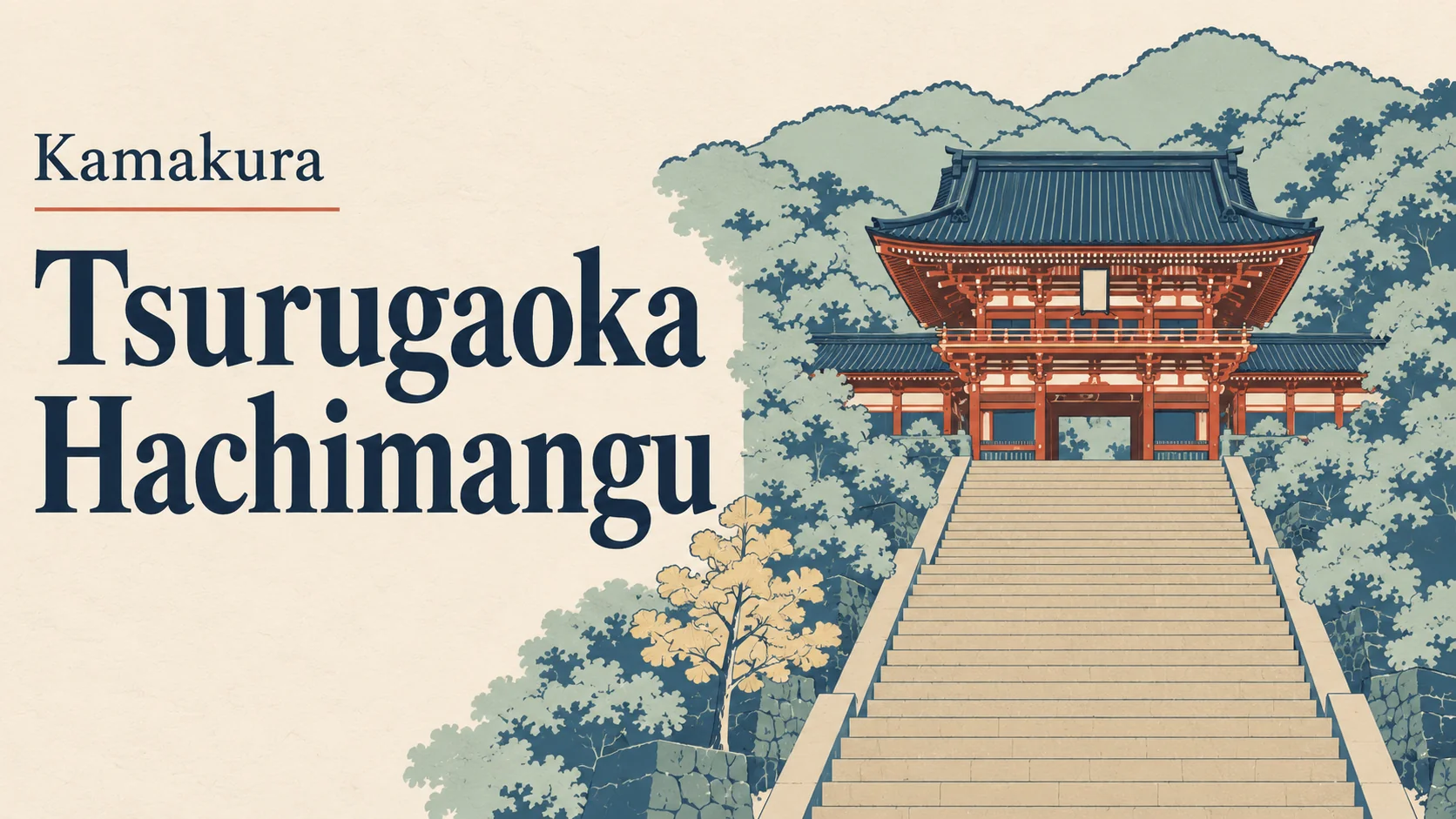
Tsurugaoka Hachimangu (also written Tsurugaoka Hachimangū or Tsurugaoka Hachiman-gū) is the main shrine of Kamakura, a ten-minute walk from Kamakura Station and about an hour from Tokyo by JR. The grounds are free and open 6:00 to 20:00; the treasure hall costs ¥200. This page follows the shrine from a beach in 1063 to a hillside in 1191, separates the ginkgo legend from the record, lists the two yabusame dates, and shows why our classification returns Fire.
What you’ll learn
- How the shrine moved from Yuigahama beach to the hill in three steps, and why the main hall dates from 1828
- What the 1219 assassination on the stone steps is recorded as, and what was added later
- What is free, what costs ¥200 or ¥500, and when to come for yabusame
- Why it scores 90 as Fire, and why one of its three deities scores nothing
What Tsurugaoka Hachimangu Is
Tsurugaoka Hachimangu is the main Shinto shrine of Kamakura, moved to its hillside site in 1180 by Minamoto no Yoritomo and dedicated to Hachiman.
Hachiman is the deity the Minamoto clan took as its guardian, and through the Minamoto, the deity of the samurai who followed them. Tsurugaoka Hachiman is the name without its suffix; -gu means a shrine of high rank, so Tsurugaoka Hachiman-gu is the Hachiman shrine on Tsurugaoka, the Hill of Cranes. The shrine’s own account ties its move to the founding of the first warrior government: in 1180 Yoritomo made Kamakura his base and, the same year, moved the shrine to its present site. The city grew around it, with the main avenue running from the sea straight to its gate.
The shrine says there are said to be more than 40,000 Hachiman shrines in Japan, and that their head shrine is Usa Jingu in Kyushu.
One line to carry, because Kamakura mixes the two: a shrine is Shinto and enshrines kami, deities, and you bow twice, clap twice and bow once; a temple, such as the Great Buddha’s, is Buddhist, and you do not clap.
From Yuigahama to the Hill: 1063, 1180 and 1191
The shrine began by the sea in 1063, was moved inland by Yoritomo in 1180, and took its present two-level form in 1191.
The shrine’s festival page dates the beginning to 1063, when Minamoto no Yoriyoshi, returning from a campaign in the north, enshrined a share of the deity of Iwashimizu Hachimangu, near Kyoto, close to Yuigahama beach. That first site survives as Yui Wakamiya, also called Moto-Hachiman, the original Hachiman. In the tenth month of 1180 his descendant Yoritomo moved the shrine to the foot of Mount Daijin.
The shrine’s English history gives the next step. In March 1191 a fire in a townhouse spread and destroyed the shrine building; Yoritomo reshaped the hillside and built the Main Shrine halfway up Mount Daijin and the Wakamiya at its foot. The festival page in English dates the deity’s move into the new halls to November 21, 1191.
The Main Hall You See Today Dates from 1828
The Main Shrine burned in 1821 and was rebuilt in 1828 by the 11th shogun, Tokugawa Ienari, in the Gongen style.
Gongen-zukuri is a layout that joins the main hall and the worship hall under one linked roof, the same style as the halls at Nikko. The shrine’s English history says the rebuilt Main Shrine and its corridor were designated a national Important Cultural Property in July 1996, and the Cultural Heritage Online database gives the same year for the Wakamiya, July 9, 1996. So the vermilion buildings at the top of the steps are Edo period, and the plan they follow is Kamakura period.
Who Is Enshrined at Tsurugaoka Hachimangu
The Main Shrine enshrines three deities: Emperor Ojin, Himegami and Empress Jingu, with further deities in the Wakamiya and Shirahata Shrine.
| Hall | Enshrined | In the shrine’s account |
|---|---|---|
| Main Shrine (upper) | Emperor Ojin | The 15th emperor; the deity identified as Hachiman |
| Main Shrine (upper) | Himegami | A female deity enshrined with Ojin |
| Main Shrine (upper) | Empress Jingu | Ojin’s mother |
| Wakamiya (lower) | Emperor Nintoku, Emperor Richu, Nakatsuhime, Iwanohime | The shrine’s only sessha, a shrine closely tied to the main deities |
| Shirahata Shrine | Minamoto no Yoritomo, Minamoto no Sanetomo | A black-lacquered hall in the precinct |
The three deities of the Main Shrine are named on the shrine’s guide to the precinct. Its account of Hachiman gives the lineage: Ojin was the 15th emperor, son of Emperor Chuai and Empress Jingu, and the deity passed from Usa to Iwashimizu and from there to Kamakura. Our guide to Hachiman shrines across Japan follows that line and compares Usa, Iwashimizu, Hakozaki and Tomioka.
The Wakamiya, at the foot of the hill, enshrines four deities, including Ojin’s son Nintoku; the festival page calls it the shrine’s only sessha. Shirahata Shrine, in its black-lacquered hall, holds Yoritomo and his son Sanetomo, the third shogun. The man who built the shrine is therefore enshrined in it, but in a side hall, not the Main Shrine.
What to See: From the Dankazura to the Main Hall
The approach runs north from the sea along Wakamiya-oji, onto the raised Dankazura path, over the ponds and up the Great Stone Stairway.
The shrine says the avenue runs about 2 km from Yuigahama, was modelled on Kyoto’s Suzaku-oji and, by tradition, was laid out by Yoritomo to pray for a safe birth for his wife, Hojo Masako. The Kamakura City Tourist Association dates it to 1182. Its central stretch is the Dankazura, a raised path about 500 m long between the second and third torii, lined with cherry trees planted in the Taisho era and rebuilt in a major project in 2016. The association points out that the path narrows toward the shrine, so it looks longer than it is.
| Stop | Fee | What to look at |
|---|---|---|
| Ichi-no-torii, the first torii | Free | Granite, 8.5 m high, in stone since 1668; near the sea end of the avenue |
| Dankazura | Free | About 500 m raised path; narrows toward the shrine |
| Genji and Heike ponds | Free | Three islands on one side, four on the other |
| Hataage Benzaiten Shrine | Free | Rebuilt in 1980 from an Edo-period drawing |
| Maiden, the dance stage | Free | Where Shizuka Gozen is said to have danced |
| Great Stone Stairway and Main Shrine | Free | View over the city; the ginkgo’s regrowth beside the steps |
| Treasure hall | ¥200 | Inside the Romon gate, to the left at the back |
| Maruyama Inari Shrine | Free | The oldest building in the precinct, Muromachi period |
| Peony garden | ¥500 | Best viewing in winter and spring |
The first torii’s size and date are from the shrine’s English history; the rest are from the guide to the precinct. The maiden stands, the guide says, where the corridor of the Wakamiya once ran, the place where Shizuka Gozen danced out of longing for Minamoto no Yoshitsune, Yoritomo’s estranged brother. Maruyama Inari Shrine, the guide adds, is the oldest building on the grounds, from the Muromachi period.
From the top of the stairway you look back down the avenue to the sea. On clear days, the guide says, you can see the Pacific and the island of Izu Oshima. The stretch of road that cuts across the middle of the grounds from east to west is the yabusame track.
The Great Ginkgo and the 1219 Assassination
The shogun Sanetomo was killed at or near the stone stairway in 1219; that his killer hid behind the ginkgo is a later tradition.
The Japan Tourism Agency’s interpretive text for the stairway is careful. It says that in the second month of 1219, on a snowy night, Sanetomo was killed on these steps or near them by his nephew Kugyo. It says the ginkgo, estimated at over 1,000 years old, entered the story later: when the killing was retold, Kugyo was said to have hidden behind a large ginkgo tree. We follow that wording. The steps are recorded; the tree is the retelling.
The tree itself fell. The shrine’s guide says strong winds brought it down before dawn on March 10, 2010. Shoots from the stump are now growing beside the steps, together with a section of the old trunk replanted next to them as the “parent,” and part of the trunk can be seen in the café at the shrine’s museum.
The Genji and Heike Ponds
The two ponds by the entrance carry a message: three islands in the Genji Pond for birth, four in the Heike Pond for death.
The Genji were the Minamoto and the Heike their rivals, the Taira. The shrine’s guide reads the numbers as wishes: three, san, for prosperity, and four, shi, a sound that also means death, for decline. The ponds have cherry blossom in spring and red and white lotus in summer. On an island in the Genji Pond stands Hataage Benzaiten Shrine; the shrine says it was rebuilt in 1980, for its 800th anniversary, from a drawing of the Bunsei era, 1818 to 1830.
Hours and Fees: What Is Free and What Costs Extra
Entering the grounds and praying at the Main Shrine is free, 6:00 to 20:00 all year; only the halls and gardens charge.
| Item | Hours | Fee |
|---|---|---|
| Grounds and the Main Shrine | 6:00–20:00, all year | Free |
| Treasure hall | 9:00–16:00; no closing day, shut for exhibit changes | ¥200 adults, ¥100 elementary pupils |
| Tsurugaoka Museum Kamakura | 10:00–16:30; closed Mondays, open on holidays | Not listed on the shrine’s pages |
| Peony garden | Best viewing New Year’s Day to late February and April to mid-May | ¥500 |
| Prayer ritual, kito | Reception 8:30–16:30 | From ¥10,000 |
| Car park | 9:00–19:30, 40 cars | ¥600 first hour, then ¥300 per 30 min |
The gate hours and car park are from the shrine’s access page, whose English version gives the same 6:00 to 20:00. The treasure hall page gives its fee and place: through the Romon, the gate of the Main Shrine, and to the left at the back. The peony garden fee and seasons are on the museum’s guide to the grounds, and the prayer ritual on the shrine’s prayer page, with the desk below the stone stairway on the east side.
The museum opened in 2019 in the building of the former Museum of Modern Art, Kamakura, designed by Junzo Sakakura and closed in 2016. It is also shut between exhibitions and at New Year. We did not find its admission on the shrine’s pages, so we print none.
Goshuin and Hamaya Arrows
Goshuin are available at the shrine, which publishes no fee for them; the hamaya arrow here has a story of its own.
A goshuin is the seal and calligraphy given as a record of a visit. The shrine’s pages give no amount, so we print none. The hamaya, an arrow charm against evil, has a local origin. The shrine’s account says its hamaya are said to be modelled on the black-lacquered arrows, a National Treasure, that Yoriyoshi received when he brought the deity from Iwashimizu.
Festivals: Yabusame on September 16 and Other Dates
Mounted archery, yabusame, is held on September 16 at the Grand Festival and again in April during the Kamakura Matsuri.
| Date | Event | What happens |
|---|---|---|
| January 1–7 | Gohan gyoji | A New Year rite held over the first seven days |
| January 5 | Joma shinji | Arrows shot at a large target to drive off evil |
| April, Kamakura Matsuri (April 19 in 2026) | Sukeisha Taisai yabusame | Mounted archery; seats for foreign residents |
| Early August, the day before the start of autumn to August 9 | Bonbori Matsuri | About 400 paper lanterns painted and inscribed, the shrine’s figure |
| September 14–16 | Reitaisai, the Grand Festival | Three days of rites; portable shrines on the 15th |
| September 16 | Yabusame shinji; Suzumushi hojosai | Mounted archery at three targets; bell crickets released |
The shrine’s festival page traces the Grand Festival to 1187, when, according to the chronicle Azuma Kagami, a ceremony of releasing living creatures and yabusame were first held here. On the 15th three portable shrines are carried to the second torii. On the 16th riders of the Ogasawara school shoot at three targets from a galloping horse, and the bell crickets are released, a rite the shrine added in 2004.
The April date is less fixed. The shrine’s page says the Sukeisha Taisai, a festival for the shrine’s supporters, includes yabusame, with an international seating area for foreign residents and diplomatic missions. The Kamakura City Tourist Association places it inside the Kamakura Matsuri and gives April 19, 2026, from 13:00. Check the year’s date before you go.
Getting to Tsurugaoka Hachimangu from Tokyo and Kamakura Station
Take the JR Yokosuka Line from Tokyo to Kamakura, about an hour, then walk ten minutes from the east exit.
| From | How | Time |
|---|---|---|
| Tokyo | JR Yokosuka Line to Kamakura | About 1 hour |
| JR Kamakura Station, east exit | On foot | About 10 min |
| Enoden Kamakura Station | On foot | About 10 min |
| Yuigahama beach | On foot up Wakamiya-oji from the first torii | About 2 km |
| By car | Asahina interchange, then about 5 km; shrine car park, 40 cars | — |
The rail time is from the Japan National Tourism Organization’s page on the shrine; the walking times, the car route and the car park are from the shrine’s access page. For a day that starts in the capital, our guide to shrines in Tokyo covers the ones on the way out.
Our advice: walk the Dankazura from the second torii rather than the road beside it. Only on it do you see the path narrow toward the gate, which the Kamakura City Tourist Association says makes it look longer than it is.
Five Elements Classification: Why Tsurugaoka Hachimangu Is a Fire Shrine
Tsurugaoka Hachimangu scores 90 as Fire, because two of its three deities and the Hachiman lineage all fall into Fire.
Kannavi sorts every shrine into one of five elements — Earth, Water, Fire, Wind and Void. This is our classification, not a teaching of any shrine and not a fortune. It reads three checkable layers: the deities, 60 for the principal and 15 per further match; the geography, 25; the lineage in the name, 15.
| Layer | What was matched | Category | Element | Points |
|---|---|---|---|---|
| 1. Deity | Emperor Ojin (principal) | People who made their name in war | Fire | 60 |
| 1. Deity | Himegami | No category matched by name | — | 0 |
| 1. Deity | Empress Jingu | People who made their name in war | Fire | 15 |
| 2. Geography | The Main Shrine halfway up Mount Daijin | Mountain or summit | Earth | 25 |
| 3. Lineage | The name Hachimangu | Hachiman shrines | Fire | 15 |
| Total | Fire 90, Earth 25 | Fire (high) | ||
The zero is the line to read. Himegami scores nothing, not because our rules rank her lower but because the classifier matches a name against a list of categories and hers is not on it. We print the limit rather than hide it. The deities of the Wakamiya and Shirahata Shrine, Yoritomo included, are not an input: the classification reads the Main Shrine only.
A second element is named only when the runner-up reaches 80 percent of the leader, which here would take 72 points. Earth has 25, so Tsurugaoka is Fire alone. Relations run around a ring — Earth to Fire to Void to Water to Wind and back — in which each shifts the flow of the next rather than opposing it.
The comparison is inside this bundle. Nikko Toshogu comes out at exactly the same score, Fire 90 and Earth 25. Yoritomo is enshrined there too, in the main hall, and there he scores 0, his name not being on the list. So the shrine Yoritomo built is Fire through Hachiman, not through him. Ise’s Naiku is Fire at 75. On the ring, Fire comes after Earth, as at Fushimi Inari Taisha, and before Void, as at Meiji Jingu; Kasuga Taisha, Wind at 90, is one of the two that shift its flow.
Frequently Asked Questions
The grounds are free and open 6:00 to 20:00; the six answers below cover value, fees, visiting time, the temple question and yabusame. Figures are from the shrine’s own pages unless another source is named.
Q. Is Tsurugaoka Hachimangu worth visiting?
A. Yes, if you are in Kamakura: the grounds are free and ten minutes from the station. You get a 2 km avenue ending at a stone stairway, a main hall rebuilt in 1828, two ponds with a story in their islands, and, on September 16, mounted archery.
Q. Is there an entrance fee at Tsurugaoka Hachimangu?
A. No. Entering the grounds and praying at the Main Shrine is free from 6:00 to 20:00 every day. The treasure hall is ¥200 for adults and ¥100 for elementary pupils, the peony garden ¥500, best in winter and spring, and a formal prayer ritual from ¥10,000. The shrine publishes no goshuin fee and we found no museum fee on its pages.
Q. How long does it take to visit Tsurugaoka Hachimangu?
A. The shrine publishes no figure, so build it from the ones it does. It is a ten-minute walk from Kamakura Station, or about 2 km on foot from the beach. The treasure hall closes at 16:00 and the museum at 16:30. The peony garden adds a stop in winter and spring, and a yabusame day adds the whole afternoon.
Q. Is Tsurugaoka Hachimangu a temple?
A. No, it is a Shinto shrine, and hachimangu means a shrine of the deity Hachiman. The Great Buddha and the Zen temples of Kamakura are Buddhist and separate. At the shrine you bow twice, clap twice and bow once; at the temples you do not clap.
Q. When can you watch yabusame at Tsurugaoka Hachimangu?
A. Twice a year. The main performance is on September 16, the last day of the Grand Festival, with riders of the Ogasawara school shooting at three targets on the track across the grounds. The second is in April during the Kamakura Matsuri, on April 19 in 2026, from 13:00, with a seating area set aside for foreign residents.
Q. Can you still see the great ginkgo tree?
A. Not the old tree. Strong winds brought it down before dawn on March 10, 2010. Shoots from its stump are growing beside the stone stairway, with a section of the old trunk replanted next to them, and part of the trunk can be seen in the café at the shrine’s museum. The story of the assassin hiding behind it is, in the Japan Tourism Agency’s wording, a later tradition.
Summary
Tsurugaoka Hachimangu is the Hachiman shrine the Minamoto built Kamakura around, free to enter and ten minutes from the station.
- Founded by the sea in 1063, moved inland by Yoritomo in 1180, rebuilt on two levels in 1191.
- The Main Shrine dates from 1828; it and the Wakamiya became Important Cultural Properties in 1996.
- Sanetomo was killed on or near the stone stairway in 1219; the ginkgo hiding place is a later tradition, and the tree fell in 2010.
- Grounds free, 6:00 to 20:00; treasure hall ¥200; peony garden ¥500 in season.
- Yabusame on September 16 and during the Kamakura Matsuri in April; about an hour from Tokyo by JR.
- In the Kannavi classification, Tsurugaoka Hachimangu is Fire 90 with no sub-element, and Himegami scores nothing.
Next: the shrine with the same score at Nikko Toshogu, a Wind shrine at Yasaka Shrine in Kyoto, what to ask for at the desk in the goshuin guide, or the English guide to Japanese shrines.
The steps and the view back to the sea are the obvious high point, and the avenue from the beach leads straight to them. The quieter fact is in the halls. Yoritomo moved the shrine, is said to have laid out the avenue, and chose the hill, and he is enshrined here, but in the black hall to the side. The Main Shrine at the top of the stairs belongs to the deity he served.