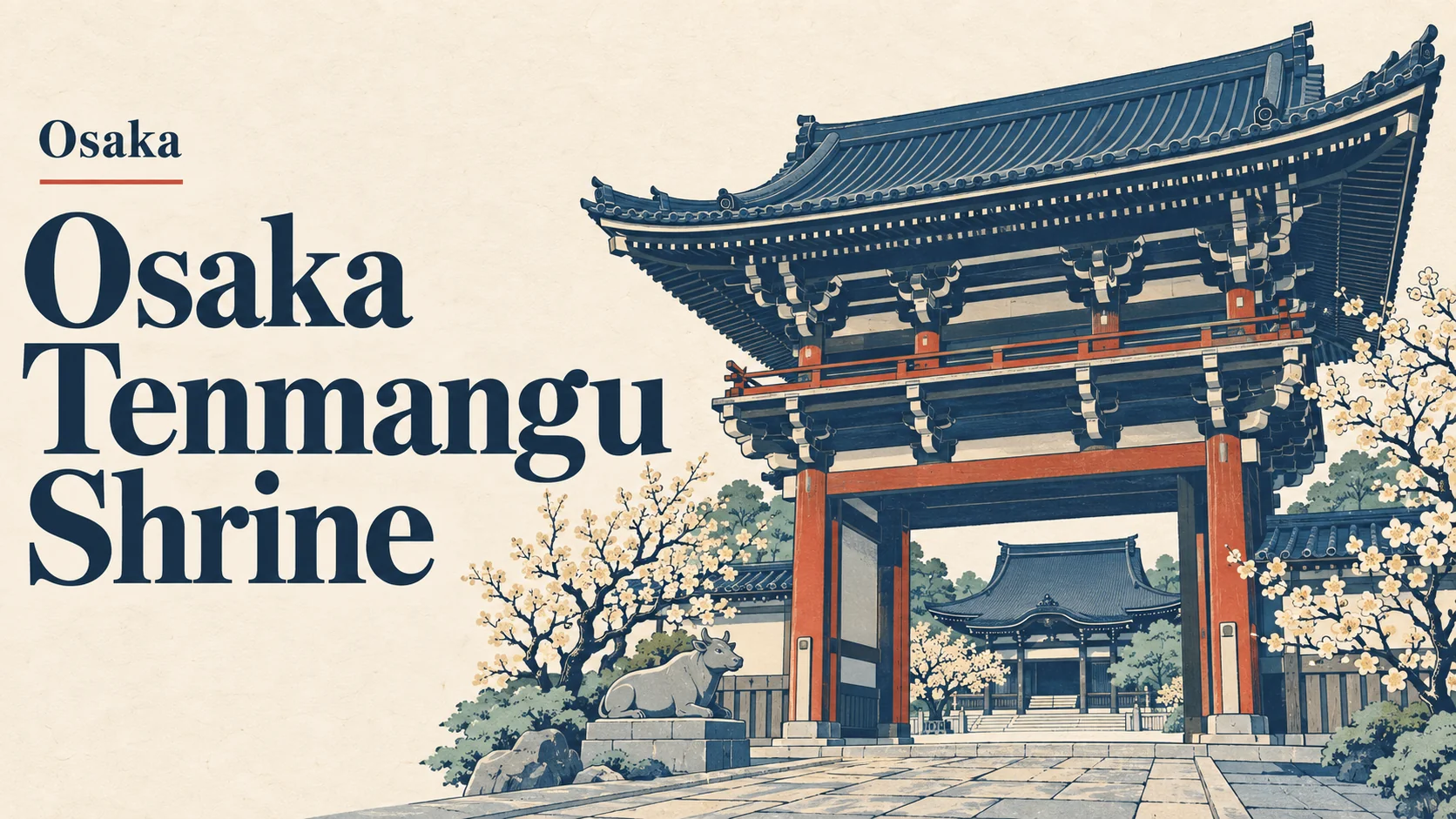
Osaka Tenmangu Shrine is a Shinto shrine in Osaka’s Kita Ward, founded in 949, by its own account, for Sugawara no Michizane, the scholar and statesman revered as Tenjin. The Osaka Convention & Tourism Bureau lists the grounds as free and open 9:00 to 17:00 every day. The shrine’s own directions start at Minamimorimachi Station Exit 4 or Osaka Tenmangu Station Exit 7, about 50 m off the Tenjinbashi-suji arcade. Its Tenjin Matsuri fills the streets and the Okawa River every July 24 and 25.
What you’ll learn
- How seven pines and a 901 stop on Michizane’s journey led to the shrine, and why the main hall dates from 1843
- How Osaka Tenmangu differs from Kitano and Dazaifu, which each call themselves the head shrine
- Hours, prayer fees, station exits, and the Tenjin Matsuri schedule for July 24 and 25
- Why nearby Ohatsu Tenjin, despite its name, comes out Earth while Osaka Tenmangu is Wind
Osaka Tenmangu: What It Is and How It Began
Osaka Tenmangu is a Shinto shrine founded in 949 for Sugawara no Michizane, the ninth-century scholar and statesman worshipped as Tenjin.
A shrine is where kami, the deities of Shinto, are worshipped; a temple is a Buddhist site that houses images of the Buddha. Osaka Tenmangu is a shrine. Its history page names one kami, “our enshrined deity, Sugawara no Michizane”, and lists no other deities on its website.
The word Tenmangu means a shrine to Michizane. According to the Mypedia encyclopedia on Kotobank, “Tenman” comes from the title he was given after death, Tenman Daijizai Tenjin. The Britannica Japan entry on the same page lists three further deities and dates his enshrinement here to 953; this guide follows the shrine’s own date of 949.
Seven Pines and the Daishogun Shrine
By the shrine’s account, seven pines sprang up overnight in 949 before the Daishogun Shrine, and Emperor Murakami ordered a shrine built there.
The shrine says it was set up around 650, when Emperor Kotoku built his palace at Naniwa, to guard the capital’s northwest. In 901 Michizane, sent away from Kyoto to a post in Kyushu, stopped here on his way and prayed for a safe journey. In 949 the pines appeared, their tops glowing.
The Daishogun Shrine still stands in the northwest corner of the grounds as a sessha, a subsidiary shrine. Each New Year’s Day, before the first ceremony of the year, the Futsugyosai rite is held there, and the shrine says it pays the older shrine a token ground rent.
Fires, Rebuilding and the 1843 Main Hall
The present main hall was rebuilt in 1843, the shrine says, after seven recorded fires in the Edo period, two of them total losses.
The shrine names the worst as the Myochi fire of 1724 and the fire of the Oshio Heihachiro rising in 1837. Some English guides give 1845 for the hall; the shrine’s own history gives 1843, about six years after the second fire. The hall also survived the Second World War, which the shrine credits to parishioners who protected it.
| Year | What happened | Source |
|---|---|---|
| 650 | Daishogun Shrine set up to guard the northwest of the Naniwa capital | Osaka Tenmangu |
| 901 | Michizane prays at the Daishogun Shrine on his way to Kyushu | Osaka Tenmangu |
| 949 | Seven pines appear; the shrine is founded by imperial order | Osaka Tenmangu |
| 951 | A sacred halberd is set adrift from the shore, the start of the Tenjin Matsuri | Osaka Tenmangu |
| 1724 and 1837 | The Myochi fire and the Oshio rising burn the shrine | Osaka Tenmangu |
| 1843 | The present main hall is completed | Osaka Tenmangu |
| 1975 | Renamed from Tenmangu to Osaka Tenmangu | Nipponica |
| 1999 | Baikaden and Sanshuden registered as national tangible cultural properties | Osaka Tenmangu |
Where Osaka Tenmangu Fits Among Japan’s Tenmangu Shrines
Osaka Tenmangu is not a head shrine; Kitano in Kyoto and Dazaifu in Kyushu each claim to lead Japan’s 10,000 to 12,000 Tenjin shrines.
The story starts with Michizane. The shrine’s page on Tenjin gives his birth as 845 and his death in Dazaifu on February 25, 903. Demoted in 901 to a post in Kyushu, he died there at 59, according to the encyclopedias on Kotobank.
Three shrines rose within half a century of his death. The table quotes their own wording; this guide does not judge between them.
| Shrine | How it describes itself | Founded | Count it gives | Source |
|---|---|---|---|---|
| Dazaifu Tenmangu, Fukuoka | “Head shrine” (sohongu) of all Tenmangu; built over Michizane’s grave | Shrine hall by imperial order in 919 | About 10,000 | Dazaifu Tenmangu |
| Kitano Tenmangu, Kyoto | “Head shrine” (sohonsha) of Tenmangu and Tenjin shrines; where Tenjin worship began | 947, by oracle | About 12,000 | Kitano Tenmangu |
| Osaka Tenmangu, Osaka | No head-shrine claim; stands where Michizane prayed in 901 | 949, by imperial order | About 12,000 nationwide | Osaka Tenmangu |
Japan’s tourism agency, in its official multilingual text, writes that Dazaifu “stands at the head of over 12,000 Tenjin shrines”. Dazaifu reopened front-facing worship at its main hall on September 19, 2026, after about three and a half years of renovation; our Dazaifu Tenmangu guide covers its hours, museums and access. Kitano is covered in our guide to shrines in Kyoto.
Like the Inari shrines, Tenmangu shrines spread as one family under one kami. Osaka’s place in it is the road to exile.
Why Oxen and Plum Trees
Oxen and plum blossoms appear at Osaka Tenmangu because both are tied to Michizane’s life and death in the shrine’s own telling.
The ox comes first. The shrine says Michizane was born in an ox year, 845, and that his last wish was to let an ox, not people, pull his coffin and to bury him where it stopped. The shrine calls the ox the messenger of the kami.
The plum comes from his poems. The shrine says he wrote one about red plum blossom at the age of five, and another to the plum tree in his garden as he left Kyoto in 901. By legend, recorded in the Nihon Kokugo Daijiten dictionary, that tree flew after him to Dazaifu. One detail the shrine corrects: the plum-blossom crest used by Tenmangu shrines was never Michizane’s own family crest. The shrine’s plum festival of potted trees and swords was not held in 2026.
What to See at Osaka Tenmangu
The main sights are the Omotemon gate, the 1843 main hall, the Daishogun Shrine and two halls registered as cultural properties, all within the grounds.
The shrine’s grounds map names each building:
- Omotemon, the main gate. The Osaka tourism bureau’s access guide points to the shimenawa, a thick sacred rope, at the centre of the gate, and to a direction board painted with the twelve zodiac animals.
- The main hall. Rebuilt in 1843. Photography is not allowed inside the main hall or the connecting corridor, the shrine’s prayer page says.
- The Daishogun Shrine. The older shrine where Michizane prayed in 901, in the northwest corner.
- Baikaden and Sanshuden. Baikaden was built in 1927 with old timber from Ise Jingu; Sanshuden was donated in 1910. Both have been national registered tangible cultural properties since July 16, 1999.
One new sight arrived on October 1, 2026. The shrine set a stone statue of Tenmaro, its first official mascot, in the middle of the temizuya, the basin where visitors rinse their hands before praying. Its notice plans seasonal flower displays in the basin: November for Shichigosan, the shrine visit for children aged three, five and seven, December for the year’s end, March for exam success and graduation.
Visiting Osaka Tenmangu: Hours, Prayers, Goshuin and Access
The Osaka tourism bureau lists free entry from 9:00 to 17:00 daily; the shrine itself publishes hours only for formal prayers.
The hours for the grounds below come from the tourism bureau.
| What | Time | Fee | Source |
|---|---|---|---|
| Grounds | 9:00 to 17:00, no closing days | Free | Osaka tourism bureau |
| Formal prayer, individual | 9:00 to 17:00, last entry 16:30, about 60 minutes | From ¥8,000 (approx. US$53) | Osaka Tenmangu |
| Formal prayer, first shrine visit or Shichigosan | Same | From ¥10,000 (approx. US$67) | Osaka Tenmangu |
| Goshuin | Not published | Not published | Shrine website (no listing) |
| Tenjin Matsuri boat seat, 2026 | Sold from July 5 at the shrine office, cash | ¥35,000 (approx. US$233) | Osaka Tenmangu |
Dollar figures use ¥150 to the dollar. A goshuin is a seal and calligraphy given at a shrine office as a record of your visit. The shrine’s website lists neither its fee nor the office hours for it, so ask at the counter; our goshuin guide explains how to ask and what you receive.
For access, the shrine’s directions start from two stations. From Minamimorimachi Station on the Osaka Metro Tanimachi and Sakaisuji lines, leave by Exit 4. From Osaka Tenmangu Station on the JR Tozai Line, leave by Exit 7. In both cases walk south along the Tenjinbashi-suji arcade, turn left at the second crossing and go about 50 m. The tourism bureau calls it a five-minute walk. The address is 2-1-8 Tenjinbashi, Kita Ward, Osaka.
Tenjin Matsuri and the Osaka Tenmangu Calendar
The Tenjin Matsuri peaks every July 24 and 25, and the shrine counts it among Japan’s three great festivals with Gion and Kanda.
A matsuri is a shrine festival, in which the kami is carried out among the people. The shrine’s festival page says the Tenjin Matsuri runs for about a month, from a lucky day in late June to July 25, and calls it a festival of fire and water. It began in 951, when a sacred halberd was set adrift from the shore in front of the shrine. The boat procession was revived in 1949, and has sailed up the Okawa River in its present form since 1953.
The rest of the year follows the 25th, the day of Michizane’s death, as the shrine calendar shows.
| Date | Event |
|---|---|
| 1st and 25th of each month | Monthly rites with a hot-water offering |
| January 9 to 11 | Tenma Tenjin Ebisu festival, 10:00 to 19:00; 2027 dates are the same |
| January 24 and 25 | First Tenjin of the year; bullfinch exchange at 13:00; exam students’ walk-through at 14:00 |
| March 25 | Annual festival (Nabana-sai) |
| July 24 and 25 | Tenjin Matsuri |
| October 25 | Autumn grand festival with yabusame, mounted archery |
| November 15 | Shichigosan festival for children |
| December 25 | Last Tenjin of the year; wooden prayer plaques are burned |
In the bullfinch exchange, visitors trade bullfinch figures to turn the year’s lies into truth, a pun on uso, which means both bullfinch and lie. In 2027 the shrine will hold a grand festival for the 1,125th year since Michizane’s death, a rite it holds every 25 years.
July 24: The Eve Festival
On July 24 the eve rites start at 7:45, and around 8:50 a child sets a sacred halberd adrift on the river.
The shrine says a procession of about 200 people leaves the main gate after 8:30 and walks to the river. The child, a local pupil, performs the Hokonagashi rite, repeating the festival’s origin. Through the day a lion dance tours the shrine’s parish. In 2026 the eve fell on a Friday.
July 25: Land and River Processions
On July 25 the kami is carried through the streets in the land procession, then onto the Okawa River for the boat procession and fireworks.
The Osaka tourism bureau describes a fleet of more than 100 boats and about 5,000 fireworks; both are round figures that change from year to year. For 2026, the shrine’s festival association sold seats on its own boats at ¥35,000 each. Kyoto’s Gion Matsuri, the second of the three great festivals, belongs to Yasaka Shrine; Tokyo’s Kanda Matsuri is in our guide to shrines in Tokyo.
Ohatsu Tenjin and Tenjinbashi-suji: Nearby
Two neighbours round out a visit: Ohatsu Tenjin, a shrine in Umeda tied to Michizane’s journey, and Tenjinbashi-suji, the arcade on the shrine’s own directions.
Ohatsu Tenjin (Tsuyu no Tenjinsha)
Ohatsu Tenjin, officially Tsuyu no Tenjinsha, is a separate shrine in Sonezaki, Kita Ward, named, by one account, after a poem Michizane wrote in 901.
The shrine’s history page says Michizane, passing through in the second month of 901 on his way to Kyushu, wrote of tears falling like dew as he thought of the capital; tsuyu means dew. Its popular name comes from 1703. That year, it says, Ohatsu, a courtesan, and Tokubei, a merchant’s clerk, died together in its grove, and Chikamatsu Monzaemon turned their story into the puppet play The Love Suicides at Sonezaki.
Despite the Tenjin in its name, Michizane is not its first kami. The shrine lists five, in this order: Sukunahikona, Onamuchi, Amaterasu, Toyouke-hime and Michizane, who was added in 1622. The grounds open 6:00 to 24:00, with the office open 9:00 to 18:00; the nearest stations are Higashi-Umeda, Umeda, Nishi-Umeda, JR Osaka and Kitashinchi. Its monthly goshuin for September 2026 was a sticker seal at ¥500 (approx. US$3) per colour; the design changes each month.
Tenjinbashi-suji Shopping Street
Tenjinbashi-suji is the covered shopping street running north to south past the shrine, which the Osaka tourism bureau calls Japan’s longest.
The bureau’s feature gives about 2.6 km (1.6 miles) from the first to the seventh block of Tenjinbashi, with about 800 shops. The shrine’s directions use it as the landmark from both stations.
Five Elements Classification: Why Osaka Tenmangu Is a Wind Shrine
Osaka Tenmangu scores Wind 75 in our classification, because Michizane falls in our category of thunder and storm kami, and the name adds Tenmangu lineage.
Kannavi sorts every shrine into one of five elements. This is our classification, not a teaching of the shrine and not a fortune. It reads three checkable layers: the principal deity, 60, with 15 for each further deity; the geography, up to 25; the lineage in the name, 15. Michizane sits in the thunder category because, after his death, he was also called Karai Tenjin, the fire-and-thunder Tenjin, according to the World Encyclopedia on Kotobank.
| Layer | What was matched | Category | Element | Points |
|---|---|---|---|---|
| 1. Deity | Sugawara no Michizane, the only kami the shrine names | Thunder and storm kami | Wind | 60 |
| 2. Geography | Near the Okawa River, whose shore saw the first festival rite in 951 | River, lake or water by the grounds | Water | 25 |
| 3. Lineage | Tenmangu in the name | Tenmangu and Tenjin shrines | Wind | 15 |
| Total | Wind 75; Water 25; Earth, Fire, Void 0 | Wind (high) | ||
A second element would need 80 percent of the leader, here 60, so Water 25 does not share the title. We also ran the shrine with no geography at all: it still returns Wind 75. Ohatsu Tenjin shows why the name alone does not decide.
| Shrine | First kami on its list | Earth | Water | Fire | Wind | Result |
|---|---|---|---|---|---|---|
| Osaka Tenmangu | Sugawara no Michizane | 0 | 25 | 0 | 75 | Wind |
| Kitano Tenmangu | Sugawara no Michizane | 0 | 25 | 0 | 75 | Wind |
| Dazaifu Tenmangu | Sugawara no Michizane | 0 | 25 | 0 | 75 | Wind |
| Ohatsu Tenjin | Sukunahikona | 90 | 0 | 15 | 15 | Earth |
At Ohatsu Tenjin, the classifier reads Sukunahikona, first on the official list, as a kami of the land, 60. Onamuchi adds Earth 15, Amaterasu as a sun kami adds Fire 15, and its place at the heart of the city adds Earth 15. The Tenjin name adds Wind 15. Michizane, fifth on the list, does not change the lead.
On the ring of five, each element shifts the flow of the next, and Wind shifts the flow toward Earth. Another Wind shrine in this guide is Kasuga Taisha in Nara.
Frequently Asked Questions
These six answers cover entry fees, festival dates, the head-shrine claims, the two names, the stations and the shrine-or-temple question.
Q. Is Osaka Tenmangu free to enter?
A. Yes, the grounds are free: the Osaka tourism bureau lists them open 9:00 to 17:00 with no closing days. The shrine publishes no gate times. Fees apply only to formal prayers, from ¥8,000 for an individual and about 60 minutes long, and to seasonal events such as the boat seats at the Tenjin Matsuri, ¥35,000 in 2026.
Q. When is the Tenjin Matsuri held?
A. The Tenjin Matsuri is held every year on July 24 and 25, on the same dates whatever the weekday. July 24 is the eve, with rites from 7:45 and the halberd set adrift around 8:50. July 25 is the main day, with the land procession, the boat procession on the Okawa River and fireworks. The festival period itself starts on a lucky day in late June.
Q. Is Osaka Tenmangu the head Tenmangu shrine?
A. No, Osaka Tenmangu is not a head shrine; that claim belongs to two others. Kitano Tenmangu in Kyoto calls itself the head shrine of about 12,000 Tenmangu and Tenjin shrines, and Dazaifu Tenmangu calls itself the head shrine of about 10,000. Osaka’s own story is older ground: the Daishogun Shrine, where Michizane prayed in 901 on his way to Dazaifu.
Q. What is the difference between a Tenmangu and a Tenjin shrine?
A. For a visitor there is very little difference, since both worship Sugawara no Michizane as Tenjin. Kitano counts them as one family. Tenmangu comes from his title Tenman Daijizai Tenjin. Some shrines with Tenjin in their name put other kami first, though; Ohatsu Tenjin in Umeda lists Sukunahikona before Michizane, who was added in 1622.
Q. What is the nearest station to Osaka Tenmangu?
A. The nearest stations are Minamimorimachi on the Osaka Metro Tanimachi and Sakaisuji lines, Exit 4, and Osaka Tenmangu on the JR Tozai Line, Exit 7. The shrine’s directions go south along the Tenjinbashi-suji arcade from either exit, left at the second crossing, then about 50 m. The tourism bureau puts the walk at five minutes.
Q. Is Osaka Tenmangu a temple?
A. No, Osaka Tenmangu is a Shinto shrine, where Michizane is worshipped as a kami, not a Buddhist temple. A temple is a separate kind of site, run by Buddhist priests. The Nipponica encyclopedia records it as a former prefectural shrine, a rank in Japan’s prewar system of shrines.
Summary
Osaka Tenmangu is the Michizane shrine of Osaka, founded in 949 where he prayed in 901, and home of the Tenjin Matsuri.
- Founded in 949 beside the older Daishogun Shrine; the main hall dates from 1843.
- Grounds free, 9:00 to 17:00 by the tourism bureau; formal prayers from ¥8,000.
- Minamimorimachi Exit 4 or Osaka Tenmangu Exit 7, then about 50 m off the arcade.
- Tenjin Matsuri every July 24 and 25; a grand festival for Michizane comes in 2027.
- In the Kannavi classification, Osaka Tenmangu is Wind 75, with Water 25 behind it; nearby Ohatsu Tenjin is Earth 90.
Next: Kitano Tenmangu and the rest of the shrines in Kyoto; Fushimi Inari Taisha, a day trip from Osaka; Yasaka Shrine and the Gion Matsuri; Kasuga Taisha, another Wind shrine; what to ask for in the goshuin guide; or the English guide to Japanese shrines.
Walk down the arcade, pass under the great gate, and stand where a traveller in exile once stopped to pray for the road ahead.