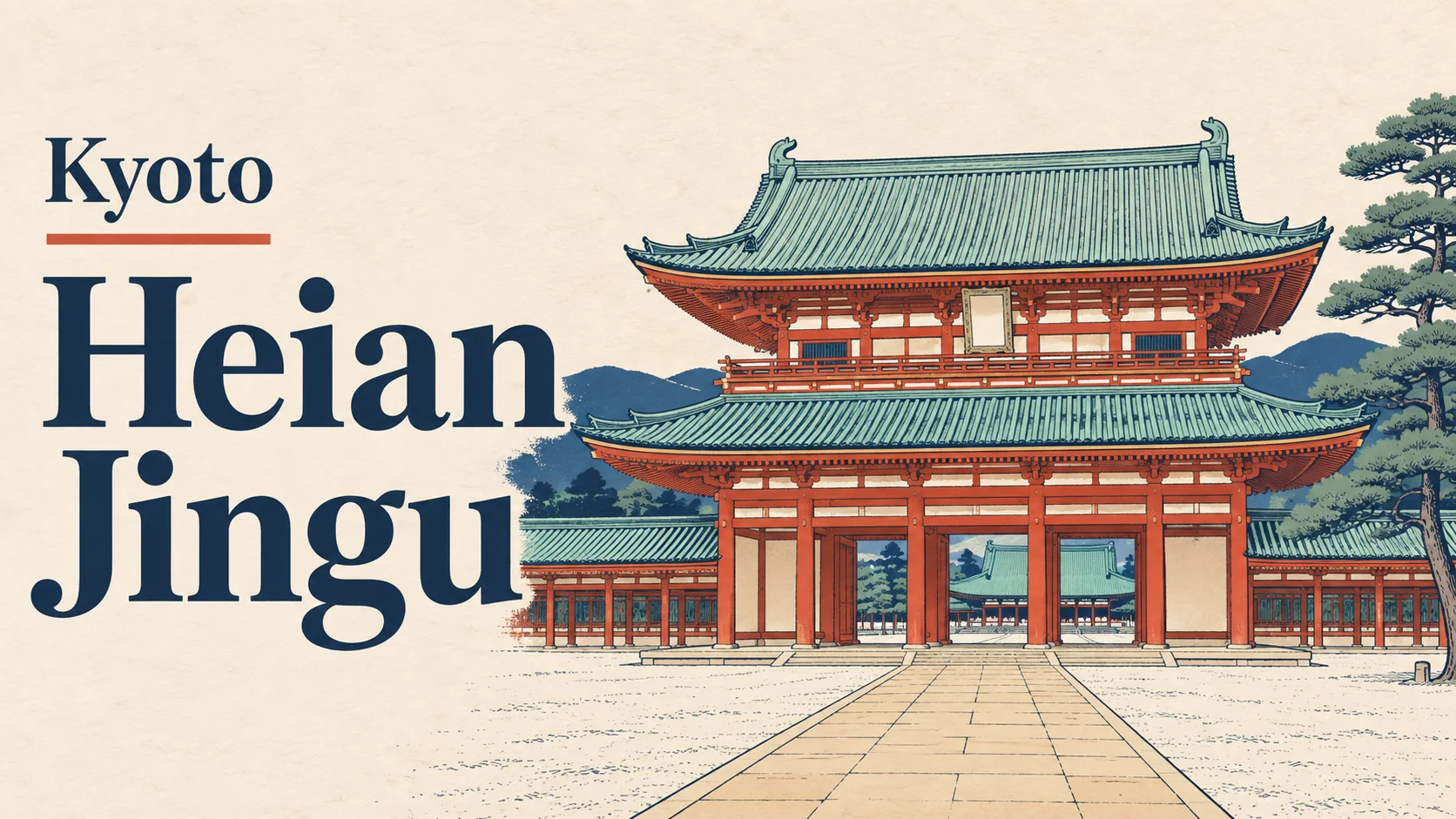
Heian Jingu in Kyoto, also called Heian Shrine, is a Shinto shrine built in 1895, and its halls copy the state halls of the Heian palace at about five-eighths of their size, by the shrine’s own account. Entry to the grounds carries no listed fee; the shrine charges only for the Shin’en garden, ¥600 for adults. From Kyoto Station, city bus 5 costs ¥230 and takes about 30 minutes on the shrine’s figure. This page covers the halls, the garden by season, closing times, routes and why our classification returns Void.
What you’ll learn
- Why a shrine to the emperor who founded Kyoto was built 1,100 years later, and what it copies
- Which halls are Important Cultural Properties, and what the repainting work and the old tram mean for your visit
- What blooms in the Shin’en garden when, and the closing times, including where the shrine’s two pages disagree
- Two bus routes and the subway from Kyoto Station, and why it scores 100 as Void
What Heian Jingu Is
Heian Jingu is a Shinto shrine in Kyoto’s Okazaki district, built in 1895 to mark 1,100 years since Emperor Kanmu moved the capital here.
Jingu is a title used by some shrines of high standing, many linked to emperors, so Heian Jingu and Heian Shrine are the same place. The shrine’s history page says it was founded on March 15, 1895 as a kanpei taisha, a government shrine of the first grade. The Nihon Kokugo Daijiten dictionary on Kotobank ties the founding to the celebration of 1,100 years since the move of the capital.
If you searched for Heian temple, you found the right place under the wrong word. Heian Jingu is a shrine, not a Buddhist temple. At a shrine you bow twice, clap twice and bow once, the order the shrine’s worship guide gives, and you avoid walking down the exact centre of the approach; at a temple you do not clap.
Built in 1895 to Revive a Shrinking Capital
The shrine was built for a city that had lost nearly a third of its people, as a monument to its founding and its recovery.
The shrine’s history sets out the background. In 1864 fighting in the city burned 811 blocks of central Kyoto and more than 27,500 houses. When the emperor moved to Tokyo, Kyoto’s population fell from about 340,000 to about 230,000. The city answered with a celebration of 1,100 years since its founding and with the Fourth National Industrial Exhibition, held from April 1 to July 31, 1895. The shrine was founded that March to enshrine the emperor who had made Kyoto the capital.
The celebration also left a festival. On October 25, 1895, a procession in the costume of past eras walked to the new shrine, the shrine says, and that became the Jidai Matsuri.
Emperor Kanmu and Emperor Komei
Two emperors are enshrined here: Kanmu, the 50th, who founded Kyoto, and Komei, the 121st, who joined him in 1940.
By the shrine’s account, Emperor Kanmu moved into the new capital on the 22nd day of the tenth month of 794 and named it Heian-kyo, the capital of peace. Japan Travel gives Komei a different number; the shrine counts him as the 121st emperor, and we follow the shrine. That date, October 22, is now the day of the Jidai Matsuri.
The Halls: a Five-Eighths Copy of the Heian Palace
The halls recreate the Chodoin, the state halls of the Heian palace, at about five-eighths of the original scale, the shrine says.
That figure is on the shrine’s guide to the grounds, which names the architects as Kiko Kiyoyoshi and Ito Chuta. The Nihon Daihyakka encyclopedia on Kotobank gives the same fraction for one building: the worship hall is five-eighths the size of the palace’s Daigokuden. Japan Travel prints six-tenths and japan-guide “somewhat smaller”; both Japanese sources say five-eighths.
| Building | What it is | Year | Protection |
|---|---|---|---|
| Otenmon | The two-storey gate; an amulet desk | 1895 | Important Cultural Property, 2010 |
| Daigokuden | Copy of the palace’s main state hall; an amulet desk | 1895 | Important Cultural Property, 2010 |
| Soryuro and Byakkoro | The Blue Dragon and White Tiger towers | 1895 | Important Cultural Property, 2010 |
| East and west corridors | Covered corridors joining the halls | 1895 | Important Cultural Property, 2010 |
| Honden | The inner sanctuaries of the two emperors | Rebuilt 1979 | — |
| Great torii | The gateway over the approach road | 1929 | Registered Tangible Cultural Property, 2002 |
The six buildings of 1895 were listed as Important Cultural Properties in 2010, according to the shrine’s history. Daigoku, the shrine explains, means the root of all things and was likened to the Pole Star. The inner sanctuaries burned in 1976 in an attack the shrine attributes to radicals and were rebuilt in April 1979. The shrine counts 145 hanging lanterns, given in 1905, which carry the designs of the four guardian beasts.
The Great Torii
The great torii over the approach road was built in 1929 and was the largest in Japan when it went up, the shrine says.
A torii is the gateway that marks the way into a shrine. The shrine’s guide says its supporters’ association built this one on March 25, 1929, and it was registered as a Tangible Cultural Property in 2002. The shrine gives no height. The Japan National Tourism Organization’s page on the shrine puts it at over 24 m (79 ft), straddling an 18 m (59 ft) road, so the figure here is JNTO’s, not the shrine’s.
Repainting Work and Japan’s Oldest Tram
For its 130th anniversary the shrine is repainting its protected halls and plans to move an old tram into the free area.
The anniversary page lists the project: repainting the Important and Registered Cultural Property buildings, and repairing a Kyoto Electric Railway tramcar and moving it from the South garden, inside the paid area, to the west side of Otenmon, which is free. The anniversary rite was held on March 15, 2026. The shrine gives no end date. Japan-guide reports work in stages from summer 2024 until March 2031, with parts of buildings covered but worship and the garden open. On September 28, 2026, the shrine announced that Kyoto Electric Railway’s work was recognized as an IEEE Milestone, and it calls its car the oldest surviving streetcar in Japan.
Shin’en Garden: Four Gardens Through the Year
Shin’en is the paid garden around the halls: four gardens covering about 33,000 m², laid out by the gardener Ogawa Jihei VII.
The shrine’s garden page describes a pond-stroll garden in four parts, South, West, Middle and East, fed by water from the Lake Biwa Canal. It was designated a national Place of Scenic Beauty in December 1975. The Nihon Daihyakka encyclopedia calls its pale pink weeping cherries famous.
| When | What to see | Where |
|---|---|---|
| Spring | Double-flowered red weeping cherries, including the Endo cherry | South garden |
| Early to late May | About 1,000 rabbit-ear irises around Soryu pond | Middle garden |
| Early June | Japanese irises, 200 kinds and 2,000 plants | West garden |
| Early June and September 19 | Free opening days | All four gardens |
| All year | Garyukyo stepping stones; Taiheikaku bridge hall | Middle and East gardens |
The details are from the same garden page. The South garden’s weeping cherries grew from saplings given by Endo Yoji, the first mayor of Sendai, so the shrine calls them the Endo cherry or the homecoming cherry. Beside them, the Heian-no-sono holds more than 200 plants named in classical literature. In the Middle garden, the Garyukyo, dragon-bridge, stepping stones are pillars from the Sanjo and Gojo bridges of the late 1500s. The East garden has Taiheikaku, a bridge with a hall on it, and Shobikan, with Mount Kacho beyond. The shrine opens the garden free twice a year, in early June and on September 19; for 2026 both dates have passed.
Hours and Fees
The gates open at 6:00 and close between 17:00 and 18:00 by season; the only fee the shrine lists is ¥600 for the garden.
| Period | Gates close (questions page) | Gates close (worship page) | Garden hours (last entry) |
|---|---|---|---|
| March 1–14 | 17:30 | 18:00 | 8:30–18:00 (17:30; questions page 17:00) |
| March 15–September 30 | 18:00 | 18:00 | 8:30–18:00 (17:30) |
| October | 17:30 | 17:30 | 8:30–17:30 (17:00) |
| November 1–February 14 | 17:00 | 17:00 | 8:30–17:00 (16:30) |
| February 15–end of February | 17:30 | 17:00 | 8:30–17:00 (16:30) |
The shrine publishes closing times on two pages that disagree for early March and late February: its questions page uses five periods, its worship page three. In those weeks, plan on the earlier time. Both pages agree on the 6:00 opening all year, so an early visit is the one time you can count on. Garden hours are on the garden page; for March 1 to 14 the questions page ends garden entry at 17:00, half an hour earlier. On October 22 the garden takes visitors only from 9:30 to 11:30.
| Item | Fee or hours |
|---|---|
| Grounds, halls and courtyard | No fee listed |
| Shin’en garden | Adults ¥600, children ¥300 |
| Goshuin | ¥500 |
| Formal prayer, kito | Reception 9:00–16:00 |
| Car park | None at the shrine |
A goshuin is the seal and calligraphy given at the desk as a record of your visit; the shrine’s questions page puts it at ¥500, with desks at Daigokuden and Otenmon. The same page lists the blessings the shrine offers as good fortune and protection from misfortune, household safety, business and good matches. Pets are not allowed unless carried in your arms or in a carrier; assistance dogs are welcome and drones are banned.
Getting to Heian Jingu from Kyoto Station
From Kyoto Station, city bus 5 runs every day to the stop in front of the shrine for ¥230, in about 30 minutes.
| Route | Legs | Fare, adult | Time given |
|---|---|---|---|
| City bus 5, daily | Kyoto Ekimae to Okazaki Koen Bijutsukan/Heian Jingu-mae; walk north 5 min | ¥230 | About 30 min (shrine) |
| EX100 express bus, weekends and holidays | Kyoto Ekimae to the same stop | ¥500 | 23 min (9:12 to 9:35 on the timetable) |
| Subway | Karasuma Line to Karasuma Oike, Tozai Line to Higashiyama; exit 1, walk 10 min | ¥260 | About 20 min plus the walk (japan-guide) |
| Keihan Railway | Sanjo or Jingu-Marutamachi station; walk 15 min | — | — |
The bus times and walks are on the shrine’s access page, which also says there is no car park. Bus 5 from Kyoto Station shows Okazaki Koen, Heian Jingu, Ginkakuji and Iwakura on its timetable, and the flat city bus fare is ¥230. The stop’s name means Okazaki Park, art museum and Heian Shrine; the shrine is a five-minute walk north.
The shrine’s page also names route 100. Under the timetable in effect from March 20, 2026, route 100 from Kyoto Station runs as the EX100 sightseeing express, only on weekends, holidays, the Obon period and New Year. The transport bureau’s express page sets its fare at ¥500. The subway fare is japan-guide’s ¥260, which matches the second zone on the transport bureau’s fare table. Our advice: take bus 5 on weekdays; on weekends the EX100’s 23 minutes cost ¥270 more.
Jidai Matsuri and the Shrine’s Year
The shrine’s biggest day is October 22, when the Jidai Matsuri procession of about 2,000 people walks about 2 km to Heian Jingu.
The shrine’s festival page gives the plan: 20 groups in the dress of eight eras leave the Kenreimon gate of the Kyoto Imperial Palace at 12:00 and reach the shrine around 14:30, and a rite follows at Daigokuden at 16:00. Rain moves it to the next day. In 2026, October 22 is a Thursday. The Kyoto City Tourism Association lists paid seats along the route. Remember that the garden closes to new visitors at 11:30 that day.
| Date | Event | What it is |
|---|---|---|
| January 1 | Saitan-sai | New Year’s Day rite |
| February 3 | Setsubun-sai | Includes Daina-no-gi, a rite driving out demons |
| March 15 | Gochinza Kinen-sai | Anniversary of the founding |
| April 13 and 15 | Kanmu Tenno-sai; Reisai | Rite for Emperor Kanmu; the annual festival |
| June 30 | Nagoshi-no-Oharae | Midsummer purification |
| October 22 | Jidai Matsuri | Procession of the eras |
| November 23–25 | Niiname-sai; confectionery exhibition | Harvest rite on the 23rd, sweets shown for three days |
The dates come from the shrine’s calendar of annual rites. A matsuri is a shrine festival; most of these are rites held in the halls, and the Jidai Matsuri is the one built for spectators.
Five Elements Classification: Why Heian Jingu Is a Void Shrine
Heian Jingu scores 100 as Void, because both emperors and its wide, open grounds fall into Void.
Kannavi sorts every shrine into one of five elements — Earth, Water, Fire, Wind and Void. This is our classification, not a teaching of the shrine and not a fortune. It reads three checkable layers: the principal deity, 60, with 15 for each further matching deity; the geography, 25; the lineage in the name, 15.
| Layer | What was matched | Category | Element | Points |
|---|---|---|---|---|
| 1. Deity | Emperor Kanmu (principal) | Those who shaped the form of the nation | Void | 60 |
| 1. Deity | Emperor Komei (enshrined with him) | Same category | Void | 15 |
| 2. Geography | Long approach, wide grounds, open sky | Open siting | Void | 25 |
| 3. Lineage | No match; jingu is a title, not a lineage | — | — | 0 |
| Total | Void 100; Earth, Water, Fire, Wind 0 | Void (high) | ||
The sixty points come from the category. Kanmu is enshrined neither as a figure of myth nor as a warrior, but as the emperor who founded a capital. The shrine names Kanmu first, so he takes the 60; reversing the two would change the split, not the total, because both fall in the same category. The twenty-five for geography are literal: a torii over a wide road, a broad courtyard and open sky above the halls.
A second element needs 80 percent of the leader; nothing else scores, so Heian Jingu is Void alone. The elements run around a ring — Earth to Fire to Void to Water to Wind and back — in which each shifts the flow of the next rather than opposing it.
The other Void shrine in this guide is Meiji Jingu in Tokyo, which scores the same way: an emperor at 60, his consort at 15, open grounds at 25. Kyoto’s other shrines land elsewhere: Fushimi Inari Taisha is Earth at 100, Yasaka Shrine is Wind and Kifune Shrine is Water at 100. Water is Void’s neighbour on the ring; Earth and Wind shift its flow.
Frequently Asked Questions
The grounds carry no listed fee and the garden costs ¥600. The six answers below cover fees, the temple question, closing times, the garden, seasons and goshuin.
Q. Is Heian Jingu free to enter?
A. The grounds, the Otenmon gate and the courtyard in front of Daigokuden carry no listed fee; the shrine lists a fee only for the Shin’en garden, ¥600 for adults and ¥300 for children. The garden is free twice a year, in early June and on September 19. Optional costs are a goshuin at ¥500 and charms at the desks.
Q. Is Heian Shrine a temple?
A. No. Heian Jingu is a Shinto shrine, a place where kami, deities, are worshipped; here they are two emperors, Kanmu and Komei. A Buddhist temple houses images of the Buddha. At the shrine you bow twice, clap twice and bow once. The name Heian temple is a common mix-up in English searches.
Q. What time does Heian Jingu close?
A. The gates open at 6:00 and close at 18:00 from mid-March to September, 17:30 in October and 17:00 from November to mid-February. The shrine’s two pages disagree for March 1 to 14 and late February, so plan on the earlier time. The garden closes 30 minutes after its last entry, at 17:00 to 18:00.
Q. Is the Shin’en garden worth the fee?
A. It depends on the season. In spring the weeping cherries bloom, in May about 1,000 irises circle a pond, and in early June 2,000 Japanese irises fill the West garden. Out of season you still get a nationally designated garden, the old bridge pillars and the Taiheikaku bridge hall. On a free day, early June or September 19, it costs nothing.
Q. When is the best time to visit Heian Jingu?
A. For flowers, spring cherries and May to early June for irises. For the festival, October 22, when the Jidai Matsuri arrives around 14:30; note that the garden stops taking visitors at 11:30 that day. For a quiet visit, arrive when the gates open at 6:00; the garden opens at 8:30. Repainting work may cover parts of halls.
Q. Can I get a goshuin at Heian Jingu?
A. Yes. The shrine gives a goshuin for ¥500, and its questions page names two desks, at Daigokuden and at the Otenmon gate. The shrine also offers it written on a separate sheet. We found no desk hours on its pages; formal prayer reception runs 9:00 to 16:00, so go in the daytime.
Summary
Heian Jingu is Kyoto’s shrine to its founder, built in 1895 as a five-eighths copy of the palace halls, with no listed fee for the grounds.
- It was founded on March 15, 1895, 1,100 years after the move of the capital, for a city that had lost nearly a third of its people.
- Six halls of 1895 are Important Cultural Properties; repainting work may cover parts of them until 2031, by japan-guide’s report.
- The gates open at 6:00 and close at 17:00 to 18:00; only the Shin’en garden charges, ¥600.
- From Kyoto Station take city bus 5, ¥230, daily, or the EX100, ¥500, on weekends and holidays.
- In the Kannavi classification, Heian Jingu is Void 100, with nothing in the other four elements.
Next: the other Void shrine, Meiji Jingu; a Fire shrine at Ise; more of the city in shrines in Kyoto; what to ask for at the desk in the goshuin guide; or the English guide to Japanese shrines.
The vermilion halls look ancient, but they are a city’s answer to losing its emperor. Kyoto rebuilt the heart of its first palace at five-eighths scale and enshrined the man who founded it. Standing in the courtyard, you are looking at 794 as 1895 imagined it.