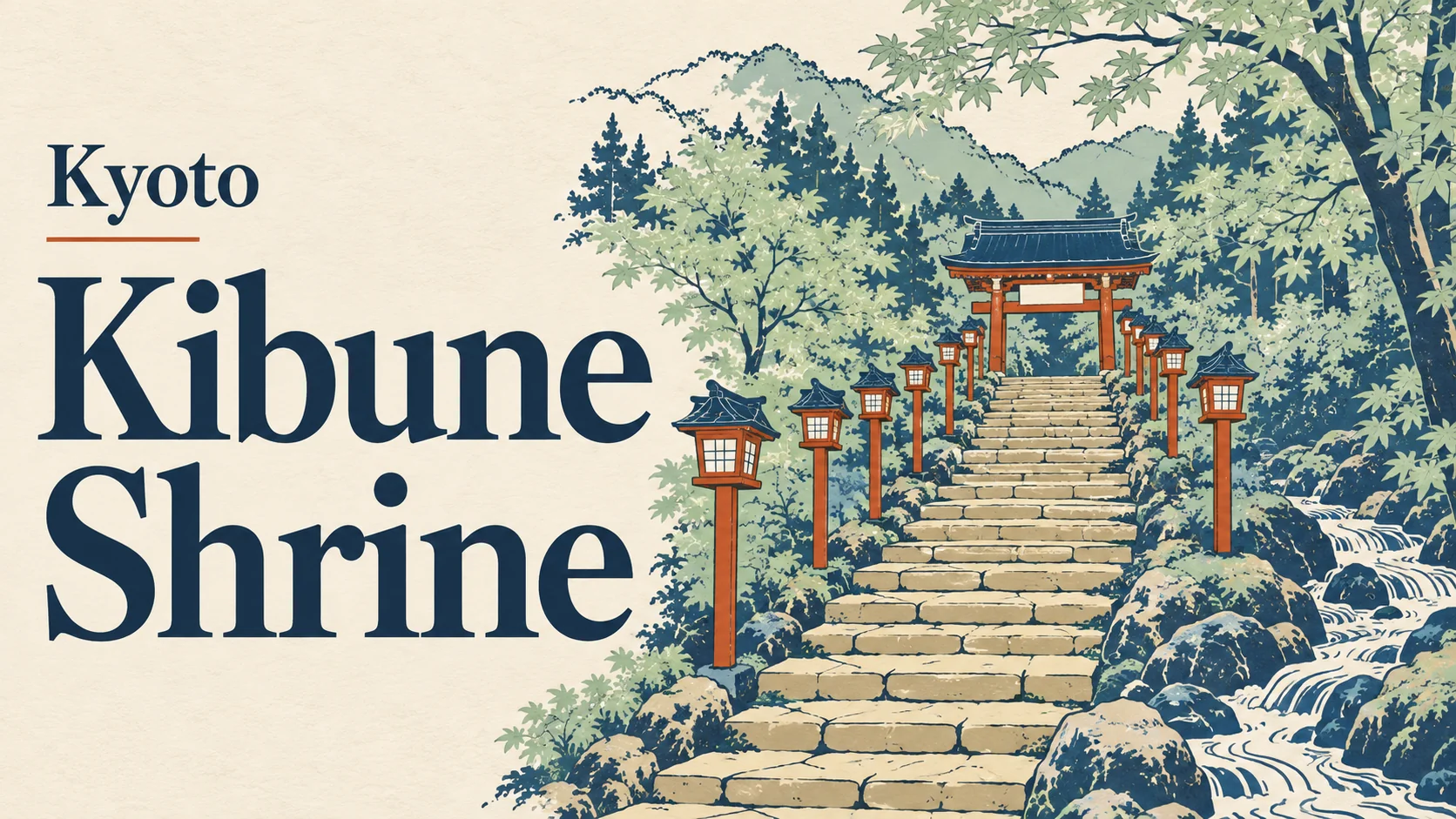
Kibune Shrine in Kyoto, officially Kifune Shrine (Kifune Jinja), is a free, three-part shrine up a river valley north of the city. By the shrine’s own hours, the main shrine opens at 6:00 and closes at 20:00 from May to November, 18:00 from December to April. From Kyoto Station the cheapest route costs ¥800 at the rail and bus companies’ published fares. This page walks the three shrines, sorts legend from record, gives the 2026 light-up dates, and shows why our classification returns Water.
What you’ll learn
- Why the shrine spells itself Kifune while maps say Kibune, and what the yellow boat legend claims
- What each of the three shrines holds, and where the water fortune is
- The winter closing time, the fees the shrine publishes and three routes from Kyoto Station with fares
- Why it scores 100 as Water, and how a fire god fits into its story
What Kifune Shrine Is
Kifune Shrine is a Shinto shrine in the Kibune valley of northern Kyoto, dedicated to Takaokami, a dragon god of rain and water.
The shrine describes itself as the head shrine of some 2,000 water-god shrines across Japan. Jinja simply means shrine, so Kifune Jinja and Kifune Shrine are the same place, and so is Kibune Shrine. The shrine and the Kyoto City Tourism Association read the name Kifune; Japanese dictionaries read both the district and the shrine Kibune, as in the Kotobank entry for the place name. The shrine’s history page adds an old spelling, Kifune written with characters meaning the root where ki, vital force, arises. Neither the shrine nor the dictionaries explain why the official reading is Kifune, so we don’t guess.
The encyclopedia entries on Kotobank record earlier spellings, one meaning yellow boat, fixed in their present form after the Meiji era. The Japan Tourism Agency’s text on Kamigamo Shrine says Kifune was once an auxiliary shrine managed by Kamigamo, and the Nihon Daihyakka encyclopedia says it became independent in 1871, when it was ranked a government shrine of the middle grade.
One line on the neighbour across the ridge: Kifune is a Shinto shrine, where you bow twice, clap twice and bow once to the kami, the deities; Kurama-dera is a Buddhist temple, where you do not clap.
The Yellow Boat Legend and the Move in 1055
The shrine’s founding date is unknown; its legend places the first shrine at today’s Okumiya, where a goddess’s boat stopped.
The shrine’s history says no record of the founding survives, but that by shrine tradition the buildings were already being rebuilt in the sixth year of Hakuho, about 1,300 years ago. The legend it tells is older still, about 1,600 years ago: the goddess Tamayorihime sailed from Osaka Bay up the Yodo, Kamo and Kibune rivers, having said she would build a shrine where her boat stopped. It stopped at the head of the valley, the site of the present Okumiya, the inner shrine.
The shrine’s visitor guide says the yellow boat she rode was enclosed in stone to keep it from view, and that it is still enshrined, moss-covered, beside the main hall of Okumiya. The same guide dates the next step: in 1055 the original site was damaged by flooding and the main shrine, Hongu, was moved downstream to where it stands now. By 1863 the halls had been rebuilt more than 36 times.
A Rain God: Black Horses, White Horses and Ema
The imperial court sent black horses here to ask for rain in drought and white or red horses to stop long rains.
That is the shrine’s wording. The Heibonsha world encyclopedia on Kotobank puts dates to it: envoys came to pray for rain in 818 and for rain to stop in 819. The horses survive in the shrine’s charms: an ema, a wooden votive plaque, painted with a white and a black horse, at ¥700. The shrine does not claim that ema began here, so neither do we.
Who Is Enshrined at the Three Shrines
Hongu and Okumiya enshrine Takaokami, the water god, and Yuishiya, the middle shrine, enshrines the goddess Iwanagahime.
| Shrine | Enshrined | Known for | Open |
|---|---|---|---|
| Hongu, the main shrine | Takaokami | Sacred spring water and the water fortune | 6:00–20:00 (May–Nov), 6:00–18:00 (Dec–Apr) |
| Yuishiya, the middle shrine | Iwanagahime | Prayers for a good match; the poet Izumi Shikibu | At all times |
| Okumiya, the inner shrine | Takaokami; by one account also Kuraokami and Tamayorihime | The original site, the yellow boat, the cedars | At all times |
The deities are named on the shrine’s history page. Takaokami is a child of Izanagi, one of the creator deities, and governs the supply of water. The shrine’s records call Takaokami and Kuraokami one god under two dragon names; one reading takes Takaokami as the dragon of the peaks and Kuraokami as the dragon of the dark valley floor. Iwanagahime, the shrine adds, is the elder sister of the goddess Konohanasakuya-hime.
A visit to all three is sansha-mairi, three-shrine worship, in the visitor guide, which sets no order. The opening times come from the shrine’s questions page: Hongu has a gate and hours, while Yuishiya and Okumiya can be visited at any time.
Walking the Three Shrines: Hongu, Yuishiya and Okumiya
The three shrines sit along the Kibune River, with Hongu nearest the bus stop and Okumiya about 500 m further upstream.
The Nihon Rekishi Chimei Taikei, a gazetteer of Japanese place names, puts the main shrine 1.8 km up the river from Kibuneguchi and the inner shrine about 500 m further up. The shrine gives its own figures on its home page: 2 km and about 30 minutes on foot from Kibuneguchi Station, or about five minutes from the Kibune bus stop. The Kyoto City Tourism Association describes three shrines at different points up a hillside, with the stone steps and red lanterns as the highlight.
The shrine notes a long flight of stone steps up to Hongu’s main hall, and its English page says the shrine cannot be visited in a wheelchair or with a stroller. The lanterns on the main approach are lit every day from dusk to 20:00, the shrine’s notice for summer 2026 says, with changes over New Year and during light-ups.
Okumiya is where the valley story ends. Beside its main hall is the stone-wrapped yellow boat. Under the hall, the visitor guide says, is a ryuketsu, a dragon’s hole, which no one is permitted to see and which the shrine says is regarded as one of Japan’s three great dragon holes. The shrine’s page on its forest lists the Aioi-sugi, paired cedars at Okumiya more than 1,000 years old, among its large trees.
Mizu-urani, the Water Fortune
At Hongu you float a blank paper fortune on the sacred spring, and the words appear as it gets wet.
The visitor guide says the water welling from the stone wall in front of the hall is spring water from Mount Kibune, and that the mizu-urani mikuji, the water fortune, is floated on it. The shrine does not print a price. The Japan National Tourism Organization’s page on the shrine gives it as ¥200 for a blank sheet. The water fortune is covered by Hongu’s hours, so in winter the last chance is before 18:00.
Yuishiya and Izumi Shikibu
Yuishiya is the shrine for a good match, called the shrine of love since the Heian poet Izumi Shikibu prayed there.
The shrine’s account says that Izumi Shikibu, troubled by her husband’s change of heart, came here, offered a poem and prayed, and that her wish was granted; the shrine has been called the shrine of love since. Its tradition also has Iwanagahime settling here to grant people good matches. The shrine’s prayer page offers a formal prayer for a match at ¥3,000, limited to wishes between a man and a woman; that is the shrine’s own condition, not ours.
Hours and Fees: Open Until 18:00 in Winter
Entry to all three shrines is free every day; Hongu closes at 20:00 from May to November and at 18:00 from December to April.
| Item | Hours | Fee |
|---|---|---|
| Hongu, including the water fortune | 6:00–20:00 May 1–Nov 30; 6:00–18:00 Dec 1–Apr 30 | Free |
| Yuishiya and Okumiya | At all times | Free |
| Amulet and goshuin desk | 9:00–17:00, longer during light-ups | Goshuin fee not published |
| Water fortune | Hongu’s hours | ¥200 (JNTO) |
| Formal prayer, kito | Reception 9:00–15:00 | ¥7,000 |
| Prayer for a match | Reception 9:00–15:00 | ¥3,000 |
| Ema, white and black horse | Desk hours | ¥700 |
| Car park | Hongu 8 cars, Okumiya 10 cars | ¥1,000 for 2 hours |
The summer hours, free entry and desk hours are on the shrine’s visitor guide. The winter hours are not; they sit on the questions page and in winter notices, so they are easy to miss. Prayer fees are on the prayer page; the access page says parking is scarce and asks visitors to use public transport.
A goshuin is the seal and calligraphy given as a record of a visit. The shrine gives it only to people who visit in person and does not post it. It publishes no fee for the goshuin itself, so we print none; its goshuin books cost ¥2,000.
Heavy rain can close the grounds. In August 2021 the shrine stopped visits for the afternoon because of the risk of a rising river, falling trees and landslides, and cancelled that evening’s light-up. On a day of heavy rain, check the shrine’s notices before you set out.
Getting to Kifune Shrine from Kyoto Station
From Kyoto Station the cheapest public route is the subway to Kokusaikaikan and two Kyoto Bus rides, ¥800 in total.
| Route | Legs | Fare, adult | Times the operators give |
|---|---|---|---|
| 1. Subway and Kyoto Bus | Karasuma subway to Kokusaikaikan ¥290; Kyoto Bus 52 to Kibuneguchi ¥310; walk 2 min; bus 33 to Kibune ¥200 | ¥800 | Bus 52 about 20 min; bus 33 about 4 min |
| 2. City bus and Eizan Railway | City bus 4 or 7 to Demachiyanagi Ekimae ¥230; Eizan Railway to Kibuneguchi ¥470; bus 33 ¥200 | ¥900 | Bus 4 about 30 min; train 28 min; bus 33 about 4 min |
| 3. JR, Keihan and Eizan Railway | JR Nara Line to Tofukuji; Keihan to Demachiyanagi ¥300; Eizan Railway ¥470; bus 33 ¥200 | ¥970 plus the JR fare | JR 2 min; Keihan 13 min; train 28 min; bus 33 about 4 min |
Each fare is the operator’s own: the subway and city bus from the Kyoto City transport bureau, bus 52 from the Kyoto Bus fare table, bus 33 from Kyoto Bus (tap an IC card once as you get off), the train from Eizan Railway and Keihan. The JR and Keihan times are from Eizan’s guide from Kyoto Station, the bus 52 time from the shrine’s route map. We found no primary figure for the JR fare or the subway’s running time, so we give none.
Our advice: route 1 is cheapest; routes 2 and 3 give you the Eizan train and the option of walking the last 2 km along the river. In winter, check the bus 33 timetable with Kyoto Bus; we could not confirm its winter service from a primary source. The Kurama line, shut by a landslide near Kibuneguchi in July 2020, reopened on September 18, 2021. By car it is about 40 minutes north of Kyoto Station, the shrine says; on set days in August 2026, cars heading up to Okumiya were barred from 11:00 to 15:00.
Walking Over from Kurama-dera
Kurama-dera’s own trail crosses the ridge from its main hall, 30 minutes to the Maoden hall and then 20 minutes down to Kifune Shrine.
The temple’s access page gives those two stages, and a ¥500 mountain fee to use the path. The Japan National Tourism Organization calls it a steep mountain walk with stone steps and handrails at the hard parts, and suggests starting in Kibune and finishing in Kurama. By train, Kibuneguchi to Kurama is three minutes on the Eizan line.
Seasons, Light-ups and Festivals in Kibune
The shrine lights the Hongu grounds three times in 2026: snowy weekends in winter, early May and the Tanabata weeks of summer.
| Date in 2026 | Event | What to know |
|---|---|---|
| Day before the start of spring, 11:00 | Setsubun-sai | Bow-string rite and bean throwing; the shrine cites a medieval tale placing the bean custom’s origin here |
| Jan 17–Feb 28, Saturdays and Sundays with snow | Snow-day light-up | Sunset to 20:30; go or no-go posted on the shrine’s account at 15:00 that day |
| March 9, 10:00 | Amagoi-sai, the rain prayer festival | Prayer for balanced rain and sun; old ema burned afterwards |
| May 2–5 | Fresh-green light-up | Sunset to 20:00; bus 33 runs later |
| June 1 | Kifune Matsuri, the annual festival | Portable shrine carried from Hongu up to Okumiya, leaving about 13:30 |
| July 1–August 15 | Tanabata bamboo light-up | Sunset to 20:00; desk open to 19:00 |
| July 7, 10:00 | Kifune water festival | Thanksgiving to the water god |
| November 7, 11:00 | Ohitaki-sai, the fire festival | Marks the story of the water god born from the fire god |
The light-up dates are from the shrine’s notices for the snow-day and fresh-green light-ups and its Tanabata notice; the festivals are on its calendar of events. Plan around the snow rule: weekend days with snow only, decided at 15:00 on the day. The shrine’s autumn illumination was last announced for 2022, and we found no notice for 2026.
Outside the shrine, the valley is known for summer dining on platforms over the river, kawadoko. The Japan National Tourism Organization says the meals need booking and puts the starting price at ¥3,000 per person, and names August, for the cool air, and autumn, for the leaves, as the best times to visit Kibune.
Five Elements Classification: Why Kifune Is a Water Shrine
Kifune Shrine scores 100 as Water, because its deity, its riverside site and its lineage all fall into Water.
Kannavi sorts every shrine into one of five elements — Earth, Water, Fire, Wind and Void. This is our classification, not a teaching of any shrine and not a fortune. It reads three checkable layers: the principal deity, 60, with 15 for each further matching deity; the geography, 25; the lineage in the name, 15.
| Layer | What was matched | Category | Element | Points |
|---|---|---|---|---|
| 1. Deity | Takaokami (principal) | Gods of water, rivers, rain and dragons | Water | 60 |
| 2. Geography | The Kibune River beside the precinct; the spring at Hongu | River, lake, waterfall, pond or spring | Water | 25 |
| 3. Lineage | The name Kifune | Kifune and water-god shrines | Water | 15 |
| Total | Water 100; Earth, Fire, Wind, Void 0 | Water (high) | ||
Two choices sit behind that total. Kuraokami, named at Okumiya by one account, would add 15 if counted as a second deity, but the shrine’s records say the two names are one god, so we count one. Iwanagahime of Yuishiya is not an input, because the classification reads the main shrine only.
A second element needs 80 percent of the leader, here 80 points; nothing else scores, so Kifune is Water alone. Relations run around a ring — Earth to Fire to Void to Water to Wind and back — in which each shifts the flow of the next rather than opposing it.
The shrine’s own story adds a turn. Its history page, citing the ancient chronicles, says Takaokami is a water god born from the fire god, and the November 7 fire festival marks that birth. On our ring Fire is one of the two elements that shift Water’s flow, as at Tsurugaoka Hachimangu, Fire at 90. We keep the two side by side and don’t merge them: one is the shrine’s tradition, the other our scoring.
Within this bundle, Itsukushima Shrine is the other Water shrine, at 130, where three sea goddesses fill the deity layer. In Kyoto, Fushimi Inari Taisha is Earth at 100 and Yasaka Shrine is Wind; Wind is Water’s neighbour, Earth one of the two that shift its flow.
Frequently Asked Questions
All three shrines are free; Hongu closes at 18:00 in winter. The six answers below cover fees, closing times, time on site, season, Kurama and the spelling.
Q. Is Kifune Shrine free to enter?
A. Yes. The shrine says it is open every day and free to visit, and that covers Hongu, Yuishiya and Okumiya. What costs money is optional: the water fortune, ¥200 by JNTO’s figure; ema at ¥700; a formal prayer at ¥7,000. The shrine does not publish a goshuin fee.
Q. What time does Kifune Shrine close?
A. Hongu, the main shrine, closes at 20:00 from May 1 to November 30 and at 18:00 from December 1 to April 30; it opens at 6:00 all year. The water fortune follows Hongu’s hours. Yuishiya and Okumiya have no gate and can be visited at any time. The amulet and goshuin desk is open 9:00 to 17:00.
Q. How long does it take to visit Kifune Shrine?
A. The shrine publishes no total, so add up the legs it does give. From Kibuneguchi Station the bus takes about 4 minutes and the walk from the Kibune stop about 5; on foot it is about 30 minutes. Okumiya is about 500 m beyond Hongu. Add the train or bus from the city, and more on a snow-day light-up.
Q. When is the best time to visit Kibune?
A. It depends on what you come for. JNTO names August, when the valley is cool and the river restaurants are open, and autumn for the leaves. In 2026 the shrine lit Hongu on snowy weekends from January 17 to February 28, on May 2 to 5, and from July 1 to August 15. In winter, arrive well before the 18:00 close.
Q. Can you visit Kurama-dera and Kifune Shrine in one day?
A. Yes. Kurama-dera’s page gives 30 minutes from its main hall to the Maoden hall and 20 more down to Kifune Shrine, with a ¥500 mountain fee. JNTO calls the path steep, with steps and handrails, and suggests starting in Kibune. Without the hike, Kibuneguchi and Kurama are three minutes apart on the Eizan Railway.
Q. Is it Kifune or Kibune?
A. Both, for the same place. The shrine calls itself Kifune, and so does the Kyoto City Tourism Association. Japanese dictionaries read the district and the shrine Kibune, which is why you see Kibune on maps and in the name of the valley. On this page Kifune Shrine and Kibune Shrine mean the same shrine.
Summary
Kifune Shrine is the water-god shrine at the head of the Kibune valley, free to enter and split into three shrines along the river.
- The shrine calls itself head of some 2,000 water-god shrines; it spells its name Kifune, while maps say Kibune.
- Legend puts the first shrine at Okumiya, where a goddess’s yellow boat stopped; Hongu moved downstream in 1055.
- Hongu opens at 6:00 and closes at 20:00 from May to November, 18:00 from December to April; Yuishiya and Okumiya never close.
- From Kyoto Station the subway and two Kyoto Bus rides cost ¥800; the Eizan Railway routes cost ¥900 or more.
- In the Kannavi classification, Kifune Shrine is Water 100, with nothing in the other four elements.
Next: the other Water shrine, Itsukushima; a Wind shrine in Nara, Kasuga Taisha; the Fire shrine at Ise; what to ask for at the desk in the goshuin guide; or the English guide to Japanese shrines.
The lantern-lined steps are the famous view, but the valley tells the story. By its own account the shrine began where a boat stopped at the head of the river, moved down when that river flooded, and has asked for rain, and for rain to stop, ever since. Walking up to Okumiya follows the river the legend followed.