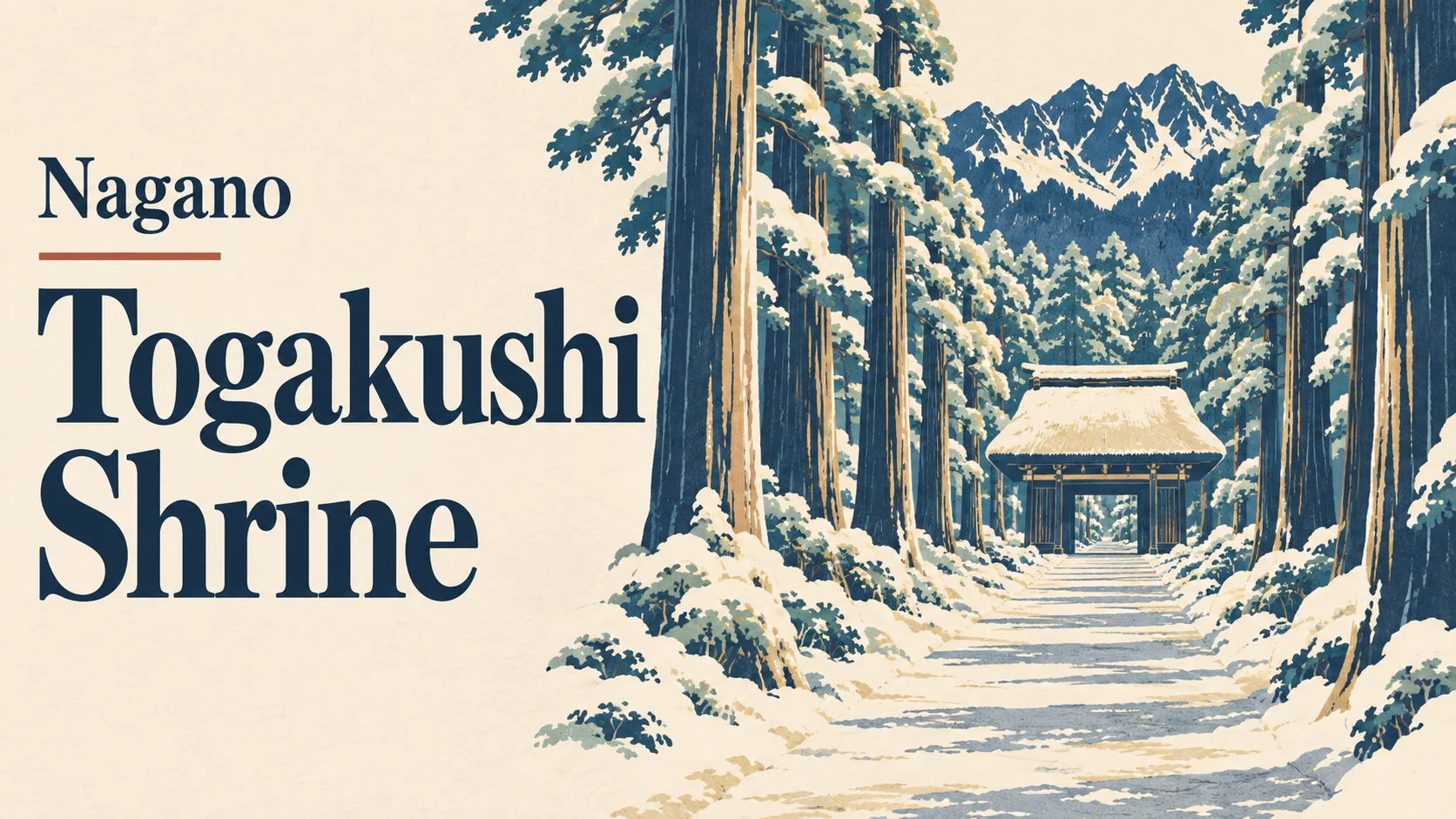
To get from Nagano to Togakushi Shrine, take Alpico’s reserved Nagano–Togakushi bus from stop 7 at Nagano Station’s Zenkoji exit. It reaches Chusha in about 55 minutes and costs ¥2,500 one way in the 2026 green season. Togakushi Shrine (Togakushi Jinja) is five shrines spread along the foot of Mount Togakushi in Nagano City, Nagano, Japan, linked by forest paths and a two-kilometer cedar-lined approach to the inner shrine, Okusha.
What you’ll learn
- Which bus to take from Nagano Station, how to book and pay, and what it costs in 2026
- The 2026 green-season timetable, the last bus back, and what last winter’s timetable looked like
- Which stop serves which of the five shrines, and how long the walks between them take
- What changes in winter: the Okusha closure, goshuin moving to Chusha, and the Okusha bus stop
- Counters, goshuin, current works and the 2027 grand festival, and why our classification leaves Togakushi unassigned
Nagano to Togakushi Shrine: Bus, Time and Fare
Alpico’s reserved bus from Nagano Station stop 7 reaches Chusha in about 55 minutes for ¥2,500, with eleven departures a day in 2026.
Nagano Station is on the Hokuriku Shinkansen line from Tokyo, and Togakushi lies in the mountains northwest of the city. Alpico Kotsu, the regional bus company, runs the route. Its green-season route page gives the details below, and the shrine’s own English page describes the same bus as “about one hour”.
| Item | Detail (2026 green season, April 1–December 4) | Source |
|---|---|---|
| Bus | Nagano–Togakushi sightseeing bus, all seats reserved | Alpico |
| Where to board | Stop 7, Zenkoji exit of Nagano Station, in front of the Alpico ticket office | Alpico |
| Fare | ¥2,500 (approx. US$17) one way, Nagano Station to the Togakushi area; no round-trip ticket | Alpico |
| Ride time | Hokosha 48 min, Chusha 55 min, Okusha 59 min on the 6:50 bus | Alpico timetable |
| Departures | 11 a day from Nagano, 6:50 to 14:10 | Alpico timetable |
| Last bus back | 16:24 from Okusha, 16:27 from Chusha; arrives Nagano 17:25 | Alpico timetable |
Booking and Paying for the Togakushi Bus
Book a seat online up to a month ahead and pay by contactless Visa or cash; Suica and other IC cards do not work.
Alpico says all seats on this bus require a reservation, though you can still board without one if seats are left. Booking runs through third-party sites such as highwaybus.com, which share seat availability with the ticket office at Nagano Station (open 6:20–19:00, cards accepted). Show a mobile or printed ticket when boarding. Cancelling costs ¥100 per person, and changes mean cancelling and booking again. Suitcases go in the luggage compartment at no limit, but there is no toilet on board.
Two old habits no longer apply. Alpico’s route page says the Togakushi & Zenkoji 1-Day Pass ended on April 1, 2025, even though an old ticket page for it is still online, so plan on one-way fares. And bus number 70 is, in Alpico’s words, a non-reserved service “primarily intended for local residents”; visitors are asked to use the reserved bus.
Which Bus Stop for Which of the Five Shrines
Get off at Togakushi Hokosha, Togakushi Chusha or Togakushi Okusha; Hinomikosha and Kuzuryusha have no stops of their own.
| Bus stop | Shrine | Ride on the 6:50 bus | Notes from the shrine |
|---|---|---|---|
| Togakushi Hokosha | Hokosha | 48 min | More than 270 stone steps to the hall |
| (none) | Hinomikosha | — | About 15 minutes on foot from Hokosha or Chusha |
| Togakushi Chusha | Chusha | 55 min | Shrine office and the main goshuin counter |
| Togakushi Okusha | Okusha and Kuzuryusha | 59 min | About 40 minutes on foot from the approach entrance; no cars |
Within Togakushi, Alpico’s Togakushi Shuttle Bus links the villages. It takes no reservations and only cash: ¥400 for most rides and ¥500 for a few longer sections. It has no luggage compartment.
Driving and Parking at Togakushi
By car, the shrine puts the Nanamagari route through Nagano City at about an hour, and the Okusha approach is closed to private cars.
The shrine’s access page gives two routes from Nagano Interchange: the Asakawa Loop Line, open to large vehicles, and Nanamagari, which runs through the city and up behind Zenkoji with steep hairpin turns and takes about an hour depending on traffic. From Shinanomachi Interchange it is about 30 minutes. The five-shrine guide lists a paid car park at the Okusha entrance (¥600 for three hours, 120 cars), a free lot of about 100 cars west of Chusha, about 20 spaces at Hokosha and three at Hinomikosha. In August 2026 the shrine wrote that roads and car parks become badly congested around August 14 and 15, and the Shinano Mainichi Shimbun reported a trial shuttle from a car park at Togakushi Ski Resort on those two days. Alpico ran a similar congestion shuttle on May 3–5, 2026.
Togakushi Bus Timetable: Green Season and Winter
In the 2026 green season the first bus leaves Nagano at 6:50 and the last at 14:10; winter uses a separate, slightly thinner timetable.
The times below come from Alpico’s timetable files for the green season and the winter season, read on November 2, 2026. The winter row is last winter’s; Alpico’s route pages say the new winter timetable is published in mid to late November and that the schedule changes only a little from year to year.
| Season | Nagano Station departures | Buses back from Okusha | Fare |
|---|---|---|---|
| Green season 2026 (April 1–December 4) | 6:50, 7:50, 8:20, 8:50, 9:20, 9:50, 11:00, 11:50, 12:50, 13:20, 14:10 | 8:19, 9:19, 10:14, 11:34, 12:34, 13:34, 14:04, 14:34, 15:04, 15:44, 16:24 | ¥2,500 to the Togakushi area |
| Last winter (December 6, 2025–March 31, 2026) | 6:50, 7:50, 8:20, 9:10, 10:10, 11:50, 12:50, 13:20, 14:20 | 8:24, 9:54, 10:44, 11:34, 12:44, 13:44, 14:44, 15:34, 16:24 | ¥2,000 to Chusha; ¥2,500 to Okusha |
Return buses stop at Chusha three minutes after Okusha and at Hokosha about eleven minutes after, and reach Nagano about an hour later. On last winter’s timetable, the six morning departures ran on to the Okusha stop, while the three afternoon ones were listed only as far as Chusha. If you are visiting this December or later, check the new winter timetable before you book; it should appear on the same Alpico page.
What Togakushi Shrine Is: Five Shrines Under One Mountain
Togakushi Shrine is five shrines at the foot of Mount Togakushi, most enshrining deities from the myth of the heavenly rock cave.
The shrine’s English history page lists the five and their kami, the deities of Shinto. A shrine is where kami are worshipped; a temple is a Buddhist site. Okusha is the main shrine, and the head office is at Chusha.
| Shrine | Enshrined kami | Blessings, as the shrine lists them | Detail |
|---|---|---|---|
| Okusha (inner shrine) | Ame-no-Tajikarao, deity of strength | Good fortune, wishes, harvests, winning in sports | At the end of the 2 km approach |
| Kuzuryusha | Kuzuryu Okami, a nine-headed dragon | Water, rain, protection from tooth decay, love | Worshipped locally before Tajikarao |
| Chusha (middle shrine) | Ame-no-Yagokoro-Omoikane, deity of wisdom | Study, business, family well-being | Dragon ceiling painting restored in 2003; cedars over 800 years old |
| Hokosha | Ame-no-Uwaharu, son of Omoikane | Learning, arts, safe childbirth, women and children | More than 270 stone steps |
| Hinomikosha | Ame-no-Uzume, with three other kami (four in all) | Performing arts, love, fire prevention | Founded around 1098; twin cedars over 500 years old |
The Rock-Door Myth Behind Mount Togakushi
The shrine tells that the sun goddess’s rock door was thrown down to earth and became Mount Togakushi, whose name means “hidden door”.
In the myth, Amaterasu, the sun goddess, hid in a cave behind a rock door and the world went dark. Omoikane, now at Chusha, planned a festival of song and dance outside; Ame-no-Uzume, now at Hinomikosha, danced; and when Amaterasu peeked out, Tajikarao, now at Okusha, pulled the door open. The shrine’s telling ends with the door falling to earth as the mountain. Three of the five shrines enshrine characters from this one story, and Hokosha’s kami is Omoikane’s son. Amaterasu herself is enshrined at the Inner Shrine of Ise; see our Ise Grand Shrine guide.
From Kenkoji Temple to a Shinto Shrine
For centuries Togakushi was Kenkoji, a Buddhist temple and mountain-training center, and it became a Shinto shrine only after 1868.
The English history page says the worship of Mount Togakushi began with water, essential to life, before Tendai Buddhism arrived and Kenkoji was founded. Monks practiced Shugendo, mountain asceticism, on its slopes. When the Meiji government ordered Shinto and Buddhism separated in 1868, Kenkoji chose Shinto and gave up its Buddhist features. Hinomikosha, the page adds, was the only one that had remained a shrine throughout. Even the noodles have roots here: the shrine’s history page says buckwheat brought by the ascetics as travel food became the soba served at the temple lodgings in the Edo period, the origin of today’s Togakushi soba. The crest, four sickles arranged in a swastika shape called kamamanji, recalls the old link with farming.
Walking the Five Shrines: Order, Times and the Cedar Avenue
There is no fixed order; walking all five shrines on foot from Hokosha to Okusha takes about half a day, by the shrine’s estimate.
The shrine’s five-shrine guide gives the walking times below, mostly along the Togakushi Kodo, an old forest path also called Kanmichi. Going uphill from Hokosha to Okusha is the natural direction if you start at the lowest bus stop, and you can ride the bus back from the Okusha stop.
Hinomikosha has no counter of its own, so its goshuin is written at Chusha or Hokosha after you visit. Bears live in these mountains: when Okusha held the mountain-opening rite for Mount Togakushi on June 11, 2026, TBS NEWS DIG reported the advice to carry a bear bell or a radio.
The Okusha Approach, Zuishinmon Gate and the Cedars
The approach to Okusha runs about 2 km, flat to the thatched Zuishinmon gate and then steeper through cedars more than 400 years old.
The access page times it at about 15 minutes from the entrance to Zuishinmon on an almost level path, then 20 to 25 minutes up to Okusha, ending on stone steps of rough natural rock. Past the gate, the shrine’s forest page describes about 500 meters lined with more than 200 giant cedars; the forest was designated a Nagano Prefecture natural monument in 1973, and visitors are asked to keep off the forest floor. The English page adds that on the first days of winter and spring on the old calendar, early November and early February, the sun rises straight along the avenue.
The shrine is protecting those trees. Its October 12, 2026 notice says drainage work on part of the approach began on October 13 to stop rain and meltwater damaging the roots and gravel. Worship continues as normal, but follow the detour signs. Kuzuryusha’s dragon has a cousin at Lake Ashi; our Hakone Shrine guide covers its Kuzuryu Shrine.
Togakushi Shrine in Winter
In winter Okusha closes from January 7 until late April, its goshuin moves to Chusha, and the buses run on a winter timetable.
Togakushi is snow country. The shrine’s diary noted on April 25, 2026 that a Golden Week with no snow at all was the first in a long while. The changes the shrine and Alpico publish are these.
| Item | Green season | Winter | Source |
|---|---|---|---|
| Okusha hall and counter | Open; counter 9:00–17:00 | Closed from January 7 to late April | Shrine |
| Okusha and Kuzuryusha goshuin | At the Okusha counter | At Chusha from January 7 | Shrine |
| Other counters | 9:00–17:00 | Hours and windows may change | Shrine |
| Bus to the Okusha stop | All 11 buses | Last winter: morning buses only (from December 6, 2025) | Alpico |
| Fare from Nagano | ¥2,500 | Last winter: ¥2,000 to Chusha, ¥2,500 to Okusha | Alpico |
| Car parks | Open | May be unusable because of snow | Shrine |
The bus stop is where sources disagree. The shrine’s access page still says winter buses run to the ski resort instead and do not stop at Okusha, so you walk from Chusha or take a taxi. Alpico, which runs the buses, wrote that from December 6, 2025 the winter bus would stop at Okusha, at the entrance to the cedar path, and last winter’s timetable shows that for the morning buses. We follow the operator’s newer page, but the 2026–27 winter timetable is not out yet, so check it before you go.
“Closed” here is the shrine’s word for the Okusha hall and its counter; the shrine does not publish a closure of the approach path, and we do not claim one. Expect snow and ice on the steps near the top, and allow time to get back to the bus before dark.
Visiting Togakushi Shrine: Counters, Goshuin and 2026–2027 Notices
The counters at Hokosha, Chusha and Okusha open 9:00–17:00, each of the five shrines has its own goshuin, and 2027 brings the grand festival.
A goshuin is a handwritten seal recording a shrine visit. The shrine’s goshuin page says the seal is a mark of worship and is not given to people who have not visited, and that goshuin books are sold at the Okusha, Chusha and Hokosha counters. Our goshuin guide covers the manners.
| Counter | Hours | Goshuin written there |
|---|---|---|
| Okusha | 9:00–17:00; closed January 7 to late April | Okusha, Kuzuryusha |
| Chusha | 9:00–17:00 | Chusha, Hinomikosha; Okusha and Kuzuryusha from January 7 |
| Hokosha | 9:00–17:00 (may change in winter) | Hokosha, Hinomikosha |
| Hinomikosha | No counter | — |
The shrine also offers a prayer omikuji, a fortune slip, for ¥500 at the Hokosha, Chusha and Okusha counters. You draw it once a year at the shrine you feel drawn to and keep it for the year ahead; it is chosen by your age in the traditional count, and a chart at each window shows it. Queues can be long, the shrine says.
Check the notices before you go. In October 2026 the shrine listed three works under way: the toilets at the Okusha entrance, the toilets at the large car park west of Chusha, and the drainage work on the Okusha approach. Next spring brings the Shikinen Taisai, the shrine’s largest festival, held from April 25 to May 25, 2027, with the procession on May 9, a rite at Okusha on May 15 and the return procession on May 23. By the shrine’s festival page, it has long been held every six years, in the years of the ox and the sheep, which the traditional count calls every seventh year. In the procession the kami of Hokosha travels to meet his father at Chusha.
Five Elements Classification: Why Togakushi Shrine Is Unassigned
Togakushi Shrine is unassigned in our classification because Okusha’s deity is not on our list; only Hinomikosha scores, at Wind 60.
Kannavi sorts shrines into one of five elements: Earth, Water, Fire, Wind and Void. This is our classification, not a teaching of the shrine and not a fortune. It reads three checkable layers: the deities, with 60 for the principal; the geography, up to 25; and the lineage in the name, 15. A shrine gets an element only when its principal deity matches a category, so we do not guess.
| Shrine | Principal kami entered | Category matched | Points | Result |
|---|---|---|---|---|
| Okusha | Ame-no-Tajikarao | None | 0 (Earth 25 if the mountain is added) | Unassigned |
| Kuzuryusha | Kuzuryu Okami | None | 0 | Unassigned |
| Chusha | Ame-no-Yagokoro-Omoikane | None | 0 | Unassigned |
| Hokosha | Ame-no-Uwaharu | None | 0 | Unassigned |
| Hinomikosha | Ame-no-Uzume | Deities of roads and guidance | Wind 60 | Wind |
| Togakushi Shrine, entered by its main deity at Okusha | Unassigned | |||
Why not call the dragon shrine Water? Our water category lists named water kami such as Takaokami, which is why Kibune Shrine in Kyoto comes out Water 100. Kuzuryu is not on that list, and adding him by guesswork would break the rule that every score can be traced. Ame-no-Uzume is filed with Sarutahiko as a deity of the way, so Hinomikosha alone gets Wind.
For comparison, Dazaifu Tenmangu scores Wind 75 through its thunder deity, and Hakone Shrine scores Void 75. An unassigned result is not a gap in the shrine; it is the honest edge of our list.
Frequently Asked Questions
These six answers cover whether to go, time needed, winter, booking, the best season and goshuin.
Q. Is Togakushi Shrine worth visiting?
A. Yes, if you want a mountain shrine with a long forest walk rather than a city shrine. The cedar avenue to Okusha, the five shrines tied to one myth, and soba with roots in the old temple lodgings make a full day from Nagano. The trade-off is time: the bus takes about an hour each way, and the last bus back leaves Okusha at 16:24 in the 2026 green season.
Q. How long do you need at Togakushi Shrine?
A. The shrine estimates about half a day to walk all five shrines on foot. For Okusha alone, allow about 40 minutes each way from the Okusha bus stop plus time at the top, roughly two hours by our own estimate. With the hour-long bus ride from Nagano at each end, a five-shrine visit fills a day; aim for a bus before 10:00.
Q. Is Togakushi Shrine closed in winter?
A. Only Okusha closes. The shrine says the Okusha hall and counter close from January 7 to late April, and its goshuin and Kuzuryusha’s are written at Chusha instead. Chusha, Hokosha and Hinomikosha stay open, though counter hours may change. The shrine does not announce a closure of the approach path, but expect snow on the path and steps.
Q. Do I need to book the bus from Nagano to Togakushi?
A. Booking is strongly advised. Alpico says all seats on the Nagano–Togakushi bus require a reservation, available online up to one month ahead, though you may board without one if seats remain. If a bus does not appear on the booking site, it is full. Reserved tickets are for one bus only; to switch, cancel (¥100) and book again.
Q. When is the best time to visit Togakushi Shrine?
A. It depends on what you want. In 2026 the shrine reported the first autumn color on the Okusha approach on October 1 and peak color at Chusha on October 15. Avoid the August 14–15 and early-May holiday peaks if you drive. From January 7 to late April, Okusha is closed, and spring 2027 brings the month-long grand festival.
Q. Can I get a goshuin at all five Togakushi shrines?
A. Yes, each of the five has its own seal, but only for people who have visited. Okusha and Kuzuryusha are written at the Okusha counter, Chusha’s at Chusha, and Hokosha’s at Hokosha; Hinomikosha has no counter, so get its seal at Chusha or Hokosha afterwards. From January 7, Okusha’s and Kuzuryusha’s move to Chusha. The shrine does not publish the fee.
Summary
From Nagano, the reserved Alpico bus takes about an hour to Togakushi’s five shrines; plan around the last bus and the winter changes.
- Board at stop 7, Zenkoji exit of Nagano Station; ¥2,500 one way in the 2026 green season (April 1–December 4).
- Book online up to a month ahead; pay by contactless Visa or cash; Suica does not work; the 1-Day Pass ended in April 2025.
- Eleven buses from 6:50 to 14:10; the last bus back leaves Okusha at 16:24.
- Walking all five shrines takes about half a day; Okusha is about 40 minutes on foot from its bus stop through the cedar avenue.
- Okusha closes January 7 to late April; its goshuin moves to Chusha. The 2026–27 winter timetable is due in mid to late November.
- The Shikinen Taisai runs April 25 to May 25, 2027.
- In the Kannavi classification, Togakushi Shrine is unassigned; only Hinomikosha scores, at Wind 60.
Next: Hakone Shrine, another mountain shrine with a Kuzuryu dragon; Ise Grand Shrine, home of Amaterasu from the rock-door myth; Nikko Toshogu in the mountains north of Tokyo; the shrines in Tokyo and Meiji Jingu if you start from the capital; or the full list of Japanese shrines.
Walk the last stretch of cedars slowly; the door the story says fell from heaven is the mountain in front of you, and the trees have stood there longer than the bus timetable by about four centuries.