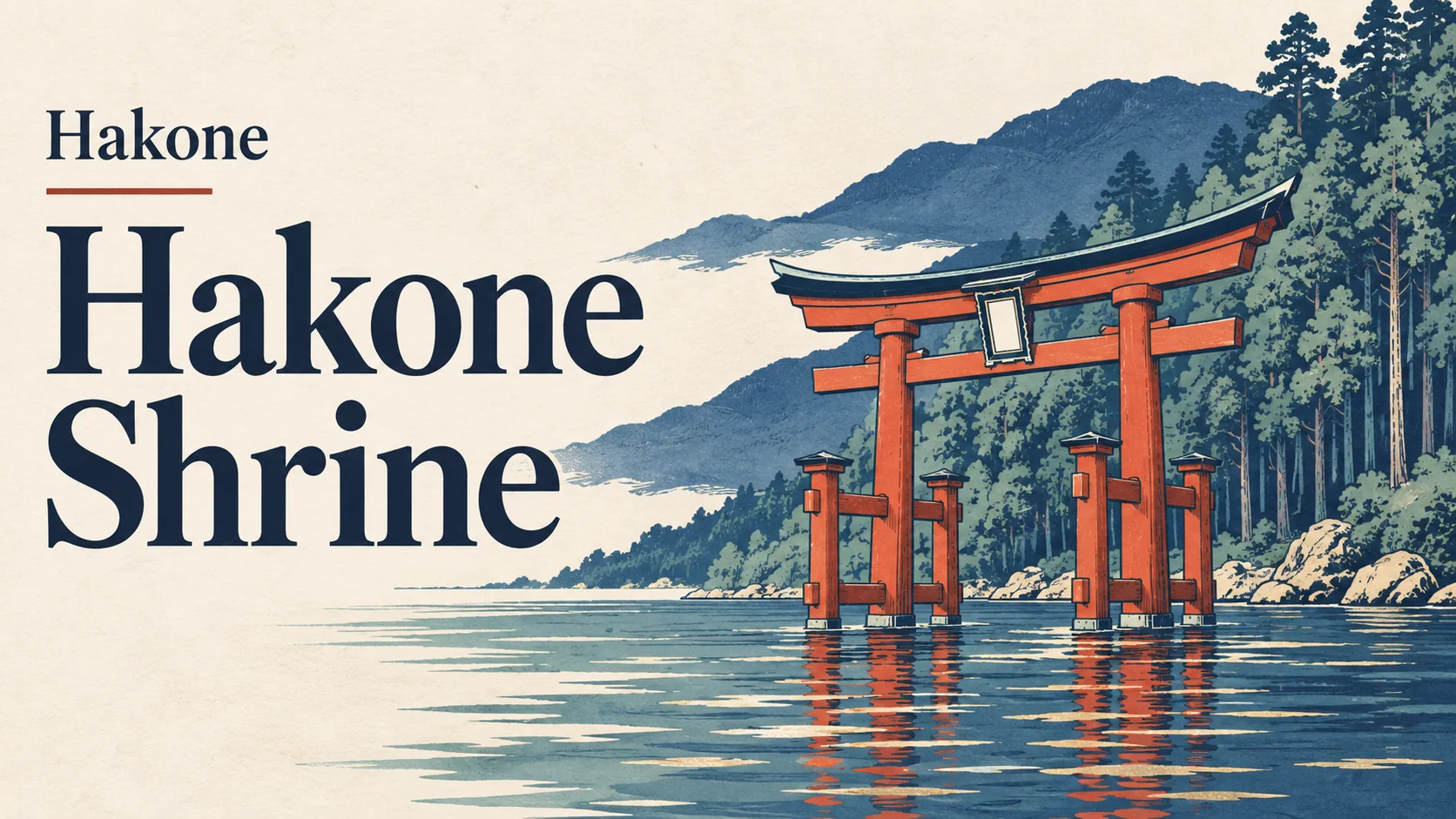
Hakone Shrine, or Hakone Jinja, is a Shinto shrine on the shore of Lake Ashi in Hakone, Japan, founded in 757 by the shrine’s own account. The red torii standing in the lake, Heiwa no Torii, dates from 1952. The shrine lists no fee for the grounds; only the treasure hall charges, ¥500. From Hakone-Yumoto Station the bus costs ¥1,210, and in the daytime it passes the stop named after the shrine. This page covers the torii, Kuzuryu Shrine, hours, goshuin, routes and why our classification returns Void.
What you’ll learn
- What Hakone Shrine is, why people search for it as a temple, and which shoguns relied on it
- The real dates of the torii in the lake, and the six weeks each winter when you cannot walk up to it
- Desk hours, goshuin at ¥500 for each of four shrines, and the two sites of Kuzuryu Shrine
- Which bus stop to use by day, fares from Hakone-Yumoto, Odawara and Togendai, and why it scores 75 as Void
What Hakone Shrine Is
Hakone Shrine is a Shinto shrine on the shore of Lake Ashi in Hakone, Kanagawa, where three deities are worshipped together as Hakone Okami.
Jinja is the Japanese word for a Shinto shrine, so Hakone Jinja and Hakone Shrine are the same place. A shrine is where kami, the deities of Shinto, are worshipped. The shrine’s history page names three: Ninigi-no-Mikoto, Konohanasakuya-hime-no-Mikoto and Hikohohodemi-no-Mikoto, honoured together under the single name Hakone Okami. The Nihon Daihyakka encyclopedia on Kotobank lists the same three and gives the annual festival as August 1. The shrine lists its blessings as good fortune, the fulfilment of wishes, safety on the road and good matches.
If you searched for Hakone temple, you found the right place under the wrong word. It is a shrine today, not a Buddhist temple, but the mix-up has a history: until the first years of the Meiji era this was Hakone Gongen, where kami and Buddhist figures were worshipped side by side. A shrine honours kami; a temple houses images of the Buddha.
From Hakone Gongen to Hakone Shrine
The shrine dates its halls on this site to 757, and it was called Hakone Gongen until the first years of Meiji.
By the shrine’s account, the priest Mangan entered the Hakone mountains in 757, received an oracle from Hakone Okami and built halls on the present site. Kotobank’s encyclopedia entry gives the same year and founder. Worship here is said to be older still: by tradition a hermit named Shosen opened a shrine on Mount Komagatake, a story the shrine takes from a chronicle compiled in 1191.
A gongen is a kami understood as the form a Buddha takes in Japan. Under that name the shrine joined with Shugendo, the mountain ascetic tradition. When Shinto and Buddhism were separated in the first years of Meiji, the shrine says, Hakone Daigongen was renamed Hakone Shrine.
The Shrine the Shoguns Relied On
From the 1100s the warrior governments of eastern Japan treated Hakone as one of their own guardian shrines, the shrine’s history says.
The same page gives the line of patrons. Minamoto no Yoritomo, founder of the Kamakura shogunate, began the nisho-mode, the shogun’s regular visit to two shrines, Hakone and Izusan; Kotobank’s encyclopedia confirms that the Kamakura shoguns made it a fixed custom. The shrine places itself second only to Tsurugaoka Hachimangu in the shogunate’s worship.
Tokugawa Ieyasu, later enshrined at Nikko Toshogu, gave the shrine land in 1594 and paid for a large rebuilding of its halls in 1612. When the Tokaido road and the Hakone checkpoint were set up in 1618, the shrine became the place where travellers prayed for a safe crossing. That is its place in Japan’s history: the guardian shrine of the pass on the road between Edo and Kyoto.
The Torii in the Lake: Heiwa no Torii
Heiwa no Torii, the Torii of Peace, is the red gate standing in Lake Ashi, built in 1952, the shrine says.
A torii is the gateway that marks the way into a shrine. The shrine’s guide to the grounds says the gate in the lake was put up in 1952 to mark two events: the investiture of the crown prince who is now the Emperor Emeritus, and the peace treaty that restored Japan’s independence. Several English pages give 1951, the year the treaty was signed; the shrine’s own year is Showa 27, which is 1952. The name came later: in 1964, for the shrine’s 1,200th year and the Tokyo Olympics, a plaque reading Heiwa, peace, was hung on the gate, written by former prime minister Yoshida Shigeru.
The gate also differs in shape. The shrine’s other torii are in the myojin style; the one in the lake is a ryobu torii, with short extra legs bracing each pillar. Itsukushima Shrine is the other shrine in this guide whose torii stands in the water. The shrine gives no height for the Hakone gate, so we give none.
| Feature | What it is | Year | What the shrine says |
|---|---|---|---|
| Heiwa no Torii | The red gate in the lake, ryobu style | 1952; plaque 1964 | Built for the crown prince’s investiture and the peace treaty |
| First torii | The gate over National Route 1 in Moto-Hakone | Rebuilt December 1993 | The largest torii spanning Route 1 |
| Main approach | Stone stairway through the cedars | — | About 90 steps |
| Main hall | Vermilion hall in the gongen style | No year given for the present hall | Stands in the forest at the top of the steps |
| Yatate cedar | Sacred tree by the approach | Linked to 801 | Tamuramaro offered an arrow here; one of Kanagawa’s 100 notable trees |
| Anzan cedar | Sacred tree for safe childbirth | — | More than 1,000 years old |
The main stairway is about 90 steps by the shrine’s count. The same page names two ways around it: a side approach with no steps, and a lift from the treasure hall for wheelchair users.
When the Torii Is Closed and How Long the Line Is
The shrine closes the area around the torii for about six weeks over New Year, and it publishes no waiting times.
The shrine’s notice for last winter put the area around the gate off limits from the evening of December 28, 2025 to February 10, 2026, to prevent crowd accidents. The notice a year earlier ran to February 9, 2025. The shrine had not posted a notice for the coming winter by October 2, 2026, so plan for the same closure.
For the photo line, we found no figure from the shrine or from newspapers. Visitors’ blogs report a few minutes in the early morning and one to two hours around midday; treat those as individual reports. Japan-guide describes the grounds as always open, so an early start is possible.
Kuzuryu Shrine: the Dragon of Lake Ashi
Kuzuryu Shrine honours the nine-headed dragon of Lake Ashi and stands in two places: inside Hakone Shrine and on the lakeshore.
By the shrine’s telling, the priest Mangan subdued a poisonous nine-headed dragon that had been harming the villagers and enshrined it as Kuzuryu Okami, the guardian of the lake. A nine-headed dragon of the same name is also worshipped far inland in Nagano, at Kuzuryusha, one of the five shrines described in our Togakushi Shrine guide. The older site, the Hongu, sits in the woods on the lakeshore; the shrine’s leaflet says the Shingu was built beside the main hall in 2000.
| Shingu (new shrine) | Hongu (original shrine) | |
|---|---|---|
| Where | Inside Hakone Shrine, to the right of the main hall | On the lakeshore, inside the Hakone Kuzuryu no Mori forest park |
| When | Any time, the shrine says | Park hours 9:00–17:00, last entry 16:30 |
| Cost | No fee listed | Park entry ¥600, cash only |
| How to get there | Climb the main steps | About 30 minutes on foot each way from Hakone-en or Kojiri, or the boat on the 13th |
| Good to know | The dragon water, ryujinsui, is drawn here | Monthly rite on the 13th at 10:00; goshuin is not given here |
The walking time and the ¥600 are on the shrine’s access page; the hours and the cash-only rule are on the park operator’s page. The festival page is firm about the water: draw it at the Shingu, not at the Hongu’s basin. The shrine does not sell it in bottles.
The 13th of each month is the Hongu’s rite, and a boat runs for it. The shrine’s September 2026 notice gives the plan: the boat leaves Moto-Hakone at 9:20 and returns from the Hongu pier at 11:25 and 12:45, the round trip costs ¥2,000, and reception is open from 8:00 to 9:05 in front of the boat office. On the morning of a rite day the park fee is waived for worshippers.
Hours, Fees and Goshuin
The shrine lists no fee and no opening hours for the grounds; its desks run from 8:15 to 17:00.
| Item | Hours | Fee |
|---|---|---|
| Grounds | None listed by the shrine; japan-guide says always open | No fee listed |
| Amulet and goshuin desks | 8:15–17:00 | Goshuin ¥500 per shrine |
| Formal prayer, kito | 8:30–16:00 | From ¥5,000 |
| Treasure hall | 9:00–16:30, last entry 16:00; open all year | Adults ¥500, elementary pupils ¥300 |
| Goshuin book | — | ¥1,500, including one goshuin |
| Car parks | 7:00–17:00, 180 spaces (tourism association) | Not stated |
The desk hours appear at the foot of every page of the shrine’s site; the treasure hall hours and fees are on the guide to the grounds. A goshuin is the seal and calligraphy given as a record of your visit. Hakone Shrine calls it goshin-in and offers four: Hakone Shrine, Kuzuryu Shrine, the Ebisu shrine and Hakone Mototsumiya, at ¥500 each. The desk is in the south wing at the foot of the main steps, left of the fourth torii: hand in your book before you climb and collect it on the way down. During the New Year period the seals come only on loose sheets. Prayer fees and charm prices are on the shrine’s amulet page.
The treasure hall opened in 1907 and was rebuilt in 2007. The shrine counts seven Important Cultural Properties in it, among them a seated statue of Mangan that it calls the oldest portrait sculpture in the Kanto region. For drivers, the shrine’s map shows four car parks without charges listed; the Hakone tourism association gives 180 spaces, open 7:00 to 17:00. The shrine’s pages do not say how the desks take payment, so carry cash.
Getting to Hakone Shrine
From Hakone-Yumoto Station, Hakone Tozan Bus line H runs to Moto-Hakone-ko for ¥1,210, a ten-minute walk from the shrine.
The shrine also sits on the loop around Hakone. The shrine’s access page gives that route itself: the mountain railway from Hakone-Yumoto to Gora, the ropeway to its last station at Togendai, and a boat across Lake Ashi to Moto-Hakone-ko. If you are on the loop, the shrine is ten minutes on foot from where the boat leg ends.
| From | Route | Fare, adult | Time given, by source | Hakone Freepass |
|---|---|---|---|---|
| Hakone-Yumoto Station | Hakone Tozan Bus line H to Moto-Hakone-ko; walk 10 min | ¥1,210 | 60 min (shrine); about 30 min (Hakone Navi, Japanese); about 40 min (Hakone Navi, English); 35 min (japan-guide) | Hakone Tozan Bus is listed, for designated sections |
| Odawara Station | The same bus; walk 10 min | ¥1,510 | 75 min (shrine) | As above |
| Togendai-ko | Hakone pirate ship to Moto-Hakone-ko; walk 10 min | ¥1,700 | About 25–40 min (operator) | The pirate ship is listed |
| Shinjuku, Tokyo | Odakyu Romancecar to Hakone-Yumoto, then the bus | ¥2,470 to Hakone-Yumoto | 75 min at the fastest (Odakyu) | The limited express ticket is extra |
The fares are those in force since the revision of October 1, 2025, read from the operator’s fare table; some guides still print an older ¥980. The times disagree by source. The shrine’s page warns of holiday jams on National Route 1, so we read its 60 minutes as an allowance for traffic and the operator’s 30 minutes as a clear run. The pirate ship has cost ¥1,700 one way since the same date, and sails from 9:30 to 18:00, or to 16:40 from December 1 to March 19.
From Tokyo, Odakyu’s Romancecar reaches Hakone-Yumoto from Shinjuku in 75 minutes at the fastest; the ¥2,470 is our sum of the fare of ¥1,270 and the limited express charge of ¥1,200. The two-day Hakone Freepass costs ¥7,100 from Shinjuku or ¥6,000 from Odawara. Odakyu’s pass page lists the pirate ship and, for designated sections, Hakone Tozan Bus, without naming the sections, so confirm the Moto-Hakone route when you buy.
The Bus Stop That Buses Pass by Day
Buses do not stop at Hakone-jinja-iriguchi, the stop named after the shrine, between 10:00 and 16:00, the shrine says.
The shrine’s access page tells visitors to use the next stop, Moto-Hakone-ko, and the operator’s notice names lines H and K. Hakone Navi’s English page still sends visitors to the shrine-entrance stop. Both stops share one fare zone, so the change costs nothing. Timetables in the Hakone area were revised on October 1, 2026; check current times before you travel.
Festivals and the Shrine’s Year
The shrine’s biggest day is August 1, the annual festival, with the lake festival and fireworks the evening before.
A matsuri is a shrine festival. The shrine’s festival page calls the Reitaisai of August 1 the largest rite of its year. The evening before, at the Kosui-sai, the chief priest takes an offering of red rice out onto the lake for the dragon. The shrine’s 2026 notice announced about 5,000 fireworks for the first night and about 2,300 for the second.
| Date | Event | What it is |
|---|---|---|
| January 1 | Saitan-sai | New Year’s Day rite; fireworks at midnight |
| February 3 | Setsubun-sai | Demons are chased across the lake; fireworks on February 2 at 19:30 |
| 13th of each month | Kuzuryu Hongu rite | 10:00 at the lakeside shrine; boat from Moto-Hakone |
| July 31 | Kosui-sai | Lake festival: rites at 18:00 and 19:00, fireworks at 20:00 |
| August 1 | Reitaisai | The annual festival, 10:00 |
| October 24 | Mototsumiya festival | Sacred fire rite and annual rite on Mount Komagatake |
| December 31 | Shiwasu Oharae | Year-end purification, 14:00 |
The February details are on the shrine’s Setsubun page. For New Year, the shrine sets traffic controls from December 31 to January 3.
Five Elements Classification: Why Hakone Shrine Is a Void Shrine
Hakone Shrine scores 75 as Void, because two of its three deities are ancestors of the imperial line in our categories.
Kannavi sorts every shrine into one of five elements — Earth, Water, Fire, Wind and Void. This is our classification, not a teaching of the shrine and not a fortune. It reads three checkable layers: the principal deity, 60, with 15 for each further deity; the geography, 25; the lineage in the name, 15.
| Layer | What was matched | Category | Element | Points |
|---|---|---|---|---|
| 1. Deity | Ninigi-no-Mikoto (named first) | Heavenly grandson; those who shaped the form of the nation | Void | 60 |
| 1. Deity | Konohanasakuya-hime-no-Mikoto | Deities of fire and volcanoes | Fire | 15 |
| 1. Deity | Hikohohodemi-no-Mikoto | Same category as Ninigi | Void | 15 |
| 2. Geography | A shrine in the mountains | Mountain siting | Earth | 25 |
| 3. Lineage | No match in the name | — | — | 0 |
| Total | Void 75; Earth 25; Fire 15; Water, Wind 0 | Void (high) | ||
The geography row needs a note. The layer is capped at 25 and takes one reading. Read as a mountain shrine, Hakone adds Earth 25; read as a lakeside shrine, it adds Water 25 in place of Earth. We ran both, and the result does not change: a second element needs 80 percent of the leader, here 60, and neither 25 nor Fire’s 15 comes close.
The deity layer follows the names the shrine gives. Entered only as Hakone Okami, the collective name, the classifier returns undetermined; entered as the three deities, it returns Void. Konohanasakuya-hime falls in our category of fire and volcano deities, which is where the Fire 15 comes from.
The elements run around a ring — Earth to Fire to Void to Water to Wind and back — in which each shifts the flow of the next. The other Void shrines in this guide are Meiji Jingu in Tokyo and Heian Jingu in Kyoto, both at 100; Hakone is Void with a mountain and a volcano mixed in.
Frequently Asked Questions
The grounds carry no listed fee, and the daytime bus stop is Moto-Hakone-ko, not the stop named after the shrine.
Q. Is Hakone Shrine free to enter?
A. The shrine lists no fee for the grounds, the approach, the main hall or the torii in the lake. It charges for the treasure hall, ¥500 for adults and ¥300 for elementary pupils, open 9:00 to 16:30 with last entry at 16:00. A goshuin is ¥500. Car park charges are not stated on the shrine’s pages.
Q. Is Hakone Shrine a temple?
A. No. Hakone Shrine is a Shinto shrine, where three kami are worshipped as Hakone Okami. The confusion has a reason: until the first years of the Meiji era it was Hakone Gongen, a site that mixed Shinto and Buddhist worship, and it took its present name when the two were separated.
Q. What is the torii gate in the lake at Hakone called?
A. It is Heiwa no Torii, the Torii of Peace. The shrine says it was built in 1952 to mark the crown prince’s investiture and the peace treaty, and that the plaque reading Heiwa was added in 1964 for the shrine’s 1,200th year and the Tokyo Olympics. It belongs to Hakone Shrine.
Q. How long is the wait for a photo at the torii?
A. No official figure exists. The shrine publishes no waiting times and we found none in newspapers. Visitors’ blogs report a few minutes in the early morning and one to two hours around midday. From late December to about February 10 the shrine has closed the area around the gate in each of the last two winters, so no line forms then.
Q. How do I get to Hakone Shrine from Tokyo?
A. Take the Odakyu Romancecar from Shinjuku to Hakone-Yumoto, 75 minutes at the fastest and ¥2,470, then Hakone Tozan Bus line H to Moto-Hakone-ko for ¥1,210, and walk ten minutes. Between 10:00 and 16:00 buses pass the stop named Hakone-jinja-iriguchi, so use Moto-Hakone-ko. See also shrines in Tokyo.
Q. Can I get a goshuin at Hakone Shrine?
A. Yes. The shrine offers four, for Hakone Shrine, Kuzuryu Shrine, the Ebisu shrine and Hakone Mototsumiya, at ¥500 each, between 8:15 and 17:00. The desk is in the south wing at the foot of the main steps; leave your book there before you climb. Kuzuryu’s seal is given here, not at the lakeside Hongu.
Summary
Hakone Shrine is the lakeside shrine of the Hakone mountains, dated to 757, with a 1952 torii standing in Lake Ashi.
- It was Hakone Gongen until the first years of Meiji, and shoguns from Yoritomo to Ieyasu supported it.
- Heiwa no Torii dates from 1952; the area around it closed from late December to about February 10 in the last two winters.
- The grounds carry no listed fee; desks open 8:15 to 17:00, and a goshuin is ¥500.
- From Hakone-Yumoto take bus line H to Moto-Hakone-ko, ¥1,210, and walk ten minutes; buses pass the shrine-entrance stop from 10:00 to 16:00.
- In the Kannavi classification, Hakone Shrine is Void 75, with Earth 25 and Fire 15 behind it.
Next: the other Void shrines, Meiji Jingu and Heian Jingu; the shoguns’ own shrine at Tsurugaoka Hachimangu in Kamakura; another gate in the water at Itsukushima; what to ask for at the desk in the goshuin guide; or the English guide to Japanese shrines.
The gate in the water dates from 1952. Behind it, a stairway climbs under old cedars to a shrine that the shoguns visited, beside the old Tokaido road and its checkpoint. Take the photograph, then climb the steps.