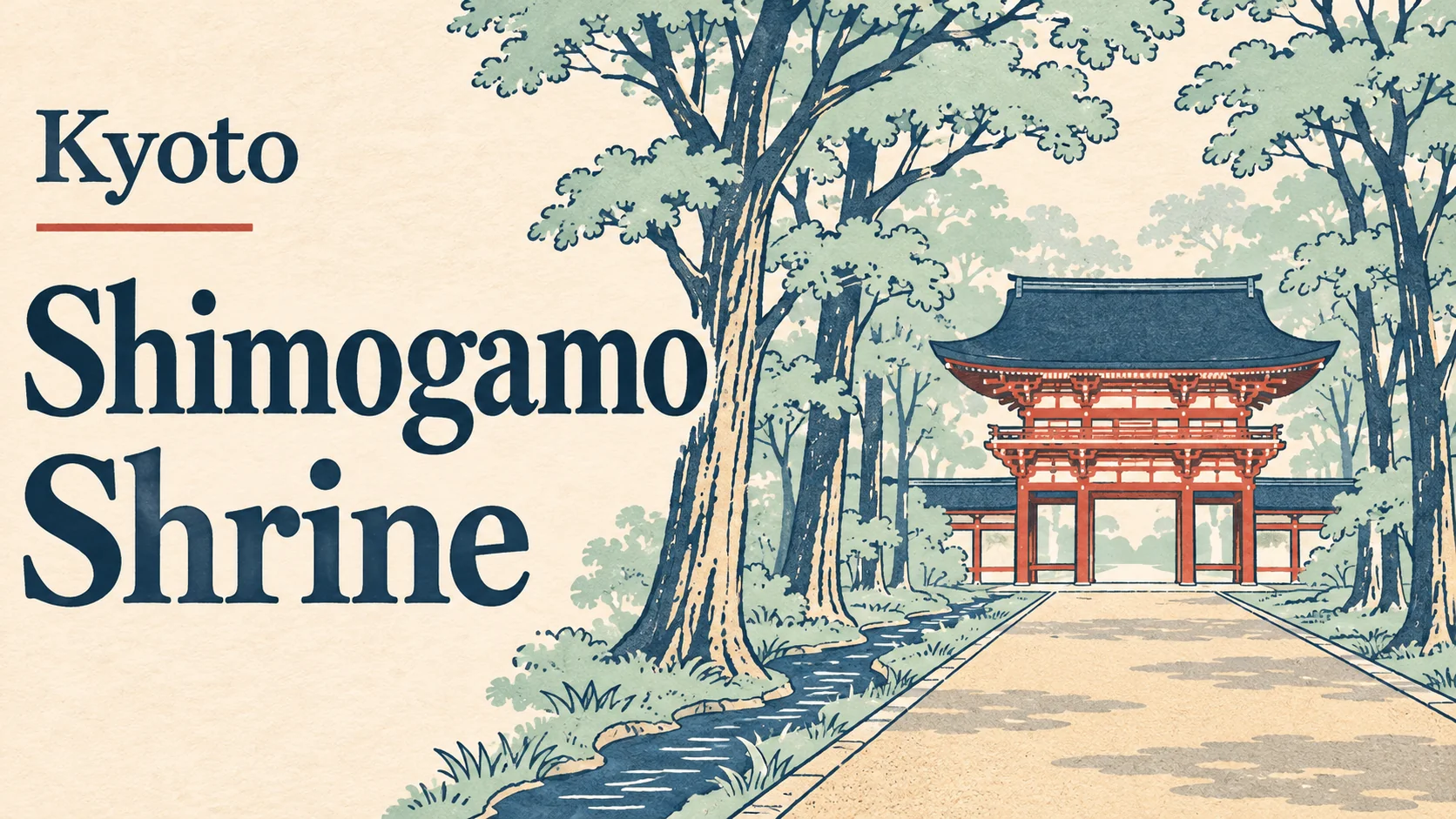
Shimogamo Shrine in Kyoto, officially Kamo-mioya Jinja, stands where the Kamo and Takano rivers meet, inside an old forest called Tadasu no Mori. It enshrines two kami, Kamotaketsunumi and his daughter Tamayorihime, and it is one of the seventeen World Heritage properties of ancient Kyoto. This guide covers its kami, the walk from the forest to the main halls, the festivals, and the hours and routes the shrine publishes.
What you’ll learn
- What Shimogamo Shrine is, and how it relates to Kamigamo Shrine upstream
- The two kami of the twin main halls, and the myths of the red arrow and the three-legged crow
- A short history, from a fence repair recorded in 90 BCE to the rebuilding due in 2036
- A walk from Tadasu no Mori to the main halls, with the Aoi Matsuri and Mitarashi festival dates
- Hours, fees and routes from Kyoto Station, and why our classification puts Shimogamo in Water
What Shimogamo Shrine Is
Shimogamo Shrine is a Shinto shrine in northern Kyoto whose formal name, Kamo-mioya Jinja, means the shrine of the ancestors of the Kamo clan.
Its official history page explains both names. “Mioya” refers to the ancestral kami of the Kamo family, and “Shimogamo” means lower Kamo: the shrine sits downstream on the Kamo River, at the point where the Kamo and Takano rivers join, while Kamigamo, upper Kamo, sits upstream. The shrine says it was worshipped as the home of the kami who opened up ancient Kyoto, and that after the capital moved here in 794 it guarded the nation and the court. Today two main halls are National Treasures and 53 other buildings are Important Cultural Properties.
| Item | What the shrine or city states | Source |
|---|---|---|
| Names | Kamo-mioya Jinja (賀茂御祖神社), also called Shimogamo Jinja or Shimogamo Shrine (下鴨神社) | Shimogamo |
| Location | 59 Shimogamo Izumikawa-cho, Sakyo Ward, Kyoto, at the meeting of the Kamo and Takano rivers | Access page |
| Kami | Kamotaketsunumi (west hall) and Tamayorihime (east hall) | Shimogamo |
| Protected status | 2 main halls National Treasures; 53 buildings Important Cultural Properties | Rebuilding page |
| World Heritage | One of 17 properties of the Historic Monuments of Ancient Kyoto, December 1994 | Kyoto City |
| Gates | Inside the tower gate 6:30 to 17:00; Kawai Shrine 6:30 to 16:30 | Shimogamo |
Whether you search “Shimogamo Jinja Kyoto” or “Shimogamo Shrine Kyoto,” you reach the same place: jinja is simply the Japanese word for a Shinto shrine.
Shimogamo and Kamigamo: Two Kamo Shrines on One River
Shimogamo and Kamigamo are two separate shrines of the Kamo clan, linked by family: Shimogamo’s goddess is the mother of Kamigamo’s kami.
Shimogamo’s page says Tamayorihime bore Kamo-wakeikazuchi, the kami of Kamigamo Shrine, formally Kamo-wakeikazuchi Jinja. Kamigamo says its kami descended on Mount Koyama behind its main hall and that its shrine was built in 677. The two share one great festival, the Aoi Matsuri, and were inscribed together as World Heritage in 1994. City bus route 4 links them: Shimogamo lists it from Kyoto Station, and it stops in front of Kamigamo. Our guide to ten shrines in Kyoto covers Kamigamo’s hours and its ¥500 main-hall visit.
Who Is Enshrined: Kamotaketsunumi and Tamayorihime
Shimogamo enshrines Kamotaketsunumi in its west main hall and his daughter Tamayorihime in its east main hall, as two separate halls side by side.
The shrine calls Kamotaketsunumi the kami who opened up ancient Kyoto and the guardian of Yamashiro, the old province around the city. Before the capital was built, it says, prayers for its success were offered here first. Tamayorihime is described as a protector of women: of marriage ties, pregnancy, childbirth and child-raising.
| Hall | Kami | What the shrine says of them | Prayed to for |
|---|---|---|---|
| West main hall | Kamotaketsunumi (賀茂建角身命) | Opened up ancient Kyoto; took the form of the crow Yatagarasu to guide Emperor Jimmu | Beginnings, guidance, warding off misfortune |
| East main hall | Tamayorihime (玉依媛命) | Daughter of Kamotaketsunumi; mother of Kamigamo’s kami | Marriage ties, safe childbirth, child-raising |
The prayers in the last column come from the shrine’s grounds map, which lists them hall by hall. The family continues across the grounds: the Mitsui Shrine enshrines Kamotaketsunumi, his wife Ikakoyahime and Tamayorihime together.
The Red Arrow in the River
The best-known Shimogamo myth tells of Tamayorihime finding a red arrow in the river, which led to the birth of Kamigamo’s kami.
The shrine retells it from the Yamashiro Fudoki, an eighth-century gazetteer of the province. While Tamayorihime was purifying herself in the stream, a red-lacquered arrow floated down from upstream. She took it home and placed it by her bed, and she conceived a son. When the boy grew up, his grandfather Kamotaketsunumi held a seven-day feast and told him to offer wine to the one he thought was his father; the boy raised the cup to the sky and rose through the roof. Because of this story, the shrine says, Tamayorihime has long been worshipped for marriage ties and child-raising.
The Three-Legged Crow and Japanese Football
Kamotaketsunumi is identified with Yatagarasu, a three-legged crow that guided Emperor Jimmu, and that crow is now the emblem of Japanese football.
The shrine quotes both chronicles, the Kojiki and the Nihon Shoki, on the crow sent from heaven to lead the first emperor through the mountains. A small shrine beside Kawai Shrine, the Tobe Shrine, enshrines Yatagarasu, and the shrine’s grounds map notes that the crow became the symbol of the Japan Football Association in 1931. The same shrine is honoured as the ancestor of kemari, the courtly game of keeping a ball in the air, which is played here every January 4. Ball sports continue at Sawata Shrine, where a stone marks the site of the first rugby match played in the Kansai region.
History: From a Fence Repair in 90 BCE to the 2036 Rebuilding
The shrine says its exact founding is unknown, but it cites a record of its sacred fence being repaired in 90 BCE.
That is the shrine’s own careful wording, in Emperor Sujin’s reign: the record of a repair shows only that worship began earlier. The shrine also cites the Shoku Nihongi, an official chronicle, for an order of 698 to police the crowds gathering for the Kamo festival, and dates the festival itself to 544. In 677 the provincial governor was ordered to rebuild the halls, which the shrine says replaced plank and thatch roofs with cypress bark and tile.
From 794 the shrine was the first shrine of Yamashiro, princesses served the Kamo shrines as saio, consecrated priestesses, and by the late Heian period more than sixty estates supported it. In the early Meiji era it was placed first among the Kanpei Taisha, the top grade of imperial shrines. Its halls are renewed in a shikinen sengu, a rebuilding at fixed intervals. The rebuilding page dates the system to 1036. The interval was set at twenty years then and stretched to thirty or fifty in times of war or famine; it is now every 21 years. The 34th was in 2015, and the 35th, due in 2036, marks 1,000 years since 1036.
Walking the Grounds from Tadasu no Mori to the Main Halls
A visit runs north from the first torii through Tadasu no Mori, past Kawai Shrine, to the vermilion tower gate and main halls.
The shrine’s grounds map numbers 48 places. The table picks the ones a first visit passes, in walking order from the south. A torii is the gate that marks a shrine’s sacred ground.
| Order | Place | What it is, by the shrine |
|---|---|---|
| 1 | Tadasu no Mori | The shrine forest, 124,000 square metres (about 31 acres), with clear streams; its centre, the Kirishiba, is an ancient ritual ground |
| 2 | Kawai Shrine | The first subsidiary shrine, for Tamayorihime as a goddess of beauty; mirror-shaped ema, wooden prayer plaques |
| 3 | Saruya | A rest house serving saru-mochi, the Aoi Matsuri rice cake revived after 140 years; 10:00 to 16:30 |
| 4 | Aioi Shrine and Renri no Sakaki | Shrine for ties between people; a sacred tree of two trunks joined into one, now in its fourth generation |
| 5 | Tower gate (romon) | Entrance to the inner precinct, open 6:30 to 17:00 |
| 6 | Kotosha | Seven small shrines, each the guardian of one or two signs of the Chinese zodiac |
| 7 | Main halls | The west and east halls, both National Treasures |
| 8 | Inoue Shrine and Mitarashi Pond | A shrine built over a well, against misfortune; the pond of the summer foot-bathing rite |
| 9 | Korin’s plum | The plum tree said to be the model for Ogata Korin’s Red and White Plum Blossoms screens |
Tadasu no Mori, the Forest
Tadasu no Mori is the shrine’s own forest, about 124,000 square metres, and walking its long approach is the first part of a visit.
The shrine describes it as a forest that keeps the vegetation of ancient times, crossed by small clear streams, and holds a used-book fair there in mid-August. On June 16, 2026, the shrine announced that one of its sacred trees, a tsuburajii chinquapin about 450 years old, had fallen under its own weight despite years of care, and that it would keep the spot as a memorial.
Kawai Shrine and the Mirror Ema
Kawai Shrine, inside the forest, enshrines Tamayorihime as a goddess of beauty, and visitors make up a mirror-shaped plaque as their prayer.
The shrine’s page for Kawai Shrine explains the kagami-ema: you draw your ideal face on the plaque with your own make-up and write your wish on the back, as a prayer for beauty inside and out. The same page lists a mirror charm at ¥2,000 and a mirror fortune at ¥500, and Kawai Shrine closes at 16:30. The page also ties Kawai to Kamo no Chomei, author of the essay Hojoki, who grew up as the son of its priest. A reconstruction of his ten-foot-square hut is now shown in the Jinguji ruins area of the special viewing, the shrine says.
Mitarashi Pond, Aioi Shrine and the Zodiac Shrines
Mitarashi Pond is a spring-fed pond for purification, the Aioi Shrine is for ties between people, and the Kotosha guard each zodiac year.
Mitarashi Pond lies before the Inoue Shrine, also called Mitarashi-sha. The shrine says the bubbles that rise from its spring are said to be the model for mitarashi dango, the skewered rice dumplings sold across Japan, and that the spring water rising each July is counted among the seven wonders of Kamo. The Aioi Shrine enshrines Kamimusubi, a kami of creation, beside a sacred tree of two trunks grown into one, and its office offers marriage-tie plaques and a fortune themed on The Tale of Genji. The Kotosha, known as “Daikoku-san,” are seven shrines to names of the kami Okuninushi; each protects people born in certain zodiac years, so visitors find the shrine of their own birth year.
Festivals: Aoi Matsuri, Mitarashi and the Shrine Year
Shimogamo’s great festival is the Aoi Matsuri on May 15, prepared by rites through early May, and its summer festival is Mitarashi in July.
The shrine’s Aoi Matsuri page calls it the annual festival of both Kamo shrines and a chokusai, a festival attended by an imperial envoy. With the Kasuga festival of Kasuga Taisha and the Iwashimizu festival of Iwashimizu Hachimangu, it is one of three such festivals. A procession about 1 km long leaves the Kyoto Imperial Palace, visits Shimogamo, and goes on to Kamigamo over a route of 8 km. If it rains on May 15, the procession moves to May 16, decided at about 18:00 the day before.
| Date | Rite | What happens, by the shrine |
|---|---|---|
| January 4 | Kemari Hajime | The first kemari ball game of the year |
| March 3 | Nagashi-bina | Paper dolls set afloat on the Mitarashi stream |
| May 3 | Yabusame | Mounted archery on the forest riding ground, about 13:00 to 15:00; ¥4,000 seats on the day in 2026 |
| May 4 | Saio-dai purification | The festival’s princess dips her hands in Mitarashi Pond; alternates with Kamigamo, held at Shimogamo in 2026 |
| May 12 | Mikage Matsuri | The kami’s new spirit is brought from Mikage Shrine on the hills, which the shrine says is held to be the oldest surviving divine procession |
| May 15 | Aoi Matsuri | Imperial envoy and procession; moves to May 16 if it rains |
| July 18 to 30, 2026 | Mitarashi Matsuri | Walk knee-deep through Mitarashi Pond with a candle, 9:00 to 20:00; candle offering ¥500 for adults |
| December 13 | Aioi Shrine festival | Festival of the shrine for ties |
The Mitarashi page sets the 2026 dates around the summer Day of the Ox, with entry until 19:30 and children of junior-high age and under paying what they wish. You take off your shoes and socks, wade to the Inoue Shrine, light your candle and drink the sacred water. The full calendar is on the annual events page.
Hours, Fees and Getting to Shimogamo Shrine
The inner precinct opens 6:30 to 17:00, the amulet office 9:00 to 16:30, and the shrine is twelve minutes on foot from Demachiyanagi Station.
Shimogamo asks visitors on its home page to come by public transport. Its access page gives three routes from Kyoto Station: JR to Tofukuji, then the Keihan line to Demachiyanagi and a 12-minute walk; city bus 4 or 205 to Shimogamo-jinja-mae or Tadasunomori-mae; or the Karasuma subway to Kitaoji and city bus 1 or 205, about 25 minutes. A taxi takes about 20 minutes and costs ¥2,000 to ¥3,000, it says.
| What | Hours | Fee | Source |
|---|---|---|---|
| Inner precinct (inside the tower gate) | 6:30 to 17:00, no closing days | No fee listed | Home page |
| Kawai Shrine | 6:30 to 16:30 | No fee listed | Home page |
| Amulets and goshuin | 9:00 to 16:30, some counters differ | Goshuin fee not published | Amulets page |
| Special viewing: Oidono kitchen hall, Jinguji ruins, Shuhosha museum | 10:00 to 16:00 | ¥1,000 adults; free for junior-high age and under | Special viewing |
| Prayer ceremonies | 9:00 to 16:30, no booking | From ¥10,000 | Prayers page |
| West car park | 24 hours | ¥500 the first hour, then ¥300 per 30 minutes, no cap | Access page |
Gates may change for rites. The car park charged more at busy times in 2026: ¥1,000 for the first hour during the Mitarashi festival and from April 29 to May 6. Hours and fees here are as the shrine’s pages stated on November 6, 2026. To pair Shimogamo with the shrines of eastern Kyoto, Heian Jingu stands in Okazaki, and Yasaka Shrine is by Gion-Shijo, the Keihan station on the line to Demachiyanagi.
Shrine Etiquette at Shimogamo
Shimogamo is a Shinto shrine, not a Buddhist temple, so you bow and clap at the halls, which you would not do at a temple.
Bow slightly at the torii, and rinse your hands and mouth at the temizuya, the water basin, in the order Jinja Honcho, the association of shrines, describes: left hand, right hand, then mouth from your cupped left hand. At the hall, the common form is two bows, two claps and one bow, as set out in Jinja Honcho’s guide to worship. A goshuin, a seal and calligraphy given at the shrine office as a record of your visit, is received after you pray; our goshuin guide explains how to ask.
Five Elements Classification: Why Shimogamo Comes Out Water
Shimogamo scores Water 85 in our classification, from Tamayorihime as a water deity and its site where two rivers meet.
Kannavi sorts shrines into one of five elements: Earth, Water, Fire, Wind and Void. This is our classification, not a teaching of the shrine and not a fortune. It reads three checkable layers: the deities, 60 for the principal and 15 for each further match; the setting, up to 25; and the lineage in the name, 15. We enter only what the shrine’s own pages state.
| Layer | What was entered | What matched | Points |
|---|---|---|---|
| Deity | Kamotaketsunumi | Not in our deity list | 0 |
| Deity | Tamayorihime, written 玉依媛命 on the shrine’s site | Matched as the standard form 玉依姫命, filed under deities of the sea and voyages | Water 60 |
| Setting | Where the Kamo and Takano rivers meet; spring-fed Mitarashi Pond | River, lake, waterfall, pond or spring in the grounds | Water 25 |
| Lineage | Kamo-mioya Jinja | No lineage in our list | 0 |
| Result | — | High confidence; no second element | Water 85 |
Two disclosures. First, as written on the shrine’s site, the goddess’s name uses a variant character that our list did not match; entered that way, the shrine scores only Water 25 and stays undetermined. The two characters write the same name, so we matched the standard form, as we did on our Kyoto page. Second, our list files the name Tamayorihime under the sea because of the goddess of that name who, in the chronicles, is the sea god’s daughter and Emperor Jimmu’s mother. Shimogamo’s grounds map describes its own Tamayorihime as the mother of Kamigamo’s kami, while its Kawai Shrine page calls the Kawai goddess Jimmu’s mother. Her Shimogamo story is set in a river, so the result stays Water, but the route to it is a name match.
Relations run around a ring, Earth to Fire to Void to Water to Wind and back, in which each shifts the flow of the next rather than opposing it. In Kyoto, Water sits beside Wind and Void: Kamigamo, its partner upstream, scores Wind 60, and Heian Jingu is Void 100. Kibune Shrine, the shrine of water and rain in the northern mountains, is Water 100; Shimogamo keeps a small Kibune shrine of its own in the forest.
Frequently Asked Questions
Start at Kamigamo if you see both, avoid driving in festival weeks, and expect no listed fee for the grounds except during the Aoi Matsuri.
Q. Should I visit Shimogamo or Kamigamo first?
A. If you want both in one morning, start upstream. Kamigamo’s visiting page opens its outer gate at 5:30, an hour before Shimogamo’s 6:30, though its tower gate waits until 8:00. Then take city bus 4 down to Shimogamo-jinja-mae. If you want the special viewing at Shimogamo, plan to be there between 10:00 and 16:00. Remember they are separate shrines: Kamigamo’s kami is the son of Shimogamo’s goddess.
Q. Can I drive or use a wheelchair at Shimogamo Shrine?
A. Driving is possible but discouraged. The west car park has a 2.3 m height limit and, in 2026, closed to ordinary cars from the evening of May 13 until about 15:00 on May 15 for the Aoi Matsuri. On festival day the shrine says no cars can park. For mobility needs, the shrine office in the grounds lends wheelchairs, its map says; ask there on arrival.
Q. When is the best time to visit Shimogamo Shrine?
A. It depends on what you want to see. The shrine’s seasons page features cherry blossom by the tower gate, the doll-floating rite on March 3, fresh green in the forest, a tunnel of autumn leaves and snow on the grounds. For rites, early May and the Mitarashi days in July hold the most; for a quiet walk, the gates open at 6:30.
Q. Did mitarashi dango come from Shimogamo Shrine?
A. The shrine says so, as a tradition. Its page on the Inoue Shrine says the dumplings are modelled on the bubbles rising in Mitarashi Pond, and the grounds map words it as “said to be.” For a taste of the shrine itself, the Saruya rest house in the grounds serves saru-mochi, a festival rice cake the shrine revived after 140 years, from 10:00 to 16:30.
Q. Can I get a goshuin at Shimogamo Shrine?
A. Yes. Amulets and goshuin are given from 9:00 to 16:30, with some counters keeping their own hours. The shrine does not publish the goshuin fee. Its amulets page shows special designs, including a manga-style Murasaki Shikibu seal from the Aioi Shrine and a Tamayorihime seal from Kawai Shrine, and in May it offers Aoi Matsuri designs.
Q. Is there an entrance fee at Shimogamo Shrine?
A. The shrine’s pages list no fee for the forest or the inner precinct, only for the special viewing, the Mitarashi candle and parking. The exception is the Aoi Matsuri: to watch the procession in the grounds, the shrine says you apply through the Kyoto City Tourism Association, and the rite before the main hall is open only to members of its supporters’ association.
Summary
Shimogamo Shrine, formally Kamo-mioya Jinja, enshrines Kamotaketsunumi and Tamayorihime where two rivers meet in northern Kyoto.
- It is the downstream shrine of the Kamo clan; Kamigamo, upstream, enshrines Tamayorihime’s son.
- The shrine says its founding is unknown, with a fence repair recorded in 90 BCE; the Aoi Matsuri dates, by its account, to 544.
- Its halls are renewed every 21 years; the 35th rebuilding is due in 2036.
- The approach runs through Tadasu no Mori, about 124,000 square metres of shrine forest.
- The inner precinct is open 6:30 to 17:00; Demachiyanagi Station is a 12-minute walk.
- In the Kannavi classification, Shimogamo is Water 85, with no second element.
Next: plan the rest of the city with our shrines in Kyoto, follow the water north to Kibune Shrine, walk the red gates of Fushimi Inari Taisha, learn how to ask for a seal in the goshuin guide, or browse the full list of Japanese shrines.
Shimogamo asks little of a visitor beyond a walk under old trees to two halls that have been rebuilt, again and again, for close to a thousand years. Its own word for that renewal is miare, the birth of new life. Walk the forest first, and the halls make more sense.